Representative Elbert Sidney Brigham
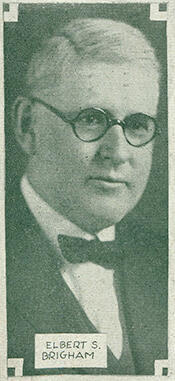
Here you will find contact information for Representative Elbert Sidney Brigham, including email address, phone number, and mailing address.
| Name | Elbert Sidney Brigham |
| Position | Representative |
| State | Vermont |
| District | 1 |
| Party | Republican |
| Status | Former Representative |
| Term Start | December 7, 1925 |
| Term End | March 3, 1931 |
| Terms Served | 3 |
| Born | October 19, 1877 |
| Gender | Male |
| Bioguide ID | B000832 |
About Representative Elbert Sidney Brigham
Elbert Sidney Brigham (October 19, 1877 – July 5, 1962) was a Republican U.S. Representative from Vermont who served three terms in the United States House of Representatives from 1925 to 1931. He was born in St. Albans, Franklin County, Vermont, the son of Sanford J. Brigham and Sarah J. (Bronson) Brigham. He was a descendant of Thomas Brigham and Edmund Rice, early immigrants to the Massachusetts Bay Colony, a lineage that connected him to some of New England’s earliest English settlers.
Brigham was educated in the public schools of St. Albans and graduated from St. Albans High School in 1898. He continued his education at Middlebury College, from which he graduated in 1903. On October 2, 1906, he married Anna S. Hazen, daughter of Stephen Hazen and Harriet (Congdon) Hazen, in St. Albans, Vermont. His association with Middlebury College endured well beyond his student years, and he later served as a trustee of the institution for nearly four decades, from 1922 to 1960.
Throughout his life, Brigham was closely identified with agriculture, particularly dairying. He was a farmer and dairy cattle breeder and gained national recognition in the field; he was the first farmer with a 100-cow herd to average more than 600 pounds of butterfat in one year, a notable benchmark in early twentieth-century dairy production. His expertise in agriculture led him into public service at the local and state levels. He served as auditor for the town of St. Albans in 1911 and 1912, and from 1913 to 1924 he was Vermont’s state commissioner of agriculture. During World War I, in 1918, he was a member of the National Agricultural Advisory Committee and served with the United States Food Administration in Washington, D.C., contributing to federal efforts to manage food production and distribution during the war emergency.
Brigham’s prominence in agricultural and civic affairs helped propel him to national office. A member of the Republican Party, he was elected to the Sixty-ninth, Seventieth, and Seventy-first Congresses and served as a Representative from Vermont in the United States Congress from March 4, 1925, to March 3, 1931. During these three terms in office, his service in Congress occurred during a significant period in American history marked by postwar adjustment and the onset of the Great Depression. As a member of the House of Representatives, Elbert Sidney Brigham contributed to the legislative process, participated in the democratic governance of the nation, and represented the interests of his Vermont constituents. He was not a candidate for renomination in 1930, concluding his congressional career after six years of service.
After leaving Congress, Brigham continued to hold important positions in finance and public policy. In 1932 he served as a member of the Reconstruction Finance Corporation, an institution created to address the economic crisis of the Great Depression. He was chairman of the Vermont Advisory Banking Board from 1933 to 1936, playing a role in stabilizing and overseeing the state’s banking sector during a period of financial uncertainty. His longstanding association with the insurance industry, which had begun when he became a director of the National Life Insurance Company in 1925, deepened in later years.
Brigham’s later career was dominated by leadership in banking and insurance. He served as president of the National Life Insurance Company in Montpelier, Vermont, from 1937 to 1948, succeeding Fred A. Howland in that position. In addition, he was president of the Franklin County Savings Bank and Trust Company in St. Albans, Vermont, from 1944 to 1957, and then chairman of its board from 1957 until his death in 1962. These roles reflected his transition from agricultural leadership and public office to influential positions in Vermont’s financial community, while he simultaneously maintained his long tenure as a trustee of Middlebury College.
Elbert Sidney Brigham died in St. Albans City, Vermont, on July 5, 1962. He was interred at St. Albans Bay Cemetery in St. Albans Town, Vermont, closing a life that combined agricultural innovation, state and national public service, and significant contributions to Vermont’s educational and financial institutions.