Senator Elbridge Gerry Lapham
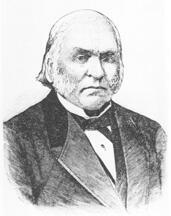
Here you will find contact information for Senator Elbridge Gerry Lapham, including email address, phone number, and mailing address.
| Name | Elbridge Gerry Lapham |
| Position | Senator |
| State | New York |
| Party | Republican |
| Status | Former Representative |
| Term Start | December 6, 1875 |
| Term End | March 3, 1885 |
| Terms Served | 4 |
| Born | October 18, 1814 |
| Gender | Male |
| Bioguide ID | L000092 |
About Senator Elbridge Gerry Lapham
Elbridge Gerry Lapham (October 18, 1814 – January 8, 1890) was a Republican politician who represented New York in both the U.S. House of Representatives from 1875 to 1881 and the United States Senate from 1881 to 1885. He was born in Farmington, Ontario County, New York, the son of Judge John Lapham (1793–1860) and Zimroda Smith Lapham (1793–1879). He was a descendant of John Lapham (1677–1734) and Mary Russell Lapham (1683–1752). Through the extended Lapham family he was related to several notable figures, and his cousins included Nathan Lapham, the reformer Susan B. Anthony, and, in a later generation, the actor Christopher Lloyd. Raised in upstate New York, he attended the public schools of the region, reflecting the common-school educational opportunities of the early nineteenth century.
Lapham pursued further studies at Canandaigua Academy in Canandaigua, New York, an institution that prepared many young men for professional careers. He studied civil engineering and law, combining technical training with legal study at a time when the expanding infrastructure and commercial life of New York State created demand for such expertise. He was admitted to the bar in 1844 and commenced the practice of law in Canandaigua, New York, where he established himself as a lawyer and community figure. On July 2, 1844, in Clifton Springs, New York, he married Jane Frances McBride (1825–1907). The couple had at least eight children: Charlotte Lapham (1845–1910), Ellen Frances Lapham (1850–1926), Benjamin Franklin Lapham (1852–1907), Charles Barnard Lapham (1854–1901), Henry Wager Lapham (1857–1938), Joanna Louise Lapham (1860–1860), John R. Lapham (1862–1888), and Elbridge Gerry Lapham Jr. (1866–1921).
Before entering national office, Lapham became active in public affairs in New York. As his legal practice in Canandaigua grew, he developed a reputation that led to his selection as a delegate to the New York State Constitutional Convention of 1867–1868, a body convened to consider revisions to the state’s fundamental law in the post–Civil War era. His participation in that convention reflected his standing within the Republican Party and his engagement with issues of governance and legal structure in a rapidly changing state. This experience in constitutional deliberation helped prepare him for later legislative responsibilities at the federal level.
Lapham was elected as a Republican to the Forty-fourth, Forty-fifth, Forty-sixth, and Forty-seventh Congresses, holding office in the U.S. House of Representatives from March 4, 1875, to July 29, 1881. During this period he represented New York in the House and contributed to the legislative process during what amounted to four consecutive terms in office. His service in Congress occurred during a significant period in American history, as the nation grappled with the aftermath of Reconstruction, economic development, and political realignment. In 1876 he was appointed one of the managers by the House of Representatives to conduct the impeachment proceedings against former U.S. Secretary of War William W. Belknap, a high-profile case arising from allegations of corruption in the Grant administration. Lapham’s role as an impeachment manager underscored the confidence his colleagues placed in his judgment and legal training.
In 1881 Lapham moved from the House to the Senate. He resigned his House seat on July 29, 1881, after being elected as a Republican to the United States Senate on July 22, 1881, to fill the vacancy caused by the resignation of Senator Roscoe Conkling amid the bitter intra-party disputes of the era. As a member of the Senate from New York, he served from July 1881 until March 4, 1885, representing the interests of his constituents and participating in the democratic process at the highest legislative level. During the Forty-eighth Congress he served as chairman of the U.S. Senate Committee on Fish and Fisheries, a position that placed him at the center of federal policy concerning the nation’s fishery resources at a time when conservation, regulation, and commercial development of fisheries were emerging national issues. He was not a candidate for reelection in 1885 and concluded his Senate service at the expiration of his term.
After leaving the Senate, Lapham returned to private life in Canandaigua, where he resumed the practice of law. He continued to be a respected figure in his community, drawing on decades of legal and legislative experience accumulated in both the House of Representatives and the Senate. He spent his later years at his residence on Canandaigua Lake, known as “Glen Gerry,” reflecting both his family name and his long association with the region.
Elbridge Gerry Lapham died at “Glen Gerry,” on Canandaigua Lake, on January 8, 1890. He was interred in Woodlawn Cemetery in Canandaigua, New York. His career, spanning service in the New York State Constitutional Convention, four terms in the U.S. House of Representatives from 1875 to 1881, and a term in the United States Senate from 1881 to 1885, marked him as a significant Republican figure in New York politics during the late nineteenth century.