Representative Elihu Stephen Williams
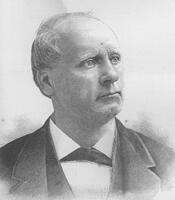
Here you will find contact information for Representative Elihu Stephen Williams, including email address, phone number, and mailing address.
| Name | Elihu Stephen Williams |
| Position | Representative |
| State | Ohio |
| District | 3 |
| Party | Republican |
| Status | Former Representative |
| Term Start | December 5, 1887 |
| Term End | March 3, 1891 |
| Terms Served | 2 |
| Born | January 24, 1835 |
| Gender | Male |
| Bioguide ID | W000496 |
About Representative Elihu Stephen Williams
Elihu Stephen Williams (January 24, 1835 – December 1, 1903) was an American farmer, lawyer, soldier, and politician who served as a Republican member of the United States House of Representatives from Ohio from 1887 to 1891. His public career spanned service in the Union Army during the Civil War, participation in Reconstruction-era politics in Tennessee, and later representation of Ohio’s third congressional district in the Fiftieth and Fifty-first Congresses.
Williams was born near New Carlisle, Clark County, Ohio, the son of Henry Williams and Elizabeth Pettigrew, both natives of Virginia. He worked on his father’s farm until the age of sixteen, attending public schools during the winter months. Dissatisfied with the limited educational opportunities available to him, he asked his father to send him regularly to school. His father replied that if he wanted a better education than he was getting at home, he would have to obtain it himself. With $1.50 in his pocket, Williams left home to make his own way. He worked for neighboring farmers to earn enough money to pay his board for a few months and then attended Antioch College in Yellow Springs, Ohio, long enough to prepare for and pass the examination for a teacher’s certificate. He subsequently taught school during the winter in Brandt, Ohio, while continuing to pursue his own education.
In 1858, Williams commenced the study of law in the office of F. P. Cuppy, Esq., in Dayton, Ohio. He continued to teach school during the winters while reading law, and in February 1861 he was admitted to the bar by the Supreme Court of Ohio. His legal career was soon interrupted by the outbreak of the Civil War. In October 1861, he enlisted as a private in the 71st Ohio Infantry for service in the Union Army. He was commissioned first lieutenant on February 14, 1862, and took part in the Battle of Shiloh. He was promoted to captain on February 10, 1863. In the fall of 1863, he was detailed to command the military post at Carthage, Tennessee, a position he held until the close of the war, gaining administrative and leadership experience that would later inform his civil and political work.
After the war, Captain Williams remained in Smith County, Tennessee, where he engaged in the practice of law. He took an active part in the first convention for the Reconstruction of Tennessee at Nashville, aligning himself with the Republican and Unionist elements seeking to reshape the state’s political and legal order in the aftermath of the Confederacy’s defeat. In April 1865, he was commissioned district attorney for the Sixth Judicial District of Tennessee, a post he held until the summer of 1867. He resigned that office to accept the Republican nomination for the Tennessee House of Representatives, representing the district composed of Sumner, Smith, and Macon Counties. Williams served for two years, until 1869, in what was known as the Radical Legislature of Tennessee, participating in Reconstruction-era lawmaking. After his legislative service, he returned to agricultural pursuits on his farm while continuing his legal and civic activities. On May 31, 1866, he married Alice Gordon, daughter of Dr. Wiley B. Gordon and Virginia Russwum. The couple had two children; a third child enumerated as a son in the 1880 census may have been adopted.
In 1875, Williams moved with his family back to Ohio, settling in Troy in Miami County. There he entered into a law partnership with his brother, Henry H. Williams, establishing himself in local legal practice. He also became editor of a newspaper, the Buckeye, using the press as a platform for Republican principles and public affairs commentary. His growing prominence in the community and within the Republican Party led to his selection as the party’s candidate for Congress from Ohio’s third district.
Elihu Stephen Williams was elected as a Republican to the Fiftieth and Fifty-first Congresses, serving in the United States House of Representatives from March 4, 1887, to March 3, 1891. His service in Congress occurred during a significant period in American history marked by industrial expansion, debates over tariffs and veterans’ benefits, and the continuing adjustment to post–Civil War economic and social conditions. As a member of the House of Representatives, Williams participated in the legislative process, contributed to the work of the Republican majority, and represented the interests of his Ohio constituents in national affairs during his two terms in office.
At the conclusion of his congressional service in 1891, Williams did not return to elective office but resumed the practice of law in Troy, Ohio. He continued his professional work there until his death on December 1, 1903. Elihu Stephen Williams died in Troy and was interred in Riverside Cemetery, leaving a record of service that encompassed military leadership in the Civil War, Reconstruction-era legal and legislative work in Tennessee, and representation of Ohio in the United States Congress.