Representative Elijah Banks Lewis
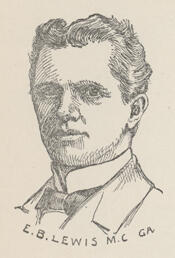
Here you will find contact information for Representative Elijah Banks Lewis, including email address, phone number, and mailing address.
| Name | Elijah Banks Lewis |
| Position | Representative |
| State | Georgia |
| District | 3 |
| Party | Democratic |
| Status | Former Representative |
| Term Start | March 15, 1897 |
| Term End | March 3, 1909 |
| Terms Served | 6 |
| Born | March 27, 1854 |
| Gender | Male |
| Bioguide ID | L000281 |
About Representative Elijah Banks Lewis
Elijah Banks Lewis (March 27, 1854 – December 10, 1920) was a Democratic U.S. Representative from Georgia who served six consecutive terms in the United States House of Representatives from 1897 to 1909. He was born in Coney, then in Dooly County and later part of Crisp County, Georgia, where he spent his early years in the rural South during the post–Civil War era. Raised in this agrarian setting, he attended the common schools of Dooly and Macon Counties, receiving a basic education that prepared him for further study and eventual entry into business and public life.
Lewis continued his education at Spalding Seminary in Spalding, Georgia, an institution that provided more advanced instruction than the local common schools. He subsequently attended a business school in Macon, Georgia, where he acquired training in commercial practices and accounting. This combination of general and business education equipped him with the skills necessary for a career in banking and mercantile pursuits, fields that were expanding in Georgia as the state’s economy diversified in the late nineteenth century.
In 1871, Lewis moved to Montezuma, Georgia, a growing community in Macon County. There he engaged in banking and mercantile enterprises, building a reputation as a businessman and community leader. His work in finance and commerce placed him in close contact with local farmers, merchants, and professionals, and he became an influential figure in the economic life of the region. This prominence in local affairs helped pave the way for his entry into politics as he gained the confidence and support of his neighbors and associates.
Lewis’s political career began at the state level. A member of the Democratic Party, which dominated Georgia politics during this period, he was elected to the Georgia State Senate and served in that body in 1894 and 1895. In the state senate he participated in legislative deliberations affecting agriculture, commerce, and local governance at a time when Georgia was grappling with issues of economic development and the restructuring of its post-Reconstruction political order. His service in the state legislature enhanced his standing within the Democratic Party and provided legislative experience that would serve him in national office.
Building on his state-level service, Lewis was elected as a Democrat to the Fifty-fifth Congress and to the five succeeding Congresses, serving in the U.S. House of Representatives from March 4, 1897, to March 3, 1909. Representing Georgia during a significant period in American history that encompassed the Spanish–American War, the beginning of U.S. overseas expansion, and the early Progressive Era, he contributed to the legislative process over six terms in office. As a member of the House of Representatives, he participated in the democratic process and represented the interests of his constituents, reflecting the priorities of a largely rural, agricultural district in central Georgia. His tenure in Congress coincided with debates over tariffs, monetary policy, and federal involvement in economic and social affairs, and he aligned with the Democratic Party’s positions as they evolved at the turn of the twentieth century.
After twelve years in Congress, Lewis sought to continue his service but was an unsuccessful candidate for renomination in 1908 to the Sixty-first Congress. With his defeat in the Democratic primary process, his congressional career came to an end on March 3, 1909. Following his departure from national office, he returned to Montezuma and resumed his former business activities in banking and mercantile pursuits. In this later phase of his life, he remained a respected figure in the community, drawing on his long experience in both commerce and public service.
Elijah Banks Lewis continued to live and work in Montezuma until his death there on December 10, 1920. He was interred in Felton Cemetery, a local burial ground that became his final resting place. His life reflected the trajectory of many Southern Democratic leaders of his era, moving from local business and state politics to national office and then back to private enterprise, while maintaining close ties to the communities he represented.