Representative Eliot L. Engel
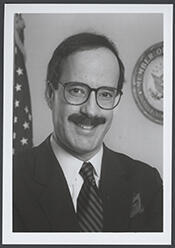
Here you will find contact information for Representative Eliot L. Engel, including email address, phone number, and mailing address.
| Name | Eliot L. Engel |
| Position | Representative |
| State | New York |
| District | 16 |
| Party | Democratic |
| Status | Former Representative |
| Term Start | January 3, 1989 |
| Term End | January 3, 2021 |
| Terms Served | 16 |
| Born | February 18, 1947 |
| Gender | Male |
| Bioguide ID | E000179 |
About Representative Eliot L. Engel
Eliot Lance Engel (born February 18, 1947) is an American politician who served as a U.S. Representative from New York from January 3, 1989, to January 3, 2021. A member of the Democratic Party, he represented districts covering portions of the north Bronx and southern Westchester County over the course of 16 consecutive terms in Congress. During his tenure, he became a prominent voice on foreign affairs, health care, energy policy, and consumer protection, and rose to chair the House Committee on Foreign Affairs in the 116th Congress after serving as its ranking member beginning in 2013.
Engel was born in the Bronx, New York City, the son of Sylvia (née Bleend) and Philip Engel, an ironworker. His grandparents were immigrants of Ukrainian Jewish background from the Russian Empire, and he was raised in a working-class, Jewish household in New York. He attended New York City public schools and developed an early interest in history and public affairs. In 1969, he graduated from the Bronx campus of Hunter College with a Bachelor of Arts degree in history. He continued his education at the same institution—renamed Lehman College after its separation from Hunter College—earning a Master of Science degree in guidance and counseling in 1973. While already embarked on a political career, Engel pursued legal studies and received a Juris Doctor from New York Law School in February 1987.
Before entering elective office, Engel worked as a teacher and guidance counselor in the New York City public school system, experience that informed his later legislative interests in education and social services. His political career began in earnest in 1977, when he entered a special election for a seat in the New York State Assembly after the resignation of incumbent Democrat Alan Hochberg. Running as the Liberal Party nominee, Engel won the March 1, 1977, special election by 103 votes, defeating Democratic nominee Ted Weinstein and Republican nominee Arlene Siegel. He served in the New York State Assembly from 1977 to 1988, sitting in the 182nd, 183rd, 184th, 185th, 186th, and 187th New York State Legislatures. In Albany, he chaired the Committee on Alcoholism and Substance Abuse and the Subcommittee on the Mitchell-Lama Housing Program, focusing on addiction treatment policy and affordable housing.
In 1988, Engel ran for the U.S. House of Representatives in New York’s 19th congressional district, much of which overlapped with his state assembly district in the southeastern Bronx. In the Democratic primary, he defeated ten-term Representative Mario Biaggi with 48 percent of the vote. Biaggi, who had resigned his seat and did not actively campaign, remained on the ballot while facing racketeering charges brought by U.S. Attorney Rudy Giuliani in connection with the Wedtech scandal; Biaggi was later jailed. Although Biaggi was unopposed for the Republican nomination, Engel went on to win the general election with 56 percent of the vote, beginning his service in the 101st Congress on January 3, 1989. Over subsequent cycles he consolidated his position, defeating musician Willie Colón by 62 percent to 38 percent in 1994 and State Senator Larry Seabrook, backed by Bronx County Democratic Party Chairman Roberto Ramirez, by 50 percent to 41 percent in 2000. As congressional lines were redrawn, Engel’s district came to encompass portions of the north Bronx and southern Westchester County, including communities such as Riverdale, Yonkers, Mount Vernon, and New Rochelle.
During his 16 terms in the House of Representatives, Engel served on the Committee on Energy and Commerce, including its Subcommittee on Energy and Power and Subcommittee on Health, and on the Committee on Foreign Affairs, where he became ranking member in the 113th, 114th, and 115th Congresses and chair in the 116th Congress following Democratic gains in the 2018 elections. Within the Democratic Caucus he held leadership roles as vice chair of the Democratic Task Force on Homeland Security and as an assistant Democratic whip. He was active in numerous caucuses, including the Arab-Israeli Peace Accord Monitoring Group, the Congressional Albanian Caucus, the Congressional Caucus on Global Road Safety, the Congressional Hellenic-Israeli Alliance, the Ad Hoc Congressional Committee for Irish Affairs, the Democratic Leadership Council, the Democratic Task Force on Health, the House Oil and National Security Caucus (which he founded and co-chaired), the Israel Allies Caucus, the New Democrat Coalition, the House Caucus on Human Rights, the House Caucus on the Hudson Valley, the United States Congressional International Conservation Caucus, the Congressional Arts Caucus, the Congressional NextGen 9-1-1 Caucus, the Congressional Medicare for All Caucus (as a founding member), the Climate Solutions Caucus, the U.S.-Japan Caucus, and the Congressional Argentina Caucus, which he founded.
Engel developed a reputation as a legislator deeply engaged in health policy. A strong supporter of single-payer health care, he co-sponsored the United States National Health Care Act to establish a national single-payer system and consistently described himself as pro-choice “all the way.” He was an early and strong supporter of the Affordable Care Act of 2010, backing the landmark law after securing provisions to ensure that New York would not be penalized for offering more generous benefits than other states. He authored the ALS Registry Act (Public Law 110–373) in 2008, which created a national registry for data on individuals suffering from amyotrophic lateral sclerosis, and the Paul D. Wellstone Muscular Dystrophy Act (Public Law 110–361), which promoted research at Centers of Excellence for Muscular Dystrophy. In 2010, he wrote the Partnering to Improve Maternity Care Quality Act to enhance maternity care for mothers and newborns through collaboration among providers, advocates, payers, and purchasers. That same year he authored the Gestational Diabetes Act of 2010, legislation to improve tracking and research into gestational diabetes, a condition that can lead to Type 2 diabetes in both mother and child if untreated. The bill passed the House but did not receive a vote in the Senate; Engel reintroduced it in the 115th Congress in 2018, though it again was not voted on.
On global health issues, Engel supported an improved reauthorization of the President’s Emergency Plan for AIDS Relief (PEPFAR). Within the PEPFAR legislation, he secured inclusion of his Stop Tuberculosis Now Act, designed to increase U.S. support for international tuberculosis control activities and to promote research into new drugs, diagnostics, and vaccines. He also pursued consumer and privacy protections in the telecommunications and technology arenas. On December 22, 2010, President Barack Obama signed into law the Truth in Caller ID Act, legislation introduced in the Senate by Bill Nelson and passed by the House on December 15, which was virtually identical to Engel’s bill. The law targets caller ID “spoofing,” a tactic used by criminals to deceive victims into divulging personal information, and provides law enforcement with a tool to combat identity theft. Engel had earlier introduced the Securing Our Borders and Our Data Act in July 2008 (H.R. 6702), reintroduced in the 111th Congress as H.R. 239, to require cause before border agents could search or seize travelers’ electronic data or equipment. The Department of Homeland Security subsequently altered its rules to prevent suspicionless searches and seizures, effectively incorporating much of Engel’s proposal. In the 109th Congress he introduced the Calling Card Consumer Protection Act (H.R. 3402) to address fraud in the prepaid calling card industry; the bill passed the House unanimously but did not advance in the Senate. In 2011, he introduced the Drug Testing Integrity Act to prohibit the sale of products designed to facilitate cheating on drug tests. In 2012, he introduced the Social Network Online Protection Act (SNOPA), reintroduced in the 113th Congress with Representative Michael Grimm as the Republican lead and Representative Jan Schakowsky as an original co-sponsor, to bar employers and educational institutions from requesting or requiring usernames or passwords to social media accounts as a condition of employment or enrollment.
Energy and environmental policy formed another major area of Engel’s legislative activity. In 2005, he and Representative Jack Kingston of Georgia introduced the Fuel Choices for American Security Act (H.R. 4409), which was later modified and reintroduced in 2007 as the Dependence Reduction through Innovation in Vehicles and Energy (DRIVE) Act (H.R. 670), attracting more than 80 bipartisan co-sponsors. The legislation sought to enhance national security and economic stability by reducing U.S. dependence on foreign oil through expanded use of clean alternative fuels, advanced vehicle technologies, and increased tire efficiency to improve fuel economy. Many provisions of the DRIVE Act were incorporated into the Energy Independence and Security Act, signed into law on December 19, 2007, as Public Law 110–140. That law mandated an increase in corporate average fuel economy standards from 25 miles per gallon to 35 miles per gallon by 2020, strengthened energy efficiency standards for appliances, lighting, and buildings, and promoted the development of American-grown biofuels such as cellulosic ethanol, biodiesel, and biobutanol. Engel also introduced the Open Fuel Standards Act with Representatives Kingston, Steve Israel, and Bob Inglis, which would have required that 50 percent of new cars sold in the United States by 2012, and 80 percent by 2015, be flexible-fuel vehicles capable of running on any combination of ethanol, methanol, or gasoline, at an added cost of about $100 per vehicle. As a member of the Energy and Commerce Committee and its Subcommittee on Energy and the Environment, he played a key role in negotiating the American Clean Energy and Security Act (H.R. 2454), a comprehensive climate and energy bill intended to create jobs, reduce dependence on foreign oil, and cut greenhouse gas emissions. The bill passed the House on June 26, 2009, but was not taken up by the Senate in the 111th Congress.
Engel was a consistent supporter of gun control measures during his time in Congress. He worked to ban assault weapons, high-capacity magazines, and armor-piercing bullets; to institute universal background checks; to promote extreme risk protection orders; and to restore federal funding for research on gun violence. He voted against a 2003 bill that granted broad immunity to firearm manufacturers and dealers from civil liability for gun misuse, supported the development and deployment of “smart gun” technology to prevent unauthorized use, and opposed efforts to shorten the waiting period for gun purchases at gun shows. In 2001, following the recall of 400,000 defective gun locks, he introduced legislation directing the Consumer Product Safety Commission to establish a national quality standard for child safety devices used on firearms. In 2009, he was among 53 members of Congress who signed a letter urging President Barack Obama to resume enforcement of a ban on the importation of foreign assault weapons under the Gun Control Act of 1968, a policy that had been enforced during the administrations of George H. W. Bush and Bill Clinton. He also intervened in housing policy, urging the Federal Housing Finance Agency in 2010 to abandon a plan to ban private transfer fees on cooperative apartment sales; Engel argued that, when properly structured, such fees could help fund projects and maintain affordability. The FHFA decided in 2011 not to pursue the proposed ban.
As chair and previously ranking member of the House Foreign Affairs Committee, Engel was involved in oversight of U.S. foreign policy and international programs, and he participated in numerous country- and region-focused caucuses, including those related to the Middle East, the Balkans, Ireland, Japan, and Latin America. He was known for his visible presence at presidential State of the Union addresses. Beginning with his first term in 1989, he routinely arrived early at the Capitol to secure an aisle seat, allowing him to shake hands with the President of the United States as the president entered the House chamber, a gesture he described as an honor “no matter who it is.” This long-standing tradition ended in 2017, when he chose not to shake the hand of President Donald Trump.
Engel’s congressional career concluded after the 2020 election cycle. That year he faced a primary challenge from Jamaal Bowman, a middle school principal from Yonkers who ran to his left on a range of issues. Engel initially received the endorsement of New York State Senator Alessandra Biaggi, granddaughter of former Representative Mario Biaggi, whom Engel had defeated in his first congressional primary in 1988. In early June 2020, however, following a widely publicized “hot mic” incident in which Engel, seeking to speak at a press conference, was heard saying, “If I didn’t have a primary, I wouldn’t care,” Biaggi withdrew her endorsement and backed Bowman. A mid-June poll showed Engel trailing Bowman by ten percentage points. After early and election day votes were counted, Bowman led Engel by almost 12,000 votes, 61.8 percent to 34.9 percent. Although absentee ballots were not scheduled to be counted until June 30, some outlets projected Bowman the winner before their tally. Once absentee ballots were included, Bowman’s margin stood at 55.4 percent to 40.6 percent, a difference of 13,218 votes. The race was formally called for Bowman on July 17, 2020, and the New York State Board of Elections certified the results on August 6, 2020, ending Engel’s 16-term tenure in the House of Representatives.