Representative Elizabeth Andrews
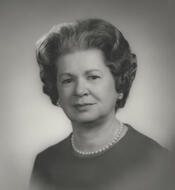
Here you will find contact information for Representative Elizabeth Andrews, including email address, phone number, and mailing address.
| Name | Elizabeth Andrews |
| Position | Representative |
| State | Alabama |
| District | 3 |
| Party | Democratic |
| Status | Former Representative |
| Term Start | January 3, 1972 |
| Term End | January 3, 1973 |
| Terms Served | 1 |
| Born | February 12, 1911 |
| Gender | Female |
| Bioguide ID | A000205 |
About Representative Elizabeth Andrews
Leslie Elizabeth Bullock Andrews (February 12, 1911 – December 2, 2002) was an American politician and educator who became the first woman to represent Alabama in the United States House of Representatives. A member of the Democratic Party, she served one term in Congress from 1971 to 1973, contributing to the legislative process during a significant period in American history. She was the wife of long-serving Representative George William Andrews and was elected to his seat following his death.
Andrews was born Leslie Elizabeth Bullock in Geneva, Geneva County, Alabama, to Charles Gillespie Bullock and Janie Aycock Bullock. She attended the public schools of Geneva, where she received her early education. Demonstrating an early interest in education and public service, she pursued higher education at Montevallo College (now the University of Montevallo) in Montevallo, Alabama. She graduated in 1932 with a Bachelor of Science degree in home economics, a field that was then closely associated with community welfare, family life, and practical education.
Following her graduation, Andrews embarked on a career as a high school teacher. She first taught in Livingston, Alabama, and later accepted a teaching position in Union Springs, Alabama, attracted by the somewhat better pay available there during the economic hardships of the Great Depression. It was in Union Springs that she met attorney George William Andrews, who would later be elected to Congress. The two married on November 25, 1936, and their marriage lasted more than thirty-five years, until his death on December 25, 1971, from complications following heart surgery. They had two children, Jane and George Jr., and made their home life a central part of their public careers.
When George William Andrews first ran for the Seventy-eighth Congress in the early 1940s, Elizabeth Andrews played an active and influential role in his campaign. After his election and subsequent reelection to fourteen succeeding Congresses, the couple relocated to Washington, D.C., where she became deeply involved in the social and support networks surrounding the nation’s capital. She was active in the Congressional Club, an organization of spouses of Members of Congress, and rose to serve as its vice president in 1971. Through these activities she gained a detailed familiarity with congressional life, political processes, and constituent service, experience that would later inform her own brief tenure in office.
The death of Representative George W. Andrews on December 25, 1971, created a vacancy in Alabama’s congressional delegation. Encouraged by friends and colleagues, including former Representative Lera Thomas, who herself had succeeded her late husband in Congress, Elizabeth Andrews decided to seek election to her husband’s seat in order to continue his work and represent their district. She announced her candidacy on January 1, 1972, and received the endorsement of Alabama Governor George Wallace. Running unopposed in the special election, she was elected as a Democrat to the Ninety-second Congress to fill the vacancy caused by her husband’s death. She took her seat on April 4, 1972, and served until January 3, 1973. During this period she was the first woman ever to represent Alabama in the United States House of Representatives, and she would remain the only woman elected to represent Alabama in either house of Congress until the elections of Representatives Martha Roby and Terri Sewell in 2010. She chose not to be a candidate for reelection to the Ninety-third Congress in 1972.
During her service in the House of Representatives, Andrews participated fully in the democratic process and represented the interests of her Alabama constituents at a time marked by the Vietnam War, domestic social change, and evolving federal social programs. She served on the Committee on Post Office and Civil Service, where she introduced amendments designed to protect medical and Social Security benefits for federal employees and retirees, reflecting her concern for social welfare and economic security. She also worked to secure federal funding for medical research centers in Birmingham, Alabama, particularly those engaged in research on cancer and heart disease, thereby supporting both public health initiatives and the development of scientific and medical infrastructure in her state. In foreign and defense policy, she supported the Nixon administration’s plan for the withdrawal of United States troops from Vietnam. Additionally, she sponsored legislation to designate Tuskegee University as a National Historic Site, recognizing the institution’s historic role in African American education and American history more broadly.
After leaving Congress in January 1973, Andrews returned to Union Springs, Alabama, where she remained active in civic affairs and community life. Although she did not seek further elective office, her experience as a congressional spouse and as a Member of Congress informed her continued engagement with public service, education, and local initiatives. She maintained an enduring connection to the people and institutions of her district, and her pioneering role as Alabama’s first female Member of Congress stood as an important milestone in the state’s political history.
Elizabeth Bullock Andrews died on December 2, 2002, in Birmingham, Alabama, at the age of ninety-one. She was interred at Oak Hill Cemetery in Union Springs, Alabama. Her life and career, encompassing work as an educator, congressional spouse, and Member of Congress, reflected a long-standing commitment to public service and to the representation of Alabama’s interests in the national legislature.