Representative Elizabeth Furse
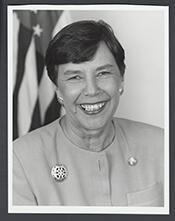
Here you will find contact information for Representative Elizabeth Furse, including email address, phone number, and mailing address.
| Name | Elizabeth Furse |
| Position | Representative |
| State | Oregon |
| District | 1 |
| Party | Democratic |
| Status | Former Representative |
| Term Start | January 5, 1993 |
| Term End | January 3, 1999 |
| Terms Served | 3 |
| Born | October 13, 1936 |
| Gender | Female |
| Bioguide ID | F000434 |
About Representative Elizabeth Furse
Elizabeth Furse (October 13, 1936 – April 18, 2021) was a Kenya Colony-born American small business owner, political activist, and former faculty member of Portland State University who served as a Democratic Representative from Oregon in the United States Congress from 1993 to 1999. Representing Oregon’s 1st congressional district, she served three terms in the U.S. House of Representatives and was the first naturalized U.S. citizen born in Africa to win election to the United States Congress. Her service in Congress occurred during a significant period in American history, and she participated actively in the legislative process while representing the interests of her constituents.
Furse was born in Nairobi, Kenya Colony, to a Canadian mother, Barbara Elizabeth (née Ross) of Regina, Saskatchewan, and a British father, Peter Reynolds Furse. Her family background connected her to notable public and cultural figures: her paternal grandparents were painter Charles Wellington Furse and nursing and military administrator Dame Katharine Furse, and her maternal grandfather was James Hamilton Ross, a Canadian rancher, Canadian Pacific Railway scout, and politician who is credited as being among the first residents of the modern-day town of Moose Jaw, Saskatchewan. She spent much of her childhood in South Africa, where she was exposed early to issues of racial injustice. Inspired by her mother, she became an anti-apartheid activist in 1951, joining the first Black Sash demonstrations in Cape Town, South Africa, an experience that helped shape her lifelong commitment to civil and human rights.
In 1956, Furse left South Africa and moved to England, and later emigrated to the United States, settling in Los Angeles, California. While in Los Angeles, she became involved in community-based social justice work, including a women’s self-help project in the Watts neighborhood. She also worked with César Chávez’s United Farm Workers movement, supporting efforts to unionize grape farm workers and improve labor conditions. In 1968, she moved to Seattle, Washington, where she became deeply involved in American Indian and Native American rights, particularly in the areas of fishing and treaty rights. She became a naturalized citizen of the United States in 1972. Two years later, in 1974, she graduated from The Evergreen State College with a Bachelor of Arts degree, further grounding her activism in formal education.
Furse moved to the Portland, Oregon, area in 1978 and enrolled at the Northwestern School of Law (now Lewis & Clark Law School). After two years of law school, she left her studies to focus on advocacy for Native American tribes in Oregon. She led efforts by several Oregon-based American Indian and Native American tribes to regain federal recognition, successfully lobbying the U.S. Congress to restore recognition of the Coquille, Klamath, Lower Umpqua, Coos, and Grand Ronde tribes. In 1986, she co-founded the Oregon Peace Institute in Portland, an organization dedicated to developing and disseminating conflict resolution curricula in Oregon schools, reflecting her broader interest in peace education and nonviolent problem-solving. During this period, she and her partner, John C. Platt, also developed Helvetia Vineyards and Winery in Helvetia, Oregon, where they had planted grapes in 1982 and started their winery in 1992; by 2007 the vineyard was producing both pinot noir and chardonnay grapes.
Furse entered electoral politics in the early 1990s. In 1992, she was first elected to Congress, defeating Oregon State Treasurer Tony Meeker in a year when the number of women in the U.S. House of Representatives increased from 28 to 47. Taking office on January 3, 1993, she represented Oregon’s 1st congressional district as a Democrat. In the 1994 election, during the Republican Revolution that produced a 54-seat gain for the Republican Party in the House, she narrowly won reelection by 301 votes, defeating businessman Bill Witt. A Northwest newspaper described her as the “antithesis of Congress’ traditional play-it-safe politicians,” underscoring her reputation for independence and issue-driven politics. In 1996, she again faced Witt and won reelection with 52 percent of the vote. She declined to seek reelection in 1998, stating that the position was “public service and not a career,” and left Congress at the conclusion of her third term in January 1999.
During her congressional service from 1993 to 1999, Furse contributed to the legislative process on a range of issues, including health care, transportation, and Native American affairs. In 1996, she joined with Representative George Nethercutt of Washington to co-found the Congressional Diabetes Caucus. Together they authored legislation, enacted in 1997, that improved Medicare coverage for diabetes education and supplies. Under their leadership, the Congressional Diabetes Caucus grew to become the largest health-related caucus in Congress. Furse also played a key role in securing federal funding to extend TriMet’s Westside MAX Light Rail project beyond its originally planned terminus at the Beaverton–Hillsboro border to downtown Hillsboro, enhancing public transit access in her district. In recognition of her efforts, TriMet later named the plaza at the Sunset Transit Center in her honor.
After retiring from Congress in 1999, Furse continued her public service and educational work in Oregon. She served as director of the Institute for Tribal Government at Portland State University, where she was a former faculty member, and spearheaded the “Great Tribal Leaders of Modern Times” video interview series, documenting the experiences and leadership of contemporary Native American leaders. Her ongoing involvement in Native American issues and broader public policy occasionally drew attention in state and national politics. Notably, she endorsed Republican U.S. Senator Gordon Smith of Oregon in his 2002 and 2008 reelection campaigns, explaining in a 2006 interview that she supported him because they “had a lot in common on tribal issues” and citing his repeated votes against drilling in the Arctic National Wildlife Refuge, which she viewed as acts of political courage. She described Smith as a “very moral person” who would be candid when he disagreed, and later praised him as “one of the first to stand up to George Bush and other Republicans to end this war.”
In 2014, Furse sought a return to elective office by running for the Washington County Board of Commissioners in District 4. Although she ran with the endorsements of Congresswoman Suzanne Bonamici and former Oregon Governors Barbara Roberts and Ted Kulongoski, she lost the race to incumbent Commissioner Bob Terry, receiving 46.57 percent of the vote to Terry’s 53.10 percent. She was also a member of the ReFormers Caucus of Issue One, a bipartisan group of former elected officials focused on political reform and strengthening democratic institutions. Throughout her later years, she continued to manage and reside at her farm and winery near Hillsboro, maintaining her engagement with local civic life.
Elizabeth Furse died on April 18, 2021, at age 84, at her farm near Hillsboro, Oregon, from complications of a fall. Her life and career reflected a consistent commitment to civil rights, Native American sovereignty, peace education, public health, and representative democracy, from her early anti-apartheid activism in South Africa to her three terms in the U.S. House of Representatives and her subsequent academic and community work in Oregon.