Representative Elizabeth Patterson
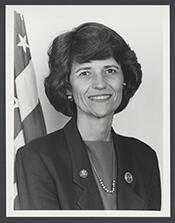
Here you will find contact information for Representative Elizabeth Patterson, including email address, phone number, and mailing address.
| Name | Elizabeth Patterson |
| Position | Representative |
| State | South Carolina |
| District | 4 |
| Party | Democratic |
| Status | Former Representative |
| Term Start | January 6, 1987 |
| Term End | January 3, 1993 |
| Terms Served | 3 |
| Born | November 18, 1939 |
| Gender | Female |
| Bioguide ID | P000112 |
About Representative Elizabeth Patterson
Elizabeth Johnston Patterson (November 18, 1939 – November 10, 2018) was an American politician from South Carolina and a member of the Democratic Party who served three terms in the United States House of Representatives from 1987 to 1993. Known as “Liz,” she was the first woman elected to Congress from South Carolina in her own right and represented the state’s 4th congressional district during a period of significant political realignment in the South.
Patterson was born Elizabeth Johnston into a prominent Democratic political family. Her father, Olin D. Johnston, served as Governor of South Carolina from 1935 to 1939 and again from 1943 to 1945, and then as a United States Senator from 1945 until his death in 1965. During her father’s Senate tenure, the family lived outside Washington, D.C., in Kensington, Maryland, where she grew up and was exposed early to national politics and public service. She later returned to South Carolina to pursue higher education, graduating from Columbia College in Columbia, South Carolina, and undertaking graduate work at the University of South Carolina.
Early in her career, Patterson worked in Washington, D.C., during the administration of President Lyndon B. Johnson. She held positions with the Peace Corps and the Office of Economic Opportunity, gaining experience in federal programs aimed at international development and domestic anti-poverty efforts. Returning to South Carolina, she served as the state director of the Head Start Program, reflecting her commitment to early childhood education and social services, and later worked as an assistant to Congressman James R. Mann, further deepening her familiarity with legislative processes and constituent service.
Patterson’s elective political career began at the local level in Spartanburg County, South Carolina, where she settled and became active in community and party affairs. She was elected to the Spartanburg County Council, serving from 1975 to 1976. Building on this local experience, she successfully ran for the South Carolina State Senate in 1978 and served from 1979 to 1986. In the state Senate she was only the second woman ever to serve in that body, following Mary Gordon Ellis, marking an early milestone for women’s representation in South Carolina politics.
In 1986 Patterson was elected to the U.S. House of Representatives from South Carolina’s 4th congressional district, succeeding Carroll A. Campbell Jr., who had vacated the seat to make a successful run for governor. In a closely contested race, she narrowly defeated Bill Workman, the mayor of Greenville, despite Campbell’s strong presence at the top of the Republican ticket. The campaign carried a historical resonance: Workman’s father, W. D. Workman Jr., had been her father’s Republican opponent in the 1962 general election, when Olin D. Johnston won his final term in the U.S. Senate. As a member of the House of Representatives, Elizabeth J. Patterson participated in the democratic process and represented the interests of her constituents during a significant period in American history. She served on the House Committee on Banking, Finance and Urban Affairs, the Committee on Veterans’ Affairs, and the Select Committee on Hunger, contributing to legislative work on financial regulation, veterans’ benefits, and domestic and international hunger issues.
Patterson was narrowly reelected in 1988, defeating Republican attorney and Greenville city councilman Knox H. White even as George H. W. Bush carried the 4th district by the largest margin of any district in South Carolina. In 1990 she secured a third term with a more comfortable margin over Republican Terry Haskins, a state representative from Greenville, in a year when Governor Carroll Campbell won reelection in a landslide. Although the 4th district had been trending Republican for some time, Patterson was regarded as a relatively secure incumbent due to her family’s political legacy and her record of winning three successive elections under challenging partisan conditions. Nonetheless, in 1992 she was narrowly defeated for reelection by Republican attorney Bob Inglis, a first-time candidate, in another cycle in which George H. W. Bush carried the district by his largest margin in the state. Her tenure in Congress thus extended from January 3, 1987, to January 3, 1993, encompassing three full terms. After Patterson left office in 1993, no woman would serve in Congress from South Carolina until 2021, when Nancy Mace took office, and Democrats have only exceeded 40 percent of the vote in the 4th district once since 1992.
Following her congressional service, Patterson remained active in South Carolina politics and public life. She was the Democratic nominee for lieutenant governor of South Carolina in 1994, though she was unsuccessful in that bid. She later taught political science at Spartanburg Methodist College, where she also served on the board of trustees, sharing her experience in government and public policy with a new generation of students. In addition, she remained engaged in party leadership as chairwoman of the Spartanburg County Democratic Party, continuing her long-standing involvement in Democratic politics at the local and state levels.
Elizabeth J. Patterson died on November 10, 2018, in South Carolina, eight days before her 79th birthday. In recognition of her service, Governor Henry McMaster ordered that flags be lowered in her honor, and on November 14, 2018, Executive Order 2018-56 was filed for that purpose. Her papers, documenting a career that spanned local government, the state legislature, and the United States Congress, are preserved in the Elizabeth “Liz” Patterson Papers at South Carolina Political Collections at the University of South Carolina.