Representative Ellis Ellwood Patterson
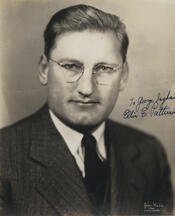
Here you will find contact information for Representative Ellis Ellwood Patterson, including email address, phone number, and mailing address.
| Name | Ellis Ellwood Patterson |
| Position | Representative |
| State | California |
| District | 16 |
| Party | Democratic |
| Status | Former Representative |
| Term Start | January 3, 1945 |
| Term End | January 3, 1947 |
| Terms Served | 1 |
| Born | November 28, 1897 |
| Gender | Male |
| Bioguide ID | P000113 |
About Representative Ellis Ellwood Patterson
Ellis Ellwood Patterson (November 28, 1897 – August 25, 1985) was an American attorney and politician who served as the 33rd lieutenant governor of California from 1939 to 1943 and as a Democratic Representative from California in the United States Congress from 1945 to 1947. Over the course of his career he served in the California State Assembly, held statewide office, and participated in national legislative affairs during a significant period in American history, contributing to the democratic process and representing the interests of his constituents.
Patterson was born in Yuba City, Sutter County, California, on November 28, 1897. He attended public schools in California before enrolling at the University of California, Berkeley, from which he graduated with an A.B. degree in 1921. During World War I he served as a seaman in the United States Navy, and after the war he also served in the United States Merchant Marine. Returning to civilian life, he began a career in education, teaching school in Colusa County, California, from 1922 to 1924. He was active in veterans’ affairs and became involved with the American Legion, serving as commander of the Colusa County post.
From 1923 to 1932, Patterson served as district superintendent of schools for South Monterey County, California, gaining administrative experience and a public profile in local educational matters. While working in education, he pursued legal studies, attending Stanford University and the University of California from 1931 to 1936. He was admitted to the bar in 1937 and commenced the practice of law in Sacramento and Los Angeles, combining his growing legal career with an increasingly active role in state politics.
Patterson entered elective office as a member of the California State Assembly, representing the 35th district from 1933 to 1939. Originally elected as a Republican, he became an advocate of President Franklin D. Roosevelt’s New Deal and subsequently switched his party affiliation to the Democratic Party. In 1936, after being defeated in the Republican primaries in his second re-election bid, he mounted a notable write-in campaign and won the general election, gaining statewide attention for this unusual political achievement. His legislative service in the Assembly during the 1930s coincided with the economic and social challenges of the Great Depression, and his alignment with New Deal policies helped define his later political trajectory.
Capitalizing on the publicity from his write-in victory, Patterson was elected lieutenant governor of California in 1938 as a Democrat and served from January 2, 1939, to January 4, 1943. As the 33rd lieutenant governor, he presided over the State Senate and played a role in state executive affairs during the early years of World War II. He was defeated for reelection in 1942. During this period he also sought higher office: in 1940 he ran unsuccessfully for the United States Senate, losing the Democratic primary to incumbent Republican Senator Hiram Johnson. In the 1940 Democratic presidential primaries in California, Patterson headed a slate of delegates pledged to himself for president, opposing President Roosevelt on the grounds that Roosevelt was devoting too much attention to foreign affairs and not enough to domestic unemployment. His slate, which included state legislators Ralph C. Dills and Paul A. Richie, journalists Carey McWilliams and Frank Scully, labor leaders Germain Bulcke and Herbert Sorrell, Los Angeles County SRA director Sam Houston Allen, and Los Angeles Board of Education member Fay E. Allen, was defeated by Roosevelt’s slate by a margin of fifteen to one.
Patterson was elected as a Democrat to the 79th United States Congress in 1944 and served in the U.S. House of Representatives from January 3, 1945, to January 3, 1947. His single term in Congress took place during the closing months of World War II and the immediate postwar period, a significant era in American history marked by demobilization, veterans’ issues, and the early stages of the Cold War. As a member of the House of Representatives, he participated in the legislative process and represented the interests of his California constituents, contributing to national debates during a time of major domestic and international transition. In 1946 he did not seek reelection to his House seat, instead entering the Democratic primary for the United States Senate, where he was again unsuccessful, losing to his predecessor in the House, Will Rogers Jr.
After leaving Congress, Patterson remained active in electoral politics. In 1948 he was an unsuccessful candidate for election to the 81st United States Congress, running as a Democrat who supported Progressive Party candidate Henry A. Wallace for president. Through California’s cross-filing system he also obtained the nomination of the Independent Progressive Party, but he lost the general election to incumbent Republican Representative Donald L. Jackson. In 1949 he ran for mayor of Los Angeles, finishing third with approximately 14 percent of the vote. Following these defeats, Patterson returned to the full-time practice of law, maintaining offices and a residence in Los Angeles and remaining a figure in California’s legal and political circles.
In his personal life, Patterson married Helen Hjelte in 1928, and the couple had three children. They remained married until her death in 1982. After her passing, he later married his second wife, Mildred. Patterson resided in Los Angeles from 1938 until his death. He died of cancer in Los Angeles, California, on August 25, 1985, closing a long career that had spanned service in education, law, state government, and the United States Congress.