Representative Ellsworth Brewer Buck
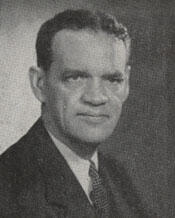
Here you will find contact information for Representative Ellsworth Brewer Buck, including email address, phone number, and mailing address.
| Name | Ellsworth Brewer Buck |
| Position | Representative |
| State | New York |
| District | 16 |
| Party | Republican |
| Status | Former Representative |
| Term Start | January 6, 1943 |
| Term End | January 3, 1949 |
| Terms Served | 3 |
| Born | July 3, 1892 |
| Gender | Male |
| Bioguide ID | B001016 |
About Representative Ellsworth Brewer Buck
Ellsworth Brewer Buck (July 3, 1892 – August 14, 1970) was a Republican member of the United States House of Representatives from New York during the 1940s. He served as a Representative from New York in the United States Congress from 1943 to 1949, completing three terms in office during a significant period in American history that encompassed the final years of World War II and the early postwar era. As a member of the House of Representatives, Buck participated in the democratic process and represented the interests of his Staten Island constituents while contributing to the legislative work of the Seventy-eighth, Seventy-ninth, and Eightieth Congresses.
Buck was born in Chicago, Illinois, on July 3, 1892. He attended Morgan Park Academy in Chicago, receiving his early education there before enrolling at Dartmouth College in Hanover, New Hampshire. He graduated from Dartmouth in 1914. With the United States’ entry into World War I, Buck enlisted in the United States Naval Reserve in 1917. During his military service he received specialized training in meteorology at the Massachusetts Institute of Technology, after which he served as a meteorology instructor, contributing to the Navy’s wartime training and preparedness.
In 1919 Buck moved to Staten Island, New York, which became the center of his business and political life. He entered the private sector and rose to become chairman of the board of L.A. Dreyfus Co., a chewing gum manufacturer that later moved to Edison, New Jersey, and was subsequently purchased by the Wrigley Company. His prominence in the industry led to his appointment as chairman of the Chewing Gum Code Authority from 1934 to 1935, an entity created under New Deal industrial codes to oversee standards and practices within the chewing gum sector. These roles established him as a notable figure in business and trade regulation during the interwar period.
Buck’s public service in New York City began with his appointment to the New York City Board of Education in 1935. He quickly assumed leadership positions within the board, serving as its vice president from 1938 until 1942 and as president from 1942 until 1944. In these capacities he helped oversee the city’s public school system during the challenging years of the Great Depression and World War II, when issues of school funding, teacher staffing, and wartime adjustments to curricula and facilities were central concerns. His work on the Board of Education enhanced his public profile and laid the groundwork for his subsequent congressional career.
Buck was elected to Congress in a special election in 1944 to fill the vacancy caused by the death of Representative James A. O’Leary. He entered the House of Representatives on June 6, 1944, and served until January 3, 1949. A member of the Republican Party, he was elected to and served in the Seventy-eighth, Seventy-ninth, and Eightieth Congresses, representing Staten Island and parts of New York City. During his tenure, Buck strongly backed the Taft–Hartley Act, landmark labor legislation that was opposed by organized labor but supported by many Republicans and business interests for its restrictions on certain union activities. He also voted in favor of a proposal to ban the poll tax, a device widely used in the South to disenfranchise African American voters, thereby aligning himself with efforts to expand voting rights. In local matters, he was an opponent of the establishment of the Fresh Kills Landfill on Staten Island, reflecting his attention to the environmental and quality-of-life concerns of his district. Buck did not run for reelection in 1948, bringing his congressional service to a close at the start of 1949.
On April 5, 1949, only months after leaving Congress, Buck was shot and seriously wounded while crossing the street on Stuyvesant Place outside Staten Island Borough Hall. The assailant, Charles Van Newkirk, was a dismissed Merchant Marine engineer who harbored resentment toward Buck because, during Buck’s tenure as chairman of a House Education and Labor subcommittee, the former congressman had denied Van Newkirk’s appeal to regain his position. The attack left Buck gravely injured, but he ultimately recovered and resumed public and political activities, demonstrating resilience in the face of personal violence connected to his prior congressional responsibilities.
Following his recovery, Buck remained active in Republican and national affairs. He served as a delegate to the 1952 Republican National Convention, participating in the party’s presidential nominating process during the election that brought Dwight D. Eisenhower to the White House. In 1954 he was appointed director of the Office of Trade Investment and Monetary Affairs, a position that placed him at the intersection of U.S. trade policy, foreign investment, and international monetary issues in the early Cold War period. The following year, in 1955, he served as public advisor to the United States delegation to the United Nations Economic and Social Council in Geneva, Switzerland, contributing to multilateral discussions on economic and social policy and representing U.S. perspectives in an important international forum.
Ellsworth Brewer Buck died at his home in Stephenson, Wisconsin, on August 14, 1970. He was cremated, and his ashes were placed in Thunder Mountain Ranch Cemetery. His career encompassed service in the military, leadership in private industry, influential roles in New York City educational governance, three terms in the United States House of Representatives from New York during the 1940s, and subsequent appointments in national and international economic and political affairs.