Representative Ely Moore
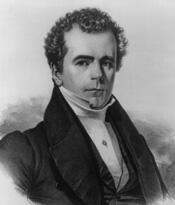
Here you will find contact information for Representative Ely Moore, including email address, phone number, and mailing address.
| Name | Ely Moore |
| Position | Representative |
| State | New York |
| District | 3 |
| Party | Democratic |
| Status | Former Representative |
| Term Start | December 7, 1835 |
| Term End | March 3, 1839 |
| Terms Served | 2 |
| Born | July 4, 1798 |
| Gender | Male |
| Bioguide ID | M000897 |
About Representative Ely Moore
Ely Moore (July 4, 1798 – January 27, 1860) was an American newspaperman, labor leader, and Jacksonian Democratic politician who served two terms as a U.S. Representative from New York from 1835 to 1839. Often described as “labor’s first congressman,” he emerged from the early nineteenth-century labor movement in New York City to become a prominent spokesman for organized labor and a defender of the interests of wage-earning workers in national politics.
Moore was born near Belvidere, Warren County, New Jersey, on July 4, 1798. He attended public schools in his youth and later moved to New York, where he initially studied medicine. Abandoning medicine for the printing trade, he became a printer and then an editor of a New York City labor newspaper, placing himself at the center of the city’s emerging workingmen’s movement. Contemporary observers, including historian Arthur M. Schlesinger Jr., described Moore as a sallow, restless man with keen, nervous eyes and long black hair brushed back from his forehead, well dressed and often carrying a heavy ivory-headed cane, who enjoyed a tremendous reputation for eloquence.
By the early 1830s, Moore had become one of the leading figures in organized labor in New York. He headed and helped establish the General Trades Union of New York, the first union in the United States to contain multiple trades under a single organizational umbrella. In 1833 he was elected the first president of New York City’s Federation of Craft Unions, and in 1834 he became the first president of the National Trades’ Union, an organization that spanned from Boston to St. Louis. Under Moore’s leadership, the National Trades’ Union played a significant role in the broader campaign to establish the ten-hour workday in many states, at a time when New York had already adopted that standard. His early interest in national politics was evident in his endorsement, on March 13, 1833, of Richard Mentor Johnson for Vice President, based on Johnson’s opposition to the Sabbatarian movement, which Moore viewed as contrary to freedom of religion, and Johnson’s support for replacing imprisonment for debt with a federal bankruptcy law.
Moore’s prominence in the labor movement and his oratorical skill led him into electoral politics through New York’s Democratic organization at Tammany Hall. He became a Tammany Hall candidate for Congress in 1834 and again in 1836. In the latter year he and Churchill C. Cambreleng, the other successful Tammany candidate, were also supported by the radical Democratic faction known as the Locofocos. Running as a Jacksonian and a member of the Democratic Party, Moore was elected to the U.S. House of Representatives from New York and served two consecutive terms from 1835 to 1839. During this period he contributed to the legislative process at a time of intense national debate over banking, labor, and democratic reform, participating in the House of Representatives as a representative of his urban, working-class constituency.
In Congress, Moore quickly gained attention for his vigorous defense of trade unions and the free labor system. In his first speech to Congress, delivered in 1836, he defended workers’ associations in explicit terms, declaring that such organizations were intended as “counterpoises against capital, whenever it should attempt to exert an unlawful or undue influence,” and that they were measures of self-defense and self-preservation and therefore not illegal. In 1836 he delivered one of his most famous speeches, a powerful reply to South Carolina Representative Waddy Thompson Jr., who had characterized northern laborers as “thieves who would raise wages through insurrection or by the equally terrible process of the ballot-box.” Moore’s oration was a stunning defense of workers, unions, and the free labor system, and it contained fierce denunciations of the “moneyed aristocracy,” Nicholas Biddle and the Second Bank of the United States, and the lack of equality for wage-earning workers. According to accounts of the event, Moore became so impassioned during this speech that he collapsed onto the podium. He also took part in the controversies over abolitionist petitions in the District of Columbia, presenting a remonstrance from citizens of the District against the reception of such petitions on February 4, 1839, and he was among the radicals who criticized early abolitionists from the standpoint of labor, fearing that antislavery agitation was a Whig-inspired effort to introduce African Americans as cheap competition in the labor market and thereby depress wages.
Moore’s congressional career came to an end when he was defeated in the 1838 elections, as his multi-member district, which returned four congressmen, shifted largely to the Whig Party. Nonetheless, his service in Congress from 1835 to 1839, during a significant period in American political and economic history, secured his reputation as the foremost labor spokesman in national politics. Shortly after his defeat, President Martin Van Buren appointed him Surveyor of the Port of New York, a position he held from 1839 to 1845. In this influential customs post, Moore remained aligned with the Democratic administration and supported Van Buren’s unsuccessful bid for re-election in 1840 against Whig candidate William Henry Harrison. In 1842 he was one of the radical Democratic leaders who supported the Dorr Rebellion in Rhode Island, a movement seeking broader suffrage and constitutional reform.
After leaving the surveyorship, Moore continued to hold important federal appointments. President James K. Polk appointed him United States marshal for the Southern District of New York in 1845, a post he occupied until 1850. Following his service as marshal, Moore returned to his native region and became owner and editor of the Warren Journal in Belvidere, New Jersey, thereby resuming his earlier vocation in journalism. His involvement in public affairs extended westward in the 1850s, when he was appointed agent for the Miami and other tribes of Native Americans in the Kansas Territory in 1853. In 1855 he was appointed register of the United States land office in Lecompton, Kansas, a position he held until his death in 1860. During his work in the Indian Bureau in Kansas, his son Ely Moore Jr. served alongside him and became embroiled in a feud with the abolitionist John Brown, reflecting the intense sectional and political tensions of the territory in the years leading up to the Civil War.
In his personal life, Moore married Emma Coutant, the daughter of a wealthy merchant, in 1824, and the couple had six children. After Emma’s death in 1846, he married Clara Baker (née Vandewater), a widow, in 1847. Moore also authored or was associated with several notable pamphlets and addresses reflecting his labor and political commitments, including a “Reply to a pamphlet entitled ‘A statement of facts in relation to the origin progress and prospects of the New-York and Harlem Rail Road Company’” (February 21, 1833), an “Address to the General Trades’ Union” (December 2, 1833), “The Laboring Classes” (May 5, 1836), and the record of “Proceedings of a meeting in favor of municipal reform held at Tammany Hall” (March 22, 1844). Ely Moore died in Lecompton, Douglas County, Kansas, on January 27, 1860, at the age of 61, and he was interred on his farm near Lecompton.