Representative Emily Taft Douglas
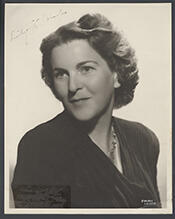
Here you will find contact information for Representative Emily Taft Douglas, including email address, phone number, and mailing address.
| Name | Emily Taft Douglas |
| Position | Representative |
| State | Illinois |
| District | At-Large |
| Party | Democratic |
| Status | Former Representative |
| Term Start | January 3, 1945 |
| Term End | January 3, 1947 |
| Terms Served | 1 |
| Born | April 10, 1899 |
| Gender | Female |
| Bioguide ID | D000452 |
About Representative Emily Taft Douglas
Emily Taft Douglas (April 10, 1899 – January 28, 1994) was an American Democratic Party politician from Illinois who served as a Representative at-large in the United States House of Representatives from 1945 to 1947. A member of the Democratic Party, she contributed to the legislative process during one term in Congress and was the first female Democrat elected to Congress from Illinois. Her election made Illinois one of the first two states, along with California, to have been represented in the House by women from both major parties. She was married to Paul H. Douglas, an economist who later served as a United States Senator from Illinois, from 1931 until his death in 1976. She was the daughter of noted sculptor Lorado Taft and his wife Ada Bartlett Taft, and was a distant relative of U.S. President William Howard Taft.
Douglas was born Emily Taft in Chicago, Illinois, where she grew up in a culturally and intellectually active household shaped by her father’s prominence in the arts. She attended the University of Chicago Laboratory School and went on to the University of Chicago, graduating with honors in French. During her youth and early adulthood, she developed an interest in international affairs and progressive politics. She joined the Democratic Party largely because of her support for President Woodrow Wilson’s advocacy of the League of Nations, an early indication of the internationalist outlook that would later define her congressional career.
After completing her undergraduate studies, Douglas pursued training in the dramatic arts at the American Academy of Dramatic Art in New York. She worked professionally as an actress for two years, an experience that honed her public speaking and presentation skills. In 1924 she left the stage to work for the League of Women Voters, reflecting a deepening commitment to civic engagement and women’s political participation in the years following the ratification of the Nineteenth Amendment. Through League of Women Voters activities she met Paul Douglas, then a professor of economics at the University of Chicago, and the two married in 1931.
During the 1930s, Emily and Paul Douglas became increasingly engaged in public affairs and reform politics in Illinois. A formative experience for them came while vacationing in Italy in 1935, when they witnessed the aftermath of Benito Mussolini’s invasion of Ethiopia. The encounter with European fascism convinced both that authoritarian regimes posed a grave threat to democratic nations, including the United States. In the years leading up to World War II, they were active in Illinois state and local politics, advocating progressive economic policies and international cooperation. After the United States entered the war, Paul Douglas enlisted in the United States Marine Corps in 1942, while Emily Douglas turned more directly to electoral politics.
In 1944, Emily Taft Douglas ran as a Democrat for Illinois’s at-large seat in the U.S. House of Representatives. She campaigned against the Republican incumbent, Stephen A. Day, who was associated with the isolationist wing of his party. Douglas ran on a strongly internationalist platform, advocating the formation of a postwar international alliance of nations to secure peace and prevent future global conflicts. She won the election and served in the Seventy-ninth Congress from January 3, 1945, to January 3, 1947. Her term coincided with the closing months of World War II and the early years of the postwar era, a significant period in American and world history. As a member of the House of Representatives, she participated in the democratic process and represented the interests of her Illinois constituents while supporting efforts to create the United Nations and to strengthen international cooperation.
During her congressional service, Douglas focused on foreign policy and issues of war and peace. In addition to working for the formation and effective functioning of the United Nations, she was an early and outspoken advocate for the control and prohibition of nuclear weapons, seeking to ban their building or use in the aftermath of the atomic bombings of Hiroshima and Nagasaki. Her positions reflected both her long-standing support for international institutions and her concern about the destructive potential of modern warfare. Despite her active engagement in these debates, she was unsuccessful in her bid for reelection in 1946 and left Congress at the conclusion of her term in January 1947.
Following her congressional service, Douglas continued to be involved in international and educational affairs. In 1950 she was appointed as the United States representative to the United Nations Educational, Scientific and Cultural Organization (UNESCO), further extending her work on global cooperation, cultural exchange, and educational initiatives. She also remained active in civic and religious life, particularly within Unitarian circles, where she participated in various organizations and causes aligned with her liberal and humanitarian outlook. Alongside these activities, she developed a career as an author, writing several books that reflected her interest in American history and social reform. Her works included “Appleseed Farm” (1948), the biographical and historical survey “Remember the Ladies; The Story of Great Women Who Helped Shape America” (1966), and “Margaret Sanger; Pioneer of the Future” (1969), a study of the birth control advocate and reformer.
In her later years, Douglas divided her time between public engagement and writing, while maintaining ties to Washington, D.C., and to political and intellectual circles shaped by her and her husband’s long careers in public service. After Paul Douglas’s death in 1976, she continued to live in Washington for a decade. In 1986 she moved to Briarcliff Manor, New York, where she spent the remainder of her life. Emily Taft Douglas died on January 28, 1994, at a nursing home in nearby White Plains, New York, closing a life that spanned nearly the entire twentieth century and encompassed work as an actress, civic activist, member of Congress, international representative, and author.