Representative Erastus Wells
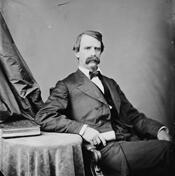
Here you will find contact information for Representative Erastus Wells, including email address, phone number, and mailing address.
| Name | Erastus Wells |
| Position | Representative |
| State | Missouri |
| District | 2 |
| Party | Democratic |
| Status | Former Representative |
| Term Start | March 4, 1869 |
| Term End | March 3, 1881 |
| Terms Served | 5 |
| Born | December 2, 1823 |
| Gender | Male |
| Bioguide ID | W000282 |
About Representative Erastus Wells
Erastus Wells (December 2, 1823 – October 2, 1893) was a 19th‑century American politician, transportation entrepreneur, and banker who became a prominent Democratic Representative from Missouri. He was born in Jefferson County, New York, the only son of Otis Wells, a farmer and descendant of Hugh Welles, an early colonist of Wethersfield, Connecticut. His paternal lineage connected him to several notable New England figures, including John Otis, a founder of Hingham, Massachusetts, in 1635; James Otis, a distinguished lawyer; Harrison Gray Otis, a statesman and orator; Samuel A. Otis, a framer of the Massachusetts constitution; and George Otis, a clergyman and author. His father died when Erastus was fourteen, and he was also the grandson of Ethelinda Otis, further anchoring him in a family tradition of public service and civic engagement.
Wells spent his boyhood on a farm and attended local district schools between the ages of twelve and sixteen. At sixteen he left farm life and moved first to Watertown, New York, and later to Lockport, New York, seeking broader opportunities in the growing commercial economy of the mid‑19th century. In September 1843 he relocated to St. Louis, Missouri, which would remain the center of his business and political career. There, inspired by the omnibus systems he had observed in New York, he turned his attention to urban transportation, an emerging field in American cities that would shape both his business fortunes and his later public life.
Soon after arriving in St. Louis, Wells organized the first omnibus line in the city—and the first such operation west of the Mississippi River—with the assistance of Calvin Case, a prominent local resident. By 1850 Wells and Case had expanded their enterprise by partnering with Robert O’Blennus and Lawrence Matthews, operating several lines, one of the most profitable being a coach route to Belleville, Illinois. On November 1, 1855, Wells was a passenger on the Pacific Railroad excursion train that plunged through a temporary bridge over the Gasconade River in the Gasconade Bridge train disaster; he survived uninjured, but his partner Calvin Case was killed. Building on the success of the omnibus business, Wells helped organize the Missouri Railway Company and served as its president until 1881; the company’s first car began operation on July 4, 1859. City directories from this period reflect his evolving role, listing him as an “omnibus proprietor” in 1859 and as “pres. Mo. R.R. Co.” by 1864. Over time he sold his interest in the Missouri Railway Company but remained deeply involved in transportation and finance, serving as president of the Narrow‑Gauge Railway, director of the Ohio and Mississippi Railroad, president of the Accommodation Bank, director and vice‑president of the Commercial Bank, and president of the Laclede Gas‑Light Company. He also participated in the erection of the Southern Hotel in St. Louis, further cementing his status as a leading businessman.
Wells’s political career began in 1848, when he was elected to the St. Louis city council, a position he held for fourteen years until he resigned to take his seat in Congress in 1869. As a councilman he quickly assumed a leadership role in municipal infrastructure. He was chosen chairman of a special committee on water‑works, alongside Thomas C. Chester and L. W. Mitchell, to initiate the construction of a new water‑works system for St. Louis. In that capacity he visited Boston, New York, and Washington, D.C., to study their water‑works, returning with a detailed report that helped prompt the Missouri Legislature to pass an act authorizing the City of St. Louis to fund a new water‑works at a cost of three million dollars. During these travels he also examined police systems in other cities, concluding that St. Louis’s police arrangements were inadequate. Drawing on a metropolitan police bill enacted in Maryland, he adapted its provisions to Missouri law and submitted the measure to the state Legislature in the 1860–1861 session. Governor Claiborne Fox Jackson signed the bill, inaugurating a new era for the St. Louis metropolitan police system and marking one of Wells’s most consequential early contributions to public administration.
On March 4, 1869, Wells took his seat in the United States House of Representatives as a Democrat from Missouri, beginning a congressional career that extended through five terms and concluded in 1881. His service in Congress coincided with a pivotal period in American history, encompassing the Reconstruction era and the presidencies of Ulysses S. Grant and his successors. Although Wells and President Grant differed politically, they maintained a personal friendship during Wells’s tenure in the House. As a Representative, Wells participated actively in the legislative process and represented the interests of his Missouri constituents, particularly in matters of infrastructure and economic development. He secured four million dollars in federal funding for the construction of the St. Louis Post Office and Custom House, a major public building project for the city. He also worked closely with Captain James B. Eads on legislation promoting the Eads Jetties, a system of river engineering works designed to improve navigation at the mouth of the Mississippi River, reflecting his long‑standing concern with transportation and commerce.
Wells’s interest in rail transportation continued unabated during his years in Congress. On February 24, 1875, he delivered a speech in the House supporting a bill to grant federal aid to the Atlantic and Pacific Railroad and the Texas and Pacific Railway. In that address he urged Congress to support the construction of a central rail line from the Mississippi River to the Pacific coast, arguing that such a route would strengthen national commerce and integration. Between 1870 and 1873 he also introduced one of several bills to establish the Territory of Oklahoma, participating in the broader congressional debates over the organization of western lands. His five terms in office, from 1869 to 1881, placed him at the center of national discussions on internal improvements, western expansion, and post‑Civil War reconstruction, and he contributed to shaping federal policy in these areas as a member of the House of Representatives.
Parallel to his congressional service and continuing afterward, Wells remained a central figure in regional rail development. Together with James C. Page, he conceived the West End Narrow Gauge Railroad to improve service to the suburban community of Wellston, where both men resided. They first proposed the line in 1871 and again in 1872, originally planning a route from Grand Avenue, 140 feet north of Olive Street in St. Louis, to Florissant, Missouri, with a Florissant extension to be funded by $25,000 in local bonds. Although Florissant agreed, state law limiting municipal bonds to ten percent of assessed valuation rendered the bonds illegal, and an alternate route to Creve Coeur Lake was surveyed. By 1873, one hundred men were grading the line, but the Panic of 1873 delayed construction. Final work began on January 9, 1875, and the first train ran on June 11, 1875, from Grand Avenue to Kienlen Avenue in Wellston, a distance of five miles; the line was formally opened on June 17, 1875, with an excursion from Fourth and Olive Streets to Wellston, where Wells hosted guests at his nearby residence. The railroad, known as the St. Louis & Florissant Narrow Gauge Railroad, gradually extended service to Normandy in October 1876 and to Florissant on October 1, 1878. Equipped with two locomotives, two passenger cars, and ten freight cars, it operated trains every half hour. The line had stations at Carsonville, Scudder, Graham’s, Taylor Road, Florissant, and reportedly at Union Avenue, with its roundhouse and machine shop located in St. Ferdinand. Sold under foreclosure on March 18, 1879, to the Missouri Horse Railroad Company, it continued under Wells’s influence, with Erastus Wells as president and his son, future St. Louis mayor Rolla Wells, as superintendent.
Although the narrow gauge line ultimately proved unprofitable—by 1882 it was described as never having been a “paying concern”—it reached sixteen miles of track from Grand Avenue to Florissant and became a key component of St. Louis’s evolving transit network. On June 7, 1883, the purchaser of the railroad was revealed as the Cable & Western Railway, an Indianapolis syndicate that planned to construct a cable car line into downtown St. Louis. In 1887 the narrow gauge route was considered as a possible approach to Forest Park, but city officials objected to the smoke from steam locomotives and urged conversion to cable operation, with a branch down Taylor Avenue to the park and a requirement that steam power cease within city limits. The narrow right‑of‑way made two‑directional cable operation impractical, but Wells’s Missouri Railway Company successfully operated a cable car line down Olive Street, with an extension approved along Boyle Avenue to Maryland Street and then to Kingshighway; service on this route began June 1, 1889. In June 1890 Cable & Western was sold to the St. Louis & Suburban Railway. The cable system was abandoned in 1891 and converted to electric streetcars to Wellston, known as the Suburban line. In subsequent years the St. Louis streetcar lines were consolidated under United Railways, acquired in 1905 by North American Company, which also owned Laclede Gas Light and Union Electric. By 1906 Suburban was the only St. Louis car line not operated by United Railways, which finally acquired it in December 1909; the line to Wellston was then renamed the Hodiamont line, a lasting legacy of the transportation corridor Wells had helped to pioneer.
In his personal life, Wells married Isabella Bowman Henry, daughter of Captain John Henry of Jacksonville, Illinois, in 1850. The couple had three children, among them Rolla Wells, who later served as mayor of St. Louis, continuing the family’s public service tradition. Isabella Wells died in 1877, and in 1879 Erastus Wells married Eleanor P. Bell of St. Louis. In 1868 he had purchased sixty‑six acres of land in St. Louis County and built a three‑story brick house that became the family’s country home; this property later formed part of the city of Wellston, Missouri, which was named in his honor. Wells died at this country residence in Wellston on October 2, 1893, at the age of sixty‑nine, and was buried two days later in Bellefontaine Cemetery in St. Louis. A few years after his death, the Wellston house burned down under unexplained circumstances. Through his long service in local government, his five terms in the United States House of Representatives from 1869 to 1881, and his extensive work in urban transportation, banking, and public works, Erastus Wells left a durable imprint on the civic and economic development of St. Louis and the surrounding region.