Representative Eric J. J. Massa
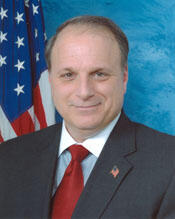
Here you will find contact information for Representative Eric J. J. Massa, including email address, phone number, and mailing address.
| Name | Eric J. J. Massa |
| Position | Representative |
| State | New York |
| District | 29 |
| Party | Democratic |
| Status | Former Representative |
| Term Start | January 6, 2009 |
| Term End | March 8, 2010 |
| Terms Served | 1 |
| Born | September 16, 1959 |
| Gender | Male |
| Bioguide ID | M001173 |
About Representative Eric J. J. Massa
Eric James Joseph Massa was born on September 16, 1959, in Charleston, South Carolina. The son of a career naval officer, he spent his childhood in a variety of locations, including Argentina and New Orleans, Louisiana, reflecting the itinerant life of a military family. This upbringing in diverse cultural and geographic settings preceded a career that would combine long military service with a brief, controversial tenure in the United States House of Representatives.
Massa attended the United States Naval Academy at Annapolis, Maryland, from which he graduated before entering active duty in the United States Navy. He served on active duty for 24 years, rising through the ranks and building a record that included service during the Persian Gulf War. During his naval career he also served as an aide to General Wesley Clark, then a senior officer in the U.S. Army. Near the end of his Navy service, Massa was diagnosed with non-Hodgkin’s lymphoma, a serious cancer from which he later recovered, though his health would remain an issue throughout his subsequent political career.
After retiring from the military, Massa moved in 2001 to Corning, New York, where he took a position with Corning Incorporated (Corning Glass Company). He lost that job due to corporate downsizing and, in 2003, moved to Washington, D.C., to work as a Republican staffer for the House Armed Services Committee. His tenure there ended when it became known that he had written to his former commander, Democrat Wesley Clark, offering advice on Clark’s presidential campaign. Following his dismissal, Massa formally joined the Democratic Party and became active in electoral politics, coordinating veterans’ outreach efforts in New Hampshire and Virginia during Clark’s unsuccessful 2004 presidential bid.
Massa first sought a seat in Congress in 2006, running as a Democrat in New York’s 29th congressional district on the strength of his military background and his advocacy on national security and veterans’ issues. On election night, incumbent Republican Representative Randy Kuhl led Massa by a margin of 52 percent to 48 percent. Because approximately 6,000 votes separated the candidates and some 10,000 absentee ballots remained uncounted, Massa requested a recount and a full accounting of the outstanding ballots. After about a week, the additional ballots did not significantly alter the margin, and Kuhl was re-elected. Massa conceded the race in a telephone call to Kuhl but almost immediately began preparing for a rematch in the 2008 election cycle.
In 2008, Massa again challenged Kuhl in a closely watched contest for the 29th district. The race remained tight throughout the campaign, but Massa emerged victorious, defeating Kuhl by a margin of 51 percent to 49 percent, or roughly 4,000 votes. Kuhl did not immediately concede, and all voting machines were impounded at his request pending a recount, with approximately 12,000 absentee ballots to be counted. The recount confirmed Massa’s lead at about 4,000 votes, and Kuhl conceded the race on November 21, 2008. Some press accounts attributed Massa’s victory in part to a plurality he achieved in Cattaraugus County, which had voted for Kuhl in 2004 and 2006.
Eric J. J. Massa served as a Representative from New York in the United States Congress from January 2009 until his resignation in March 2010, completing one term in office. A member of the Democratic Party, he represented New York’s 29th congressional district during a significant period in American political history, participating in the legislative process and representing the interests of his Southern Tier constituents. In the 111th Congress, Massa was assigned to the House Committee on Armed Services, where he served on the Subcommittee on Seapower and Expeditionary Forces and the Subcommittee on Air and Land Forces. He also inherited his predecessor’s seat on the House Committee on Agriculture, serving on the Subcommittee on Conservation, Credit, Energy, and Research and the Subcommittee on Horticulture and Organic Agriculture. In addition, he was appointed to the House Committee on Homeland Security, where he sat on the Subcommittee on Border, Maritime and Global Counterterrorism and the Subcommittee on Transportation Security and Infrastructure Protection.
In his legislative work, Massa generally supported the American Recovery and Reinvestment Act of 2009 and voted in favor of the measure, though he publicly expressed reservations about aspects of the legislation. After the act failed, in his view, to generate the anticipated economic stimulus in New York’s Southern Tier, he argued that virtually all of the stimulus funds had been funneled to state governments and diverted to interests in New York City. In April 2009, he drew attention for suggesting that the United States–Mexico border be closed temporarily in response to the 2009 swine flu pandemic, which originated in Mexico. He also became a prominent critic of Time Warner Cable’s proposed tiered pricing plan for high-speed Internet service, opposing what he characterized as an unfair burden on consumers. On health care, Massa generally supported the goal of reform but opposed the specific plans advanced by the Obama administration, citing cost concerns and expressing a preference for a single-payer health care system. At the 2009 Netroots Nation convention in Pittsburgh, he told activists that he would “vote adamantly against the interests of my district” if he believed his actions would be helpful in achieving single-payer health care, later clarifying that he meant he would vote against the prevailing opinions of his constituents if he believed it was the right course. In the same context, he controversially described Senator Chuck Grassley’s comments about end-of-life care as “killing Grandma” as constituting “an act of treason.”
Massa announced his intention to seek re-election on October 10, 2009, stating that he wished to be “very direct and candid” with voters about his plans. On March 3, 2010, however, he disclosed that his cancer had returned and announced that he would not seek another term. In that statement, he also addressed emerging allegations of sexual harassment but indicated that he intended to serve out the remainder of his term. On March 4, 2010, House Majority Leader Steny Hoyer confirmed that the House Ethics Committee was investigating allegations of sexual misconduct against Massa, stemming from a complaint filed on February 8, 2010, by a senior member of his staff. The investigation focused on alleged sexual advances and harassment directed toward a younger male staff member. At a press conference, Massa characterized his behavior and language as “salty,” said that he had apologized to those involved, and asserted that he did not know the specific allegations and had not based his retirement decision on them.
On March 5, 2010, Massa announced that he would resign his seat effective 5:00 p.m. on March 8, 2010. In a statement published on his congressional website, he cited his declining health and the ongoing ethics investigation as the reasons for his departure. He apologized in connection with the sexual harassment complaint, acknowledging that, after 24 years in the Navy, he had used language in private settings that “might make a Chief Petty Officer feel uncomfortable,” and stated that “this ethics issue is my fault and mine alone.” In subsequent public comments, Massa alleged that there was a conspiracy to remove him from Congress because he had voted against the administration’s health care overhaul. He directed particular criticism at White House Chief of Staff Rahm Emanuel, calling him “the son of the devil’s spawn” and asserting that Emanuel would “sell his mother to get a vote.” Massa recounted an alleged confrontation with Emanuel in the House gym locker room, claiming that Emanuel, unclothed, had poked him in the chest and berated him for not supporting the president’s budget. A Democratic spokesperson denied any conspiracy to oust Massa over his health care vote.
Following his resignation, additional details emerged about the allegations against Massa. On March 10, 2010, The Washington Post reported that he was under investigation for allegedly groping multiple male staffers in his office. In a televised interview with Fox News host Glenn Beck, Massa stated that “not only did I grope [a staffer], I tickled him until he couldn’t breathe,” but later the same day told CNN’s Larry King that “it is not true” that he had groped anyone on his staff. He told Beck that he resigned because he had become “too familiar” with his staff, while emphasizing to King that health concerns were the primary reason for his departure. Massa, who had survived non-Hodgkin’s lymphoma, said he feared he was facing his “third major cancer-recurrence scare.” He also acknowledged that, as a cost-saving measure, he had shared a Washington residence with several unmarried male staffers. Massa later said he had contemplated vehicular suicide at least twice while driving back to his home in Corning, New York, after his resignation. Subsequent campaign finance filings showed that his campaign committee continued to pay a salary to his wife and to cover legal fees related to disputes with former staffers well after he left office, with payments to his wife continuing through the end of 2012. In 2017, it was reported that Congress had paid nearly $100,000 to settle harassment claims brought by two male staffers against Massa, underscoring the lasting repercussions of the ethics investigation that had coincided with his brief tenure in the House of Representatives.