Representative Ernest Robinson Ackerman
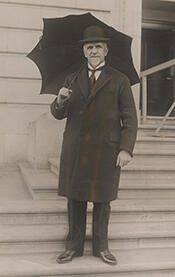
Here you will find contact information for Representative Ernest Robinson Ackerman, including email address, phone number, and mailing address.
| Name | Ernest Robinson Ackerman |
| Position | Representative |
| State | New Jersey |
| District | 5 |
| Party | Republican |
| Status | Former Representative |
| Term Start | May 19, 1919 |
| Term End | March 3, 1933 |
| Terms Served | 7 |
| Born | June 17, 1863 |
| Gender | Male |
| Bioguide ID | A000021 |
About Representative Ernest Robinson Ackerman
Ernest Robinson Ackerman (June 17, 1863 – October 18, 1931) was an American businessman, philatelist, and Republican Party politician who served in the New Jersey Senate from 1906 to 1912 and as a Representative from New Jersey in the United States Congress from 1919 to 1933. Over seven terms in the House of Representatives, he contributed to the legislative process during a significant period in American history, participating in the democratic process and representing the interests of his constituents in New Jersey’s 5th congressional district.
Ackerman was born in New York City on June 17, 1863, to J. Hervey Ackerman and Ellen (née Morgan) Ackerman. His family lineage included several ancestors who had participated in the American Revolution, a heritage that shaped his sense of public duty. When he was a child, he moved with his parents to Plainfield, New Jersey, where his father became a prominent local official, serving as president of the common council and as a city judge. Ackerman was educated in the Plainfield public schools and graduated from Plainfield High School in 1880. Immediately after graduation, he traveled to England with George E. Vincent, who would later become president of the University of Minnesota and of the Rockefeller Foundation, an early experience that broadened his international outlook.
Following his return from England, Ackerman entered the cement industry, beginning work at the Lawrence Cement Company, which later became the Lawrence Portland Cement Company. Over time he rose through the firm’s ranks and eventually became its president, establishing himself as a successful businessman. He also expanded his interests into finance and transportation, serving as a director of the Plainfield Trust Company and as a director of the Central Railroad Company of New Jersey. On February 11, 1892, he married Nora L. Weber, and in September 1907 the couple traveled together on the maiden voyage of the Cunard liner RMS Lusitania from Liverpool to New York, reflecting their social standing and his continuing interest in travel.
Ackerman’s public career began at the municipal level. He served on the Plainfield common council in 1891 and 1892, following in the civic footsteps of his father. In 1896 he was chosen as a presidential elector and cast his electoral vote for Republican nominees William McKinley and Garret Hobart, serving as secretary of the New Jersey delegation in January 1897. He became increasingly active in Republican politics, serving as a delegate to the Republican National Conventions of 1908 and 1916. At the 1908 convention he was designated as New Jersey’s representative on the committee that formally notified James S. Sherman of his nomination as vice president. Beyond partisan politics, he was appointed to the New Jersey State Board of Education after Joseph S. Frelinghuysen Sr. was elected to the United States Senate in 1916, and he served on that board until 1920, contributing to the oversight of public education in the state.
In 1905, Ackerman was elected to the New Jersey Senate from Union County and took office in 1906. He was re-elected in 1908, serving until 1912. During his tenure he became one of the body’s most influential members. He was the author and primary sponsor of New Jersey’s first civil service statute, widely known as the Ackerman Civil Service Law, which established merit-based standards for public employment. He also introduced and pressed for passage of the state’s first employers’ liability law, expanding protections for workers injured on the job. Ackerman helped form a special Senate committee on capital punishment with Senators Barton B. Hutchinson of Mercer County and Jacob C. Price of Sussex County, which studied practices in other states and abroad. By 1910 he chaired both the Senate Judiciary Committee and the Finance Committee, positions that placed him at the center of legislative decision-making. In 1911 he was elected president of the Senate and, in that capacity, served as acting governor of New Jersey during periods when Governor Woodrow Wilson was traveling in the West in advance of his presidential campaign. Ackerman did not seek re-election in 1911 and was succeeded in the Senate by Carlton Pierce. During the First World War, he continued his public service as the federal food administrator for Union County, chair of the War Savings Committee for Plainfield, and local chair of the YMCA War Work Council.
In 1918, Ackerman was elected as a Republican to the United States House of Representatives from New Jersey’s 5th congressional district, which then comprised Union County and Morris County. He took his seat in March 1919 and was re-elected to six additional terms, typically leading the Republican ticket in his district. His service in Congress extended from 1919 until his death in 1931, encompassing the post–World War I era, the early years of Prohibition, and the onset of the Great Depression. Known initially as a firm “dry,” he supported Prohibition and enforcement of the Volstead Act, but over time he modified his position to favor “reasonable” changes that would permit the sale of light wines and beer. He also supported the Smoot–Hawley Tariff Act, aligning with protectionist economic policies favored by many Republicans of his era. At the time of his death, he was a member of the powerful House Committee on Appropriations, which oversaw federal spending, and he also served on the Migratory Bird Commission, reflecting an interest in conservation policy. His long tenure in the House made him a familiar figure in Washington, where he was remembered for carrying a distinctive black umbrella that he had purchased in London in 1880. He began using it regularly around 1895 after contracting pneumonia in Trenton, and by the time of his death the umbrella had reportedly crossed the Atlantic more than 100 times and traveled some 740,000 miles. Obituaries in The Washington Post and The New York Times highlighted this unusual personal trademark, noting that, in accordance with his wishes, the umbrella was donated to the Plainfield Public Library.
Outside of politics and business, Ackerman was deeply involved in civic, professional, and educational organizations. He was a member of the New Jersey Geological Survey and an associate of the American Society of Civil Engineers, reflecting his interest in infrastructure and technical matters. He served on the board of trustees of Rutgers College in New Brunswick, contributing to the governance of one of the state’s leading institutions of higher education. In Plainfield he was a director of the local YMCA and a member of the Boy Scouts Council, and he was known as a generous benefactor of the YMCA, the Crescent Avenue Presbyterian Church, and Muhlenberg Hospital. In New York City he belonged to the Union League Club and India House, a private club for men engaged in international commerce, and he was active in the Chamber of Commerce and the Merchants Association, serving on its committee on commercial law and city traffic.
Ackerman achieved international recognition as a philatelist. He assembled renowned collections of the postage stamps and postal history of British Guiana and Spain, and he was widely regarded as an expert on the stamps and postal history of the United States. His American holdings included scarce carrier and local issues, departmental stamps, and essays and proofs. His philatelic pursuits took him as far as San Marino, where he discovered a letter from Abraham Lincoln to the captains regent of the principality, a notable find in both philatelic and historical terms. By the time of his death, his stamp collection was valued at more than $1 million, equivalent to roughly $17 million in modern terms. Portions of his United States collection were bequeathed to the Smithsonian Institution’s National Postal Museum in Washington, D.C., ensuring that his philatelic legacy would be preserved for public study and appreciation. In recognition of his contributions to the field, he was posthumously inducted into the American Philatelic Society Hall of Fame in 2000.
Ernest Robinson Ackerman died at his home in Plainfield, New Jersey, on October 18, 1931, after several days of illness from heart disease, while still serving in the United States House of Representatives. His death placed him among the members of Congress who died in office in the first half of the twentieth century. Funeral services were held at the Crescent Avenue Presbyterian Church in Plainfield, where he had long been an active member and benefactor. He was interred in the family plot at Hillside Cemetery in Scotch Plains, New Jersey, closing a life marked by business success, extensive civic engagement, and more than two decades of influential service in state and national government.