Senator Ernest William McFarland
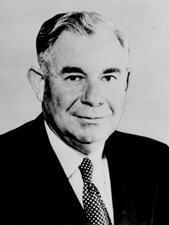
Here you will find contact information for Senator Ernest William McFarland, including email address, phone number, and mailing address.
| Name | Ernest William McFarland |
| Position | Senator |
| State | Arizona |
| Party | Democratic |
| Status | Former Representative |
| Term Start | January 3, 1941 |
| Term End | January 3, 1953 |
| Terms Served | 2 |
| Born | October 9, 1894 |
| Gender | Male |
| Bioguide ID | M000438 |
About Senator Ernest William McFarland
Ernest William McFarland (October 9, 1894 – June 8, 1984) was an American politician and jurist who served in all three branches of government, two at the state level and one at the federal level, and was, with Warren Atherton, one of the “Fathers of the G.I. Bill.” A member of the Democratic Party, he became a central figure in mid‑twentieth‑century Arizona and national politics, ultimately holding office as United States senator, governor of Arizona, and chief justice of the Arizona Supreme Court.
McFarland’s early life was shaped by the rural American West and the era surrounding the First World War, experiences that later informed his interest in veterans’ affairs and public service. His formative years and early professional development led him toward the study and practice of law, providing the legal foundation for his later judicial and legislative work. By the time he entered public life, he had established himself as a capable attorney and community leader, prepared to move into elective office.
McFarland’s rise in public affairs began in Arizona, where his legal training and growing reputation brought him into state and local government roles. His early career in law and public service positioned him for higher office and introduced him to the issues—particularly water, reclamation, and veterans’ benefits—that would define much of his later work. Through these experiences he developed a legislative and administrative skill set that would serve him in both the state and federal arenas.
Ernest William McFarland served as a senator from Arizona in the United States Congress from 1941 to 1953. Elected as a Democrat, he served two terms and contributed actively to the legislative process during a significant period in American history encompassing World War II and the early Cold War. As a member of the Senate, McFarland participated in the democratic process and represented the interests of his Arizona constituents while also playing a national role in shaping postwar policy. He was a Democratic U.S. senator from Arizona from 1941 to 1953 and served as Senate Majority Leader from 1951 to 1953. During his Senate tenure he became known, alongside Warren Atherton, as one of the “Fathers of the G.I. Bill,” helping to craft landmark legislation that expanded educational and economic opportunities for returning veterans.
After leaving the Senate in 1953, McFarland continued his public career at the state level. He was elected the tenth governor of Arizona in 1954 and re‑elected in 1956, serving from 1955 to 1959. As governor, he emphasized education, making it a central priority of his administration, and worked to strengthen Arizona’s public school system and higher education infrastructure. He also collaborated closely with the United States Bureau of Reclamation on major water and infrastructure projects, notably working with its officials to select a location for the Glen Canyon Dam on the Colorado River, a decision with long‑term implications for water management, power generation, and development in the Southwest.
Following his gubernatorial service, McFarland moved into the judicial branch of state government. His legal background and long experience in legislative and executive roles culminated in his service on the Arizona Supreme Court. He ultimately sat as chief justice of the Arizona Supreme Court in 1968, completing a rare trajectory of high office in all three branches of government. In this capacity he brought to the bench a deep understanding of both statutory law and the practical consequences of public policy, further solidifying his reputation as a versatile public servant.
In his later years, McFarland remained active in public and civic life beyond elective and judicial office. In his mid‑1970s, he served as director of the Federal Home Loan Bank of San Francisco, contributing to regional and national housing finance policy. At the same time, he was president of the Arizona Television Company, reflecting his interest in communications and the emerging influence of broadcast media in public affairs. Ernest William McFarland died in Phoenix, Arizona, on June 8, 1984, and is buried in that city’s Greenwood/Memory Lawn Mortuary & Cemetery, leaving behind a legacy of service that spanned the legislative, executive, and judicial branches of government.