Representative Eugene V. Atkinson
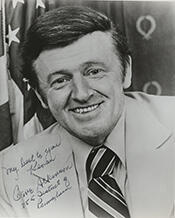
Here you will find contact information for Representative Eugene V. Atkinson, including email address, phone number, and mailing address.
| Name | Eugene V. Atkinson |
| Position | Representative |
| State | Pennsylvania |
| District | 25 |
| Party | Democratic |
| Status | Former Representative |
| Term Start | January 15, 1979 |
| Term End | January 3, 1983 |
| Terms Served | 2 |
| Born | April 5, 1927 |
| Gender | Male |
| Bioguide ID | A000329 |
About Representative Eugene V. Atkinson
Eugene Vincent Atkinson (April 5, 1927 – August 4, 2016) was an American politician who served two terms as a member of the U.S. House of Representatives from Pennsylvania from 1979 to 1983. A prominent figure in western Pennsylvania politics, he was associated during his congressional tenure with both major political parties, ultimately serving as a Republican member of Congress after beginning his federal legislative career as a Democrat.
Atkinson was born on April 5, 1927, in Aliquippa, a city in the Pittsburgh metropolitan area of western Pennsylvania. He was educated in local schools and went on to attend the University of Pittsburgh, from which he graduated. His early life and education in the industrial Pittsburgh region helped shape his understanding of the economic and social concerns of working-class communities, an understanding that would later inform his public service at the local and national levels.
Before entering national politics, Atkinson built a career in public administration and local government. From 1962 to 1969, he served as director of customs for the port of Pittsburgh, a position that placed him at the intersection of regional commerce, federal regulation, and international trade. He then advanced in local politics as a Beaver County commissioner, holding that office from 1972 to 1978. In this role, he gained experience in county governance, budgeting, and constituent service, establishing a political base in Beaver County and the surrounding area.
In 1978, Atkinson was elected to the U.S. House of Representatives from Pennsylvania as a member of the Democratic Party, beginning his first term on January 3, 1979. His service in Congress occurred during a significant period in American history, marked by economic challenges, shifting party coalitions, and intense debates over federal spending and social policy. As a member of the House of Representatives, Eugene Vincent Atkinson participated in the democratic process, contributed to the legislative work of the chamber, and represented the interests of his Pennsylvania constituents over the course of two terms in office, from 1979 to 1983.
Atkinson’s national political profile was shaped by his involvement in presidential politics and his evolving relationship with party leadership. He was an early supporter of Jimmy Carter in the 1976 presidential campaign, aligning himself with Carter’s reform-oriented image within the Democratic Party. By 1980, however, Atkinson endorsed Senator Edward “Ted” Kennedy for president, and at rallies for Kennedy he publicly praised Kennedy’s leadership, reflecting internal Democratic divisions during that election cycle. His later alignment with key elements of President Ronald Reagan’s economic agenda further underscored his ideological movement across the political spectrum.
A pivotal moment in Atkinson’s congressional career occurred in 1981. While he was appearing on a radio call-in show, President Ronald Reagan telephoned from his hospital bed in Washington, D.C., where he was recovering from a gunshot wound sustained in an assassination attempt. During that call, Reagan personally urged Atkinson to support his proposed budget cuts. Atkinson’s backing of Reagan’s budget and broader economic program strained his relations with many Democrats. On October 14, 1981, citing Democratic reaction to his support for Reagan’s agenda, Atkinson formally switched parties and joined the Republican Party. New York Republican Representative John LeBoutillier played a leading role in the congressional effort to persuade Atkinson to make the switch. Following this change of party affiliation, House Speaker Thomas P. “Tip” O’Neill predicted that Atkinson would be defeated in his next election, a prediction that proved accurate when Atkinson lost his 1982 re-election bid by a margin of 21 percentage points to Democratic challenger Joseph P. Kolter.
After leaving Congress in January 1983, Atkinson returned to private life, his congressional career having become a notable example of a mid-career party switch in the modern era. His name has been associated with broader historical discussions of American politicians who changed party affiliation while in office, reflecting the political and ideological realignments of the late twentieth century. Although he did not return to elective office at the federal level, his earlier service as director of customs, county commissioner, and U.S. Representative marked a long engagement with public affairs in Pennsylvania and the nation.
Eugene Vincent Atkinson died on August 4, 2016, at the age of 89. His death closed a career that spanned local, regional, and national public service, including two terms in the United States Congress during a period of significant political and economic change in the United States.