Representative Eugene Francis Loud
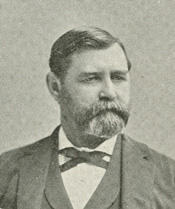
Here you will find contact information for Representative Eugene Francis Loud, including email address, phone number, and mailing address.
| Name | Eugene Francis Loud |
| Position | Representative |
| State | California |
| District | 5 |
| Party | Republican |
| Status | Former Representative |
| Term Start | December 7, 1891 |
| Term End | March 3, 1903 |
| Terms Served | 6 |
| Born | March 12, 1847 |
| Gender | Male |
| Bioguide ID | L000448 |
About Representative Eugene Francis Loud
Eugene Francis Loud (March 12, 1847 – December 19, 1908) was an American politician, lawyer, merchant, and Civil War veteran who represented California in the United States House of Representatives from 1891 to 1903. A member of the Republican Party, he served six consecutive terms in Congress during a significant period in American history, participating in the legislative process and representing the interests of his constituents in a rapidly developing Pacific Coast state.
Loud was born on March 12, 1847, in Abington, Massachusetts. As a young man he went to sea, an experience that preceded his eventual relocation to the West Coast. After his time at sea, he settled in California, which would become the center of his professional, political, and public life.
During the American Civil War, Loud enlisted in a California Cavalry Battalion in 1862. This battalion formed part of the Second Regiment, Massachusetts Volunteer Cavalry, in which he served as a Union soldier. His wartime service as a young man helped shape his public reputation and provided him with the credentials of a veteran at a time when Civil War service was an important element in American political life.
After the war, Loud returned to California, where he engaged in mining and worked as a clerk for fifteen years. During this period he studied law, preparing for a professional career while gaining practical experience in business and administration. He later served as a clerk in the customs service in San Francisco, further deepening his familiarity with commercial regulation and federal operations in a major Pacific port. He also worked as cashier of the city and county of San Francisco, a position that entrusted him with significant financial responsibilities and contributed to his standing in local affairs.
Loud entered elective office as a member of the California State Assembly, representing the 43rd district from 1885 to 1887. His service in the state legislature provided him with legislative experience and a platform for broader political ambitions. As a Republican, he aligned with the dominant political currents in California of the late nineteenth century, emphasizing economic development and closer integration of the Pacific Coast with national markets and institutions.
In 1890, Loud was elected as a Republican to the Fifty-second Congress and was subsequently reelected to the five succeeding Congresses, serving from March 4, 1891, to March 3, 1903. During his six terms in the U.S. House of Representatives, he played an active role in the legislative process and contributed to national policy debates at a time of American industrial expansion and overseas engagement. He served as chairman of the Committee on the Post Office and Post Roads during the Fifty-fourth through Fifty-seventh Congresses, overseeing legislation related to the postal service and transportation routes that were vital to communication and commerce, particularly for a distant state such as California.
Loud’s congressional career was marked by several notable votes that reflected his independent judgment. In April 1898, he was among the six representatives who voted against declaring war on Spain, placing him in a small minority at the outset of the Spanish–American War. Near the end of his tenure, in one of his last acts before leaving office, he voted against the Anarchist Exclusion Act of 1903, and was the only Republican to oppose the measure, indicating a willingness to break with his party on questions of civil liberties and immigration policy. He was an unsuccessful candidate for reelection in 1902 to the Fifty-eighth Congress, bringing his twelve-year congressional career to a close on March 3, 1903.
Eugene Francis Loud died in San Francisco, California, on December 19, 1908. His remains were cremated, and his ashes were originally interred in the Odd Fellows Cemetery, a burial ground that no longer exists. He was later reinterred at Greenlawn Memorial Park in Colma, California, ensuring a permanent resting place in the San Francisco Bay Area, the region in which he had built his career and to which he had devoted his public service.