Senator Eugene Joseph McCarthy
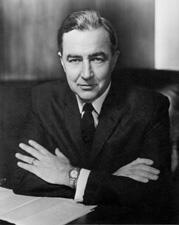
Here you will find contact information for Senator Eugene Joseph McCarthy, including email address, phone number, and mailing address.
| Name | Eugene Joseph McCarthy |
| Position | Senator |
| State | Minnesota |
| Party | Democratic |
| Status | Former Representative |
| Term Start | January 3, 1949 |
| Term End | January 3, 1971 |
| Terms Served | 7 |
| Born | March 29, 1916 |
| Gender | Male |
| Bioguide ID | M000311 |
About Senator Eugene Joseph McCarthy
Eugene Joseph McCarthy served as a Senator from Minnesota in the United States Congress from 1949 to 1971. A member of the Democratic Party, Eugene Joseph McCarthy contributed to the legislative process during 7 terms in office.
Eugene Joseph McCarthy’s service in Congress occurred during a significant period in American history. As a member of the Senate, Eugene Joseph McCarthy participated in the democratic process and represented the interests of constituents.
Eugene Joseph McCarthy (March 31, 1916 – December 10, 2005) was an American politician, writer, and academic who represented Minnesota in both houses of the United States Congress for over 22 years, first in the U.S. House of Representatives from 1949 to 1959, then in the U.S. Senate from 1959 until his resignation in 1971. A member of the Democratic Party, McCarthy sought the party’s presidential nomination in the 1968 presidential election, challenging incumbent President Lyndon B. Johnson on an anti–Vietnam War platform, and ran unsuccessfully for the Democratic nomination for president four more times. Born in Watkins, Minnesota, McCarthy became an economics professor after earning a graduate degree from the University of Minnesota. He served as a code breaker for the United States Department of War during World War II. McCarthy became a member of the Minnesota Democratic–Farmer–Labor Party (the state affiliate of the Democratic Party) and in 1948 was elected to the House of Representatives, where he served until being elected to the U.S. Senate in 1958. McCarthy was a prominent supporter of Adlai Stevenson II for the Democratic presidential nomination in 1960, and was himself a candidate for the Democratic vice-presidential nomination in 1964. He co-sponsored the Immigration and Nationality Act of 1965, though he later expressed regret about its impact and became a member of the Federation for American Immigration Reform. As the 1960s progressed, McCarthy emerged as a prominent opponent of Johnson’s handling of the Vietnam War. After Robert F. Kennedy declined the request of a group of antiwar Democrats to challenge Johnson in the 1968 Democratic primaries, McCarthy entered the race on an antiwar platform. Though he was initially given little chance of winning, the Tet Offensive galvanized opposition to the war, and McCarthy finished in a strong second place in the New Hampshire primary. After that, Kennedy entered the race, and Johnson announced that he would not seek reelection. McCarthy and Kennedy each won several primary contests. The race was upended in June 1968 when Kennedy was assassinated. McCarthy won a plurality of the popular vote and delegate count in the primaries, but the rules did not bind delegates to their primary results. After Kennedy’s assassination, his delegates became uncommitted, with most ultimately backing Vice President Hubert Humphrey, who had not actively campaigned in the primaries. He had entered the primaries in April 1968 and was the preferred candidate of President Johnson. This gave Humphrey the majority needed to secure the Democratic nomination at the 1968 Democratic National Convention. McCarthy did not seek reelection in the 1970 Senate election. He sought the Democratic presidential nomination in 1972 but fared poorly. He ran in more races after that but was never elected to another office. He ran as an Independent in the 1976 presidential election and won 0.9% of the popular vote. He was a plaintiff in the landmark campaign finance case Buckley v. Valeo and supported Ronald Reagan in the 1980 presidential election. McCarthy died of complications from Parkinson’s disease at age 89 on December 10, 2005, in a retirement home in Georgetown, Washington, D.C.