Representative Eustace Gibson
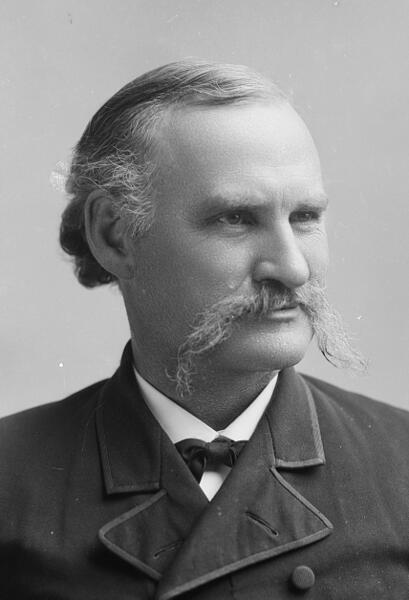
Here you will find contact information for Representative Eustace Gibson, including email address, phone number, and mailing address.
| Name | Eustace Gibson |
| Position | Representative |
| State | West Virginia |
| District | 4 |
| Party | Democratic |
| Status | Former Representative |
| Term Start | December 3, 1883 |
| Term End | March 3, 1887 |
| Terms Served | 2 |
| Born | October 4, 1842 |
| Gender | Male |
| Bioguide ID | G000160 |
About Representative Eustace Gibson
Eustace Gibson (October 4, 1842 – December 10, 1900) was a Democratic politician and lawyer who served as a Representative from West Virginia in the United States Congress from 1883 to 1887. Over the course of his career he was active in public life in both Virginia and West Virginia, serving in the Confederate Army, participating in the Virginia Constitutional Convention of 1868, holding legislative office and the speakership in the West Virginia House of Delegates, and ultimately representing West Virginia’s now-defunct Fourth Congressional District in the U.S. House of Representatives.
Gibson was born in Culpeper County, Virginia, on October 4, 1842, to Jonathan C. Gibson, Sr., a lawyer, and his second wife, Mary Shackleford. He and his brothers received a private education, reflecting the professional standing of their family in the region. His father died in 1849, when Eustace was still a boy, but Gibson continued his studies and turned to the law, following the family profession. He read law, was admitted to the bar, and opened his own law practice in 1861, just as the sectional crisis was culminating in civil war.
With the outbreak of the American Civil War, Gibson entered the Confederate States Army in June 1861 as first lieutenant of the Sperryville Rifles. He served under his brother, Jonathan C. Gibson, who would rise to the rank of colonel of the 49th Virginia Infantry. Demonstrating ability and leadership, Eustace Gibson was promoted to captain in 1863. His active military service ended after he sustained a severe abdominal wound at the Battle of Gettysburg, which forced his retirement from the army. The experience of war and its aftermath would shape his subsequent legal and political career in the Reconstruction era.
After the war, Gibson resumed the practice of law and chose to establish himself in the mountains of southwest Virginia rather than in the north-central Piedmont region where his father had practiced and where his brother J. C. Gibson continued to practice. His legal and political abilities were soon recognized by local voters. Residents of Pulaski and Giles Counties elected him to represent them at the Virginia Constitutional Convention of 1868, convened as part of the Reconstruction process to frame a new state constitution. At the same convention, voters from his native Culpeper County elected his brother J. C. Gibson as one of their representatives, underscoring the family’s continued prominence in Virginia public affairs.
In 1871, Gibson moved across the newly drawn state line to Huntington, West Virginia, where he continued his legal practice and entered the political life of the new state. A member of the Democratic Party, he gained the confidence of his constituents and was elected to the West Virginia House of Delegates in 1876. He was re-elected in 1878, and in 1877 his fellow delegates chose him as Speaker of the House of Delegates, placing him in a key leadership role in the state legislature. In these positions he participated actively in the legislative process and helped shape the early political development of West Virginia.
Gibson’s state-level prominence led to his election to the United States House of Representatives. In 1882, voters of West Virginia’s Fourth Congressional District elected him as a Democrat to the Forty-eighth Congress. In that campaign he defeated local Judge Robert S. Brown, who ran in part on a temperance platform. Gibson was re-elected in 1884 to the Forty-ninth Congress, and he served two consecutive terms from March 4, 1883, to March 3, 1887. His service in Congress occurred during a significant period in American history, marked by post-Reconstruction adjustments, industrial expansion, and debates over federal economic and social policy. As a member of the House of Representatives, he participated in the democratic process, represented the interests of his West Virginia constituents, and contributed to the legislative work of the chamber. During the Forty-ninth Congress he served as chairman of the Committee on Expenditures in the Department of Justice, overseeing aspects of federal administrative and fiscal accountability in that department.
Gibson sought to continue his congressional career but faced setbacks within his party. His candidacy for renomination in 1886 was unsuccessful, as was a subsequent effort to secure the Democratic nomination in 1888. After leaving Congress at the conclusion of his second term in March 1887, he returned to the practice of law, remaining active in his profession and in Democratic Party circles. He continued to be identified with the legal and political communities of both Virginia and West Virginia during his later years.
Eustace Gibson died in Clifton Forge, Virginia, on December 10, 1900. His career spanned the antebellum, Civil War, Reconstruction, and Gilded Age eras, and included service as a Confederate officer, constitutional convention delegate, state legislator and speaker, and member of the United States House of Representatives from West Virginia.