Representative Eva M. Clayton
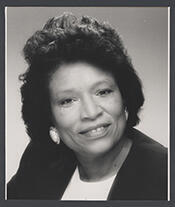
Here you will find contact information for Representative Eva M. Clayton, including email address, phone number, and mailing address.
| Name | Eva M. Clayton |
| Position | Representative |
| State | North Carolina |
| District | 1 |
| Party | Democratic |
| Status | Former Representative |
| Term Start | January 3, 1991 |
| Term End | January 3, 2003 |
| Terms Served | 6 |
| Born | September 16, 1934 |
| Gender | Female |
| Bioguide ID | C000494 |
About Representative Eva M. Clayton
Eva McPherson Clayton (née McPherson; born September 16, 1934) is an American politician from North Carolina who served as a Representative from North Carolina in the United States Congress from 1992 to 2003. A member of the Democratic Party, she became the first African American to represent North Carolina in the United States House of Representatives since George Henry White was elected to his second and last term in 1898, and she contributed to the legislative process during six terms in office. On taking her seat in the House following a special election in 1992, she also became one of the first two African Americans elected to Congress from North Carolina in the modern era, alongside Mel Watt.
Clayton was born Eva McPherson in Savannah, Georgia, to Thomas McPherson, an insurance agent, and Josephine Martin, a teacher. She spent her early years in the segregated South, an experience that would later inform her commitment to civil rights, economic opportunity, and rural development. Seeking higher education at a historically Black institution, she enrolled at Johnson C. Smith University in Charlotte, North Carolina, where she earned a Bachelor of Science degree in biology in 1955. Her undergraduate years helped lay the foundation for her later interest in public health, nutrition, and agriculture policy, which would become central themes of her congressional career.
In 1956, she married Theaoseus T. Clayton, also a graduate of Johnson C. Smith University. Following their marriage, both Eva and Theaoseus pursued graduate studies at North Carolina Central University in Durham, North Carolina. She completed a Master of Science degree there in 1962. The couple later moved to Warrenton, North Carolina, where Theaoseus established himself as a lawyer. During this period, Eva Clayton also attended law school at the University of North Carolina at Chapel Hill, further strengthening her grounding in legal and public policy issues and preparing her for a life in public service.
Clayton’s political engagement began in the context of the civil rights movement and efforts to expand Black political participation in the South. In 1968, civil rights activist Vernon Jordan, working to increase Black political engagement, met with Theaoseus Clayton to recruit a Black candidate for public office in eastern North Carolina. After discussions, they concluded that Eva Clayton was the best choice. Later that year, she mounted an unsuccessful challenge to incumbent Lawrence H. Fountain for the Democratic nomination in North Carolina’s 2nd congressional district, seeking his seat in the U.S. House of Representatives. Although she did not win, the campaign marked her emergence as a serious political figure in the region. In the 1970s, she worked on the Soul City community development project in Warren County, North Carolina, an ambitious, federally supported effort to build a new, majority-Black town focused on economic development, jobs, and racial equality. In 1977, she was appointed Assistant Secretary for Community Development for the North Carolina State Department of Natural Resources and Community Development, serving from 1977 to 1981 and gaining extensive experience in housing, infrastructure, and community planning.
From 1982 to 1992, Clayton served as an elected member and chair of the Warren County Board of Commissioners, becoming a prominent local leader and helping to guide county policy on economic development, health, and public services. Her decade on the board coincided with growing national attention to environmental justice and rural poverty, issues that were particularly acute in Warren County and that would later shape her priorities in Congress. When Representative Walter B. Jones Sr. announced his retirement from North Carolina’s 1st congressional district in 1992, Clayton entered the Democratic primary to fill his seat. The district, recently reapportioned by the state legislature, was one of two in North Carolina with a Black majority, drawn in the early 1990s to comply with the Voting Rights Act of 1965 and to give African American voters a realistic opportunity to elect candidates of their choice. In 1992, Clayton was elected from the 1st congressional district as a Democrat and, at the same time, won a special election to complete the remaining months of Jones’s term. Because she took office following the special election, she entered Congress before Mel Watt, making her the first African American to serve North Carolina in the House since 1898.
Clayton’s service in Congress occurred during a significant period in American history, encompassing the final years of the Cold War era, the Clinton administration, and the early years of the George W. Bush administration. She quickly gained national attention as president of her Democratic freshman class in Congress. During her ten years of distinguished service as a United States Congresswoman, she served on the House Agriculture Committee and as the ranking member of the United States Department of Agriculture’s Operations Oversight, Nutrition, and Forestry Subcommittees. She also served on the House Budget and Small Business Committees. Clayton was actively engaged in the legislative development of the Department of Agriculture’s operating policy and became a leading advocate for rural communities, small farmers, and nutrition programs. She was a conferee on the 2002 Farm Bill and is recognized by national organizations, including National Journal publications, for providing essential leadership in garnering support for nutritional programs, civil rights protections, and support for African American farmers in the final version of the Farm Bill. She provided additional leadership by serving as the bipartisan co-chair of the Rural Caucus and as the chair of the Congressional Black Caucus Foundation, helping to shape policy discussions on poverty, health, and education within the African American community and across rural America.
Clayton also played a visible role in one of the most contested presidential elections in modern U.S. history. Following the 2000 presidential election, she and other members of the House of Representatives objected to counting the 25 electoral votes from Florida, which George W. Bush narrowly won after a contentious recount. Their objection was based on concerns about voting irregularities and disenfranchisement. Because no senator joined the objection, it was dismissed by Vice President Al Gore, who was himself Bush’s opponent in the 2000 election. Had Florida’s electoral votes been rejected, the election would have been decided by the U.S. House of Representatives, with each state delegation casting one vote under the procedures of the Twelfth Amendment to the United States Constitution. Clayton continued to serve until January 2003, completing six terms in office and leaving a legacy of advocacy for rural development, food security, and civil rights.
In 2003, after concluding her congressional service, Clayton was appointed Assistant Director-General of the Food and Agriculture Organization (FAO) of the United Nations in Rome, Italy, and Special Adviser to the Director-General on World Food Summit Follow-up. She served in that capacity for three years, during which she was responsible for encouraging the establishment of global alliances and partnerships to fight hunger and poverty in twenty-four countries, including the United States, Brazil, Ghana, and Jordan. Her work at FAO extended her long-standing commitment to combating hunger and promoting sustainable agriculture from the domestic to the international arena. Clayton remains a strong advocate for the hungry and the poor and has continuously promoted sustainable agriculture and equality in the United States and around the world.
Following her service at the United Nations, Clayton became a consultant and founded Eva Clayton Associates International (ECAI), which describes itself as “a multidisciplined consulting firm actively engaged in several governmental practice areas.” Through this firm and her extensive board service, she has remained active in public policy, particularly in the areas of hunger, agriculture, and rural development. She serves on several boards that address hunger, agriculture, and state policy issues, including the United States Alliance to End Hunger, the Global Food Banking Network, and the Center for Environmental Farming Systems. Clayton is the recipient of eight honorary doctorate degrees in recognition of her public service and leadership. She is an active member of Alpha Kappa Alpha sorority and an Elder at Cotton Memorial Presbyterian Church in Henderson, North Carolina, reflecting her ongoing engagement in civic, educational, and religious life.
In her personal life, Clayton shared a long marriage and professional partnership with her husband, Theaoseus T. Clayton Sr., Esq., who died in 2019 at age 88. Together they raised four children and have six grandchildren. In recognition of her decades of service to North Carolina and the nation, in November 2022 North Carolina Governor Roy Cooper awarded her the 2022 North Carolina Award, the state’s highest civilian honor. Clayton’s career, spanning local government, Congress, and international service, has made her a trailblazer in African American political representation and a leading voice on issues of agriculture, nutrition, and rural equity.