Representative Everett Glen Burkhalter
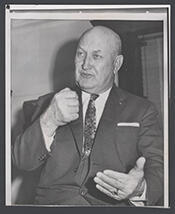
Here you will find contact information for Representative Everett Glen Burkhalter, including email address, phone number, and mailing address.
| Name | Everett Glen Burkhalter |
| Position | Representative |
| State | California |
| District | 27 |
| Party | Democratic |
| Status | Former Representative |
| Term Start | January 9, 1963 |
| Term End | January 3, 1965 |
| Terms Served | 1 |
| Gender | Male |
| Bioguide ID | B001104 |
About Representative Everett Glen Burkhalter
Everett Glen Burkhalter (January 19, 1897 – May 24, 1975) was an American politician and member of the Democratic Party who served in the California State Assembly, on the Los Angeles City Council, and as a Representative from California in the United States Congress from 1963 to 1965. Over the middle decades of the twentieth century he played a visible role in both state and municipal government in California before serving a single term in the U.S. House of Representatives during a significant period in American political history.
Burkhalter was born in Heber Springs, Arkansas, on January 19, 1897. During his youth he attended schools in several states, including Arkansas, Indiana, Colorado, and California, reflecting his family’s movement across different regions of the country. In 1918, during the final year of World War I, he enlisted in the United States Navy. He was honorably discharged in 1919 and remained in the active reserve until 1921, gaining early experience in public service and national defense that preceded his later political career.
After his naval service, Burkhalter eventually settled in Southern California. He moved to Los Angeles around 1928 and married his wife, Velma, around 1929. The couple established their home at 11005 Morrison Street in North Hollywood, where they lived for many years. Before and during his political career, which often included periods out of public office, Burkhalter worked as a film studio electrician, connecting him to the region’s growing motion picture industry and providing a practical livelihood alongside his electoral pursuits.
Burkhalter’s first bid for elective office came in 1939, when he ran for the Los Angeles City Council from District 1 and finished third in a field of four candidates for the seat then held by Jim Wilson. He achieved his first major legislative office two years later at the state level. A Democrat, he was elected to the California State Assembly from the 42nd District and served from 1941 to 1947. After three terms in the Assembly, he declined to run for a fourth in 1946 and instead sought a seat in the U.S. House of Representatives from California’s 20th Congressional District, but he was defeated by the Republican incumbent, Carl Hinshaw. Undeterred, Burkhalter returned to state politics and in 1948 successfully ran again for his old Assembly seat, resuming service in the legislature. He was reelected to another Assembly term in 1950. In 1952 he made a second attempt at Congress, this time in the newly created 21st District, but lost to Republican Edgar W. Hiestand.
Following his second congressional defeat, Burkhalter turned again to municipal government. In 1953 he was elected to the Los Angeles City Council from District 1 on his second attempt, succeeding Councilman Leland S. Warburton. He was reelected to four-year terms in 1957 and 1961, serving nearly a decade on the Council. During his tenure he supported the plan to bring the Brooklyn Dodgers to Los Angeles and the construction of Dodger Stadium in Chavez Ravine, and he voted in favor of the redevelopment of Bunker Hill, a major urban renewal project in downtown Los Angeles. He took positions on a wide range of local issues: in 1958 he voted to establish a Fair Employment Practices Commission in Los Angeles, a proposal that failed on a 7–7 tie vote; that same year he opposed the introduction of pay television in the city. In 1959 he publicly challenged Kaiser Steel officials in Fontana over air pollution, accusing the company of releasing a “stream of smoke” into the Los Angeles area that could be observed from the top of City Hall on some days. In 1961 he introduced a resolution urging that a congressional committee study the growing practice of producing American motion pictures overseas, citing reports that a majority of U.S. films might soon be made in Europe and expressing concern that Communists were being hired abroad to do work formerly done in Los Angeles; at the suggestion of Councilman Ernani Bernardi, the resolution was amended to include the music industry and was adopted. In 1962 he drew attention for announcing that he would start a fund to send to Russia any protesters picketing a House Committee on Un-American Activities meeting in Los Angeles, “if they desired to go.” That same year he vigorously but unsuccessfully fought to relocate the Los Angeles Zoo from Griffith Park to Roger Jessup Park in Pacoima, a move recommended by architect Charles Luckman.
Burkhalter’s long-sought election to Congress came in 1962. Making his third bid for a U.S. House seat—and his second contest against Edgar W. Hiestand, an ultraconservative Republican and member of the John Birch Society—he ran in the newly drawn 27th Congressional District. In the general election he defeated Hiestand by a margin of 52 percent to 48 percent. As a member of the House of Representatives from California, he served one term in the Eighty-eighth Congress, from January 3, 1963, to January 3, 1965, representing the interests of his constituents during a period marked by major national debates over civil rights, foreign policy, and domestic reform. His service in Congress occurred during a significant period in American history, and he participated in the legislative process as part of the Democratic majority. However, having previously served in the California State Assembly, he reportedly found the federal lawmaking process less efficient and more cumbersome than that of the state legislature. Disillusioned with what he viewed as the ways of the House, he declined to seek reelection in 1964 and thus concluded his congressional career after a single term.
In his later years, Burkhalter lived in Southern California, remaining part of the region whose development he had helped shape through his service in the State Assembly, on the Los Angeles City Council, and in Congress. He died at the age of 78 on May 24, 1975, in Duarte, California. Interment took place at Forest Lawn Memorial Park–Hollywood Hills. He was survived by his wife of 46 years, Velma, and by two brothers, William of Woodland Hills and Lawrence of Los Angeles.