Representative Ewin Lamar Davis
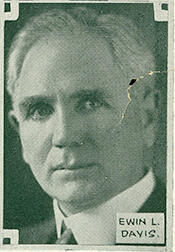
Here you will find contact information for Representative Ewin Lamar Davis, including email address, phone number, and mailing address.
| Name | Ewin Lamar Davis |
| Position | Representative |
| State | Tennessee |
| District | 5 |
| Party | Democratic |
| Status | Former Representative |
| Term Start | May 19, 1919 |
| Term End | March 3, 1933 |
| Terms Served | 7 |
| Born | February 5, 1876 |
| Gender | Male |
| Bioguide ID | D000098 |
About Representative Ewin Lamar Davis
Ewin Lamar Davis (February 5, 1876 – October 23, 1949) was an American politician, jurist, and federal regulator who represented Tennessee’s 5th congressional district in the United States House of Representatives from 1919 to 1933. A member of the Democratic Party, he served seven consecutive terms in Congress during a significant period in American history, contributing to the legislative process and representing the interests of his constituents.
Davis was born in Bedford County, Tennessee, the son of McLin H. Davis and Christina Lee (Shoffner) Davis, and was the brother of Norman Hezekiah Davis, who later became a prominent diplomat and government official. He was educated in the public schools of Tennessee and attended The Webb School in Bell Buckle and the Woolwine School in Tullahoma. From 1895 to 1897 he studied at Vanderbilt University in Nashville, Tennessee. On December 28, 1898, he married Carolyn Windsor; the couple had five children: Windsor, Margaret, Ewin, Latham, and Carolyn.
Pursuing a legal career, Davis enrolled at Columbian University, now the George Washington University Law School, in Washington, D.C., and graduated in 1899. He was admitted to the bar that same year and commenced the practice of law in Tullahoma, Tennessee. Alongside his legal practice, he became active in Democratic Party politics, serving as a delegate to all Tennessee state Democratic conventions from 1900 to 1910. His engagement in civic and educational affairs included service as a director of the Traders National Bank of Tullahoma from 1903 to 1940 and as a trustee of the Tennessee College for Women from 1906 to 1939.
Davis’s judicial career began in 1910, when he was appointed judge of the Seventh Judicial Circuit of Tennessee, a position he held until 1918. During World War I, he also served the federal government as chairman of the district exemption board for the middle district of Tennessee in 1917 and 1918, overseeing matters related to military conscription. These roles enhanced his reputation as a capable jurist and administrator and helped pave the way for his entry into national legislative service.
In 1918, Davis was elected as a Democrat to the Sixty-sixth Congress from Tennessee’s 5th congressional district and was subsequently reelected to the six succeeding Congresses, serving from March 4, 1919, until March 3, 1933. His seven terms in the House of Representatives coincided with the post–World War I era, the Roaring Twenties, and the onset of the Great Depression. During the Seventy-second Congress he served as chairman of the United States House Committee on Merchant Marine and Fisheries, where he played a role in shaping policy affecting maritime commerce and transportation. He was an unsuccessful candidate for renomination in 1932, bringing his congressional career to a close at the end of his seventh term.
Among Davis’s notable legislative contributions was the so‑called “Davis Amendment” to the Radio Act of 1927. Incorporated into the 1928 reauthorization of the act, this provision required that each region of the country receive equal allocations of radio licenses, station power, and related facilities. Intended to ensure geographic equity, the amendment significantly complicated the work of the Federal Radio Commission, which was obliged to deny applications from otherwise qualified broadcasters if approval would have placed a particular state or region over its quota. The measure limited the growth of stations in more populous areas such as the Northeast, while also preventing some sparsely populated communities in the Southwest from adding local stations even where interference would have been minimal. The Davis Amendment remained in force until it was repealed on June 5, 1936.
After leaving Congress, Davis continued his public service at the federal level. He was appointed a member of the Federal Trade Commission on May 23, 1933, and served on the Commission until his death in 1949. During his long tenure he was chosen chairman of the FTC in 1935, 1940, and 1945, guiding the agency through the New Deal era, World War II, and the immediate postwar period as it addressed issues of competition, trade practices, and consumer protection. In 1936, he also served as a member of the American National Committee of the Third World Power Conference, reflecting his involvement in broader national and international economic and industrial questions.
Ewin Lamar Davis died in Washington, D.C., on October 23, 1949, at the age of 73 years, 260 days. He was interred in Oakwood Cemetery in Tullahoma, Tennessee, returning in death to the community where he had begun his legal and civic career.