Representative Ezekiel Silas Sampson
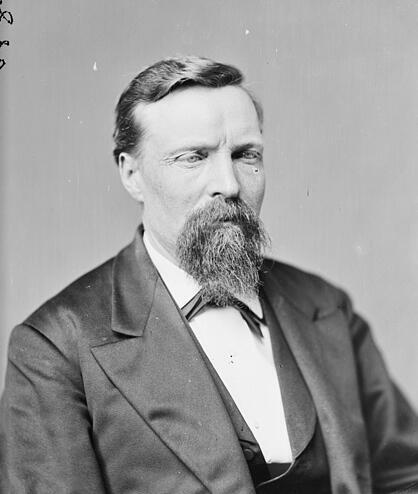
Here you will find contact information for Representative Ezekiel Silas Sampson, including email address, phone number, and mailing address.
| Name | Ezekiel Silas Sampson |
| Position | Representative |
| State | Iowa |
| District | 6 |
| Party | Republican |
| Status | Former Representative |
| Term Start | December 6, 1875 |
| Term End | March 3, 1879 |
| Terms Served | 2 |
| Born | December 6, 1831 |
| Gender | Male |
| Bioguide ID | S000025 |
About Representative Ezekiel Silas Sampson
Ezekiel Silas Sampson (December 6, 1831 – October 7, 1892) was a lawyer, prosecutor, Civil War officer, judge, and two-term Republican Congressman from Iowa’s 6th congressional district. He was born in Huron County, Ohio, on December 6, 1831. In 1843 he moved with his family to Keokuk County, Iowa, which at that time was part of the developing American frontier. There he attended the local public schools, receiving his early education in the emerging school system of the young state.
As a young man, Sampson pursued further education at Howe’s Academy and later at Knox College, institutions that helped prepare him for a professional career in the law. After his academic studies, he read law and was admitted to the bar in 1856. That same year he commenced the practice of law in Sigourney, Iowa, the county seat of Keokuk County. Almost immediately he entered public service in the legal field, serving as prosecuting attorney of Keokuk County from 1856 to 1858, a role in which he gained experience in criminal law and local governance.
With the outbreak of the American Civil War in 1861, Sampson joined the Union cause. He enlisted in the Union Army as a captain in the 5th Iowa Volunteer Infantry Regiment. Over the course of his service he rose in rank, being promoted to lieutenant colonel of the same regiment. He served in that capacity until he was mustered out of service in 1864. His wartime experience as an officer contributed to his public standing in Iowa and shaped his subsequent career in law and politics.
After leaving military service, Sampson returned to Sigourney and resumed the practice of law. His legal and military credentials facilitated his entry into state politics. In 1866 he was elected a member of the Iowa Senate, where he participated in post–Civil War legislative affairs during the early Reconstruction era. The following year, in 1867, he was appointed or elected judge of the sixth judicial district of Iowa. He held that judgeship from 1867 to 1875, presiding over a wide range of civil and criminal matters during a period of significant growth and change in the state.
In 1874, Sampson was elected as a Republican to the United States House of Representatives to represent Iowa’s 6th congressional district. He entered Congress at the beginning of the Forty-fourth Congress, and his service in the House of Representatives extended from March 4, 1875, to March 3, 1879. Near the end of his first term, he was re-elected in 1876 to a second term, serving in the Forty-fifth Congress. As a member of the Republican Party during a significant period in American history, he contributed to the legislative process during two terms in office, participating in the democratic process and representing the interests of his Iowa constituents in the national legislature.
Sampson sought a third consecutive term in the House in 1878. In that election he was defeated in the general contest by Greenback Party candidate James B. Weaver, who later became a notable third-party presidential candidate. Following his departure from Congress in March 1879, Sampson returned once again to Sigourney and resumed the practice of law, remaining active in his profession and community.
Ezekiel Silas Sampson continued his legal work in Sigourney until his death there on October 7, 1892. He was interred at West Cemetery in Sigourney, Iowa. His career encompassed service as a county prosecutor, Civil War officer, state senator, district judge, and United States Representative, reflecting a lifetime of public service at the local, state, and national levels.