Representative Ezra Booth Taylor
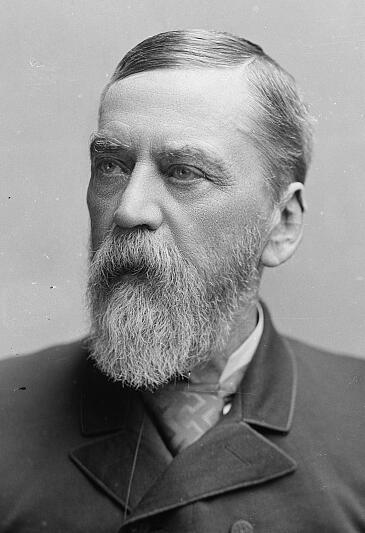
Here you will find contact information for Representative Ezra Booth Taylor, including email address, phone number, and mailing address.
| Name | Ezra Booth Taylor |
| Position | Representative |
| State | Ohio |
| District | 19 |
| Party | Republican |
| Status | Former Representative |
| Term Start | March 18, 1879 |
| Term End | March 3, 1893 |
| Terms Served | 7 |
| Born | July 9, 1823 |
| Gender | Male |
| Bioguide ID | T000073 |
About Representative Ezra Booth Taylor
Ezra Booth Taylor (July 9, 1823 – January 29, 1912) was an American lawyer, jurist, and Republican politician who served as a U.S. Representative from Ohio from 1879 to 1893, with his formal congressional service recorded from December 13, 1880, to March 3, 1893. He won election to the congressional seat vacated by James A. Garfield after Garfield was elected president, and over seven terms in office he contributed to the legislative process during a significant period in American history, representing the interests of his Ohio constituents in the House of Representatives.
Taylor was born on July 9, 1823, in Nelson Township, Portage County, Ohio. He attended the common and select schools and local academies, receiving the type of mixed formal and practical education typical of aspiring professionals in the mid-nineteenth century. He studied law in Ohio and was admitted to the bar in 1845. Shortly thereafter, he commenced the practice of law in Portage County, building a legal career that would form the foundation for his later service as a prosecutor, judge, and member of Congress.
In 1849, Taylor married Harriet M. Frazier in Ravenna, Ohio. The couple had a son and a daughter. Their daughter, Harriet Taylor Upton, later became a prominent suffragist and author, playing a notable role in the women’s suffrage movement in the United States. Harriet M. Frazier Taylor died in 1876, several years before her husband entered Congress, but during a period when his legal and judicial career was firmly established in northeastern Ohio.
Taylor’s early public career developed alongside his legal practice. In 1854 he was elected prosecuting attorney in Portage County, an office that placed him at the center of local law enforcement and judicial proceedings. In 1861 he moved to Warren, Ohio, a growing community in Trumbull County that would remain his home for the rest of his life. His relocation coincided with the opening of the Civil War, and he continued his legal work there while also preparing for military service.
During the American Civil War, Taylor enlisted in the Union Army. He enrolled as a private in Company A of the 171st Ohio Infantry on April 27, 1864. He was mustered into service on May 5, 1864, and served with this short-term regiment during a critical phase of the war. His military service concluded with an honorable discharge on August 20, 1864. After his return to civilian life, he resumed his legal practice and continued to expand his role in public affairs in Ohio.
Taylor’s judicial career began in earnest in the 1870s. He was elected judge of the court of common pleas for the ninth judicial district of Ohio and served from March 1877 until September 1880. In this capacity he presided over a wide range of civil and criminal matters, gaining a reputation for legal competence and integrity. He resigned from the bench in September 1880 when he was elected to Congress, marking his transition from the state judiciary to the national legislature.
As a member of the Republican Party, Taylor entered national politics at a moment of transition following the election of James A. Garfield to the presidency. He was elected as a Republican to the Forty-sixth Congress to fill the vacancy caused by Garfield’s resignation from the House and was subsequently re-elected to the Forty-seventh and the five succeeding Congresses. His service in the U.S. House of Representatives extended from December 13, 1880, to March 3, 1893, encompassing seven consecutive terms. During this period he participated actively in the legislative process at a time of industrial expansion, labor unrest, and evolving national policy.
In Congress, Taylor became particularly noted for his work on legal and judicial issues. He served as chairman of the Committee on the Judiciary during the Fifty-first Congress, a position that placed him at the center of deliberations on federal law and constitutional questions. He was also an outspoken opponent of the Chinese Exclusion Act of 1882, arguing that Chinese immigrants were being unfairly singled out by labor interests on the West Coast. His stance distinguished him from many contemporaries in his party and region, reflecting a concern with principles of equal treatment under the law. After more than a decade in the House, he declined to be a candidate for renomination in 1892, bringing his congressional career to a close in March 1893.
Following his retirement from Congress, Taylor returned to Warren, Ohio, where he resumed the practice of law. He remained a respected figure in the community, known both for his long public service and for his role in a family that continued to be active in public and civic life through his daughter’s suffrage work. Ezra Booth Taylor died in Warren on January 29, 1912. He was interred in the Warren mausoleum at Oakwood Cemetery, closing a life that spanned from the early antebellum period through the dawn of the twentieth century and that included service as a lawyer, soldier, judge, and member of the United States Congress.