Representative F. Edward Hebert
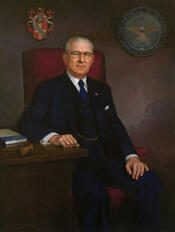
Here you will find contact information for Representative F. Edward Hebert, including email address, phone number, and mailing address.
| Name | F. Edward Hebert |
| Position | Representative |
| State | Louisiana |
| District | 1 |
| Party | Democratic |
| Status | Former Representative |
| Term Start | January 3, 1941 |
| Term End | January 3, 1977 |
| Terms Served | 18 |
| Born | October 12, 1901 |
| Gender | Male |
| Bioguide ID | H000437 |
About Representative F. Edward Hebert
Felix Edward Hébert (pronounced ay-BEAR; October 12, 1901 – December 29, 1979) was an American journalist and politician from Louisiana who became one of the most enduring figures in the state’s congressional history. A member of the Democratic Party, he represented Louisiana’s New Orleans–based 1st congressional district in the United States House of Representatives for 18 consecutive terms, from 1941 until his retirement in 1977, and he remains Louisiana’s longest-serving U.S. representative. His congressional career spanned a period of profound national transformation, from the Second World War through the Cold War, the civil rights era, and the early stages of modern American political realignment.
Hébert was born on October 12, 1901, in New Orleans, Louisiana, into a community and culture that would shape his lifelong connection to the city and its politics. Growing up in New Orleans at the turn of the twentieth century, he was exposed early to the city’s complex social and political life, which later informed both his journalistic work and his legislative priorities. His early years coincided with the consolidation of Democratic dominance in Louisiana and the broader South, a political environment in which he would eventually build his career.
Before entering elective office, Hébert worked as a journalist, a profession that provided him with detailed knowledge of public affairs and the workings of government. His reporting experience helped establish his reputation in New Orleans and across Louisiana, giving him visibility and credibility as an observer of state and local politics. This background in journalism honed his skills in investigation, communication, and public engagement, which later proved valuable in his legislative work and in his ability to navigate the often complex relationships between local interests and national policy.
Hébert’s transition from journalism to politics culminated in his election in 1940 as a Democrat to the 77th United States Congress. He took office on January 3, 1941, representing Louisiana’s 1st congressional district, centered on New Orleans. His service in Congress thus began on the eve of the United States’ entry into World War II, placing him in the House of Representatives during a critical period in American and world history. As a member of the House, Hébert participated in the democratic process and represented the interests of his constituents while the nation mobilized for war, then adjusted to postwar realities and the onset of the Cold War.
Over the course of his 18 terms in office, Hébert contributed to the legislative process during some of the most consequential decades of the twentieth century. Serving continuously from the 77th through the 94th Congresses, he was involved in deliberations on national defense, economic policy, and domestic programs as the federal government expanded its role in American life. His long tenure gave him seniority and influence within the House, and he became a prominent figure in Louisiana’s congressional delegation. Throughout these years, he remained closely identified with the interests of New Orleans and southeastern Louisiana, reflecting the concerns of his district in matters ranging from infrastructure and commerce to broader national policy debates.
Hébert chose not to seek a nineteenth term in 1976, bringing his House service to a close at the end of the 94th United States Congress on January 3, 1977. His retirement marked the end of more than three and a half decades of continuous representation of the 1st district. The longevity of his service set a Louisiana record for tenure in the U.S. House of Representatives. He was temporarily succeeded by Democrat Richard Alvin Tonry, whose brief tenure was followed by the election of Republican Bob Livingston, the first Republican to represent the district since the Reconstruction Era. The seat has remained in Republican hands ever since, passing from Livingston to David Vitter to Bobby Jindal to Steve Scalise, underscoring the broader partisan realignment that followed the period in which Hébert had served as a Democratic mainstay.
Felix Edward Hébert died on December 29, 1979. By the time of his death, he was widely recognized for his long service in Congress and his role in representing New Orleans and the surrounding region during a time of major national and regional change. His career, spanning from his early work as a journalist to his 36 years in the House of Representatives, left a lasting imprint on Louisiana’s political history and on the institutional memory of the United States Congress.