Representative Floyd Spence
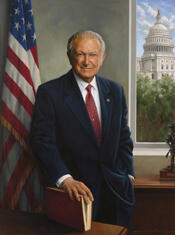
Here you will find contact information for Representative Floyd Spence, including email address, phone number, and mailing address.
| Name | Floyd Spence |
| Position | Representative |
| State | South Carolina |
| District | 2 |
| Party | Republican |
| Status | Former Representative |
| Term Start | January 21, 1971 |
| Term End | August 16, 2001 |
| Terms Served | 16 |
| Born | April 9, 1928 |
| Gender | Male |
| Bioguide ID | S000718 |
About Representative Floyd Spence
Floyd Davidson Spence (April 9, 1928 – August 16, 2001) was an American attorney, naval officer, and Republican politician from South Carolina who represented the state’s 2nd congressional district in the United States House of Representatives from January 3, 1971, until his death on August 16, 2001. Over sixteen terms in Congress, he became a prominent figure in national defense policy, serving as ranking Republican and later chairman of the House Armed Services Committee. His long career in public life reflected and helped shape the broader political realignment of the South from Democratic to Republican dominance in the latter half of the twentieth century.
Spence was born in Columbia, the capital of South Carolina, on April 9, 1928, and spent most of his life in nearby Lexington County. Shortly after graduating from high school, he enlisted in the United States Navy Reserve, beginning a parallel military career that would span several decades and strongly influence his later legislative interests. He remained in the Navy Reserve until his retirement in 1988 with the rank of captain. His early life in the Midlands region of South Carolina, combined with his military service, grounded him in the conservative political culture and strong support for national defense that would characterize his public career.
Spence pursued higher education at the University of South Carolina in Columbia, where he earned a degree in English in 1952. He continued at the University of South Carolina School of Law, receiving his Juris Doctor in 1956. After law school, he was admitted to the bar and began practicing law. During this period, he joined the Democratic Party, then the dominant party in South Carolina, and quickly moved into elective office. His legal training and early political activity laid the foundation for his later work as a legislator at both the state and federal levels.
In 1956, Spence was elected as a Democrat to the South Carolina House of Representatives from Lexington County and was reelected in 1958 and 1960. As national Democratic policies grew more liberal in the early 1960s, particularly on civil rights and other issues, Spence became increasingly uncomfortable with the party’s direction. On April 14, 1962, he publicly announced that he was switching to the Republican Party, citing his dissatisfaction with the national Democrats’ increasingly liberal platform and his opposition to a loyalty oath required by South Carolina Democrats. His switch made him the first Republican to serve in either house of the South Carolina legislature since Reconstruction and marked him as an early participant in the broader partisan realignment underway in South Carolina and across the South. On the same day he announced his party switch, he declared his candidacy for the Republican nomination for South Carolina’s 2nd congressional district, based in Columbia. In the 1962 general election he faced Democratic state representative Albert W. Watson, who had secured his party’s nomination with 52 percent of the vote over Frank C. Owens, the former mayor of Columbia and the choice of party regulars. Watson, backed by powerful U.S. Senator Strom Thurmond, defeated Spence with 53 percent of the vote in what was then regarded as the closest congressional race in South Carolina in memory, in a district that already had a conservative bent and where many old-line Democrats had begun splitting their tickets in national elections.
Although unsuccessful in his first bid for Congress, Spence remained active in state politics. In 1966 he was elected to the South Carolina Senate as a Republican and became the minority leader of a small six-member Republican caucus, reflecting the still-limited but growing GOP presence in the state. He was reelected to the Senate in 1968. In 1970, when Albert W. Watson—who had himself switched to the Republican Party in 1965, a year after Thurmond’s own party change—gave up his 2nd district congressional seat to run unsuccessfully for governor against Democratic Lieutenant Governor John C. West, Spence again sought the 2nd district seat. That year he won a narrow victory, becoming the first freshman Republican congressman elected from South Carolina since 1896 and only the second Republican elected to Congress from the state since Reconstruction, after Watson, who had first been elected as a Democrat and then reelected as a Republican incumbent. Both men drew their support largely from conservative white voters, rather than from the majority African American Republicans who had historically supported the party of Abraham Lincoln in South Carolina.
Spence took his seat in the U.S. House of Representatives on January 3, 1971, beginning a congressional career that would last until his death in 2001. He was re-elected fourteen times after his initial victory, serving a total of sixteen terms. He was unopposed for reelection in the 1972 Nixon–Agnew landslide and established himself as a durable incumbent in a district that increasingly favored Republican candidates. In 1974 he defeated Democratic challenger Matthew J. Perry, an African American civil rights attorney of statewide prominence. Spence continued to win reelection throughout the 1970s and 1980s, aided in 1980 by Ronald Reagan’s presence at the top of the Republican ticket, when he secured 55 percent of the vote. After relatively easy reelections in 1982 and 1984, his margin narrowed to about seven percent in 1986, a year in which Republican Carroll Campbell was elected governor, becoming only the second Republican to hold that office in South Carolina since Reconstruction. Spence faced another competitive race in 1988 but did not encounter major-party opposition again until 1998, reflecting the consolidation of Republican strength in his district.
For his first eleven terms, Spence represented a relatively compact district centered in the central portion of South Carolina, including Columbia and surrounding areas. Following the 1990 census, redistricting significantly altered the political and demographic composition of his constituency. Most of his African American constituents were shifted to the 6th District, which was reconfigured as a black-majority district and subsequently won by Columbia resident and state human affairs commissioner Jim Clyburn, who became the first Democrat to represent Columbia in Congress since Watson’s party switch in 1965. To compensate for the population loss, the 2nd District was extended south and west, reaching as far south as the resort city of Hilton Head Island and as far west as the fringes of the Augusta, Georgia, suburbs. By this time, voting patterns in the region had become highly polarized along racial lines, with African American voters forming the core of the Democratic base and white voters largely supporting Republicans. The removal of many African American voters from Spence’s district was a likely factor in the Democratic Party’s decision not to field a candidate against him for most of the 1990s. Throughout his tenure, Spence participated actively in the legislative process and represented the interests of his constituents during a significant period in American political and military history.
Spence’s most influential work in Congress was in the field of national defense. A member of the House Armed Services Committee from his first term, he rose in seniority over the years and became the ranking Republican on the committee in 1993. The presence of Fort Jackson, a major U.S. Army training installation, within his district underscored his long-standing interest in military affairs. Following the Republican takeover of the House of Representatives in the 1994 elections under Speaker Newt Gingrich, Spence became chairman of the Armed Services Committee in 1995. Upon assuming the chairmanship, he renamed the panel the “Committee on National Security,” reflecting his emphasis on broad strategic and defense concerns. He focused on military readiness, which he described as “the best insurance we have both for peace and freedom,” and was a strong advocate of missile defense systems. Under caucus-imposed term limits, he stepped down as chairman after the 106th Congress but continued to exert influence as chairman of the House subcommittee on military procurement. Over the course of his sixteen terms, he became one of the most prominent Republican voices on defense policy in the House.
Spence’s personal life was marked by both family commitments and significant medical challenges. He married his first wife, Lula Hancock Drake, on December 22, 1952, and the couple had four sons. Lula Spence died in 1978. On July 3, 1988, he married his second wife, Deborah E. Williams. That same year, Spence underwent a pioneering double lung transplant at the University of Mississippi Medical Center. This standalone lung transplant, performed without a concurrent heart transplant, was among the first of its kind in medical history. At age sixty, he was then the oldest patient to receive such a procedure. At the time of his death thirteen years later, he was the longest-surviving lung transplant patient without a re-transplant, a record he had held for nearly a decade. Despite these health issues, he continued to serve actively in Congress and remained engaged in legislative work until his final illness.
Floyd Spence died in Washington, D.C., on August 16, 2001, at the age of seventy-three, from complications following brain surgery, described as cerebral thrombosis. He had been admitted three weeks earlier to St. Dominic Hospital in Jackson, Mississippi, for testing and treatment related to nerve pain in his face, and his condition ultimately required surgical intervention. At the time of his death, he was still serving in the U.S. House of Representatives, placing him among the members of Congress who died in office in the early 2000s. He was buried in Saint Peters Lutheran Church Cemetery in Lexington, South Carolina, reflecting his deep roots in the community he had long represented. Following his death, his former aide, Republican State Senator Joe Wilson, won the special election to fill the vacant 2nd District seat, continuing the Republican hold on the district that Spence had helped to establish and maintain over three decades of congressional service.