Representative Foster Waterman Stearns
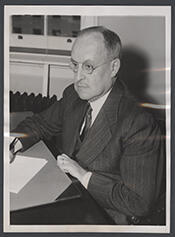
Here you will find contact information for Representative Foster Waterman Stearns, including email address, phone number, and mailing address.
| Name | Foster Waterman Stearns |
| Position | Representative |
| State | New Hampshire |
| District | 2 |
| Party | Republican |
| Status | Former Representative |
| Term Start | January 3, 1939 |
| Term End | January 3, 1945 |
| Terms Served | 3 |
| Born | July 29, 1881 |
| Gender | Male |
| Bioguide ID | S000823 |
About Representative Foster Waterman Stearns
Foster Waterman Stearns (July 29, 1881 – June 4, 1956) was a Republican member of the United States House of Representatives from New Hampshire who served three consecutive terms in Congress from 1939 to 1945. Born in Hull, Massachusetts, he attended the local public schools before pursuing higher education. He graduated from Amherst College in 1903, received a degree from Harvard University in 1906, and later earned an additional degree from Boston College in 1915, reflecting a broad and sustained commitment to academic study in the liberal arts and related fields.
Stearns began his professional career in the field of librarianship and cultural institutions. He served as Librarian of the Museum of Fine Arts in Boston from 1913 to 1917, overseeing collections and contributing to the administration of one of the nation’s leading art museums. In 1917 he was appointed State Librarian of Massachusetts, a position that placed him at the center of the state’s efforts to organize and expand public access to information and historical records on the eve of American entry into the First World War.
During World War I, Stearns entered military service and served with distinction. He was commissioned a first lieutenant with the Sixteenth Infantry, First Division, and was later assigned to the General Headquarters of the American Expeditionary Forces in France. From November 27, 1917, until his discharge on August 5, 1919, he served as assistant military attaché, performing diplomatic and liaison duties in a wartime environment. For his service he received the Silver Star and the Purple Heart, decorations that recognized both gallantry and wounds received in the line of duty.
After the war, Stearns continued his involvement in foreign affairs through diplomatic service. He worked in the Department of State in Washington, D.C., in 1920 and 1921, and then served abroad as third secretary of the American Embassy attached to the United States High Commission in Constantinople from 1921 to 1923. He subsequently was second secretary of the American Embassy in Paris in 1923 and 1924, further deepening his experience in international relations and European affairs. Returning to the United States, he resumed his work in librarianship as Librarian of the College of the Holy Cross in Worcester, Massachusetts, from 1925 to 1930. In 1927 he moved to Hancock, New Hampshire, establishing the residency that would anchor his later political career.
Stearns entered elective office in New Hampshire in the late 1930s. He served as a member of the New Hampshire House of Representatives in 1937 and 1938, participating in state-level legislative work during the closing years of the Great Depression. Building on this experience, he was elected as a Republican to the Seventy-sixth, Seventy-seventh, and Seventy-eighth Congresses, serving in the U.S. House of Representatives from January 3, 1939, to January 3, 1945. His tenure in Congress coincided with a critical period in American history that encompassed the end of the New Deal era and the nation’s mobilization for and participation in World War II. As a member of the House of Representatives from New Hampshire, he contributed to the legislative process and represented the interests of his constituents in this transformative period. A confidential 1943 analysis of the House Foreign Affairs Committee by Isaiah Berlin for the British Foreign Office described Stearns as one of the liberal Republicans who supported the Roosevelt Administration’s foreign policy on all major measures, noted that he was considered to be in the Wendell Willkie camp yet likely to align with the Democratic majority on the committee, and characterized him as “a mild internationalist” and “a kindly old derelict rather than a man of parts,” while also observing that he was a Catholic and, at that time, sixty-two years of age.
In addition to his legislative duties, Stearns held several notable positions and party roles during his years of public service. He served as a Regent of the Smithsonian Institution from 1941 to 1945, linking his earlier career in cultural and educational institutions to a national scientific and cultural establishment. In 1941 he also became a hereditary member of the New Hampshire Society of the Cincinnati, reflecting his family’s historic ties to the Revolutionary era officer corps. He was a delegate to the Republican National Convention in 1940 and again in 1948, participating in the selection of his party’s presidential nominees and in the formation of national party platforms. In 1942 he became a director of the Rumford Printing Company of Concord, New Hampshire, extending his activities into the business sector. Although he chose not to seek renomination to the House in 1944, he sought higher office that year as a candidate for the Republican nomination for United States Senator from New Hampshire, but his bid was unsuccessful.
In his later years, Stearns continued to reside in New Hampshire and to maintain his connections to public life and cultural institutions. After leaving Congress and remaining active in party affairs, he moved from Hancock to Exeter, New Hampshire, in 1948. He lived there until his death on June 4, 1956. Foster Waterman Stearns was interred in Exeter Cemetery, closing a life that had encompassed service as a librarian, soldier, diplomat, state legislator, and three-term U.S. Representative from New Hampshire during a pivotal era in American and world history.