Representative Francis Edwin Dorn
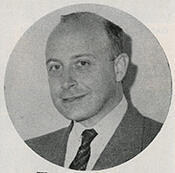
Here you will find contact information for Representative Francis Edwin Dorn, including email address, phone number, and mailing address.
| Name | Francis Edwin Dorn |
| Position | Representative |
| State | New York |
| District | 12 |
| Party | Republican |
| Status | Former Representative |
| Term Start | January 3, 1953 |
| Term End | January 3, 1961 |
| Terms Served | 4 |
| Born | April 18, 1911 |
| Gender | Male |
| Bioguide ID | D000433 |
About Representative Francis Edwin Dorn
Francis Edwin Dorn (April 18, 1911 – September 17, 1987) was a Republican member of the United States House of Representatives from New York who served from 1953 to 1961 and was the last Republican to represent the state’s 12th congressional district. His eight years in Congress spanned a significant period in American history, during which he participated in the legislative process and represented the interests of his Brooklyn constituents in the U.S. House of Representatives.
Dorn was born on April 18, 1911, in Brooklyn, New York. He received his early education in local Catholic schools, attending St. Augustine High School and Bishop Loughlin Memorial High School. He went on to Fordham University, from which he graduated in 1932, and then to Fordham University School of Law, earning his law degree in 1935. The following year, in 1936, he pursued further study at the New York University Wagner School of Public Service. Dorn was admitted to the bar in 1936 and began the practice of law in Brooklyn, establishing himself professionally before entering public office.
Dorn’s political career began in state government. He was elected to the New York State Assembly as a Republican, representing Kings County’s 10th District, and served in the Assembly in 1941 and 1942. His tenure in the legislature was cut short by World War II. On April 1, 1942, he resigned his Assembly seat in order to enlist in the United States Navy. Dorn served four years overseas during the war and was discharged in 1946 as a lieutenant commander in the Naval Reserve. He later received a promotion to the rank of commander, reflecting his continued association with the Naval Reserve after the war.
After returning from military service, Dorn resumed his legal and public careers in Brooklyn and soon sought federal office. He was elected as a Republican to the 83rd United States Congress and took his seat on January 3, 1953, representing New York’s 12th congressional district. He was subsequently re-elected to three additional terms, serving continuously until January 3, 1961. During his four terms in office, Dorn contributed to the legislative process as a member of the House of Representatives and participated actively in the democratic governance of the country. His service coincided with the early Cold War, the Eisenhower administration, and the emerging civil rights movement.
In Congress, Dorn developed a record that included support for key civil rights legislation. He voted in favor of the Civil Rights Act of 1957 and the Civil Rights Act of 1960, aligning himself with efforts to strengthen federal protections for voting rights and civil liberties. He also played a notable role in the symbolic and cultural life of the nation by advocating in 1954 for the addition of the phrase “under God” to the previously nonsectarian Pledge of Allegiance, a change that was ultimately adopted and remains in use. Dorn’s tenure is also historically significant in partisan terms: he was the most recent Republican to represent New York’s 12th District, and the only Republican to hold that seat since Charles St. John left office in 1875.
Dorn’s congressional career ended following the 1960 election, when he was defeated for re-election by his neighbor, Hugh Carey, who would later become governor of New York. After leaving Congress on January 3, 1961, Dorn turned his attention to private enterprise. He continued in business in New York City as the owner of the F.E.D. Concrete Company, maintaining an active role in commercial life for many years after his departure from public office. His residence in the Park Slope neighborhood of Brooklyn, a mansion that reflected his long-standing ties to the borough, later gained note when it was purchased by actor Paul Bettany and his wife, actress Jennifer Connelly.
Francis Edwin Dorn died on September 17, 1987, in New York City. He was buried at Green-Wood Cemetery in Brooklyn, a historic resting place for many notable New Yorkers. His career encompassed service in state government, military duty in World War II, and four terms in the U.S. House of Representatives, during which he remained a prominent Republican voice from Brooklyn and the last member of his party to represent New York’s 12th congressional district.