Representative Francis Granger
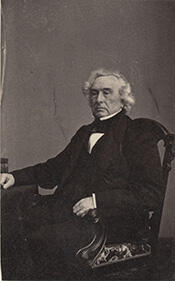
Here you will find contact information for Representative Francis Granger, including email address, phone number, and mailing address.
| Name | Francis Granger |
| Position | Representative |
| State | New York |
| District | 26 |
| Party | Whig |
| Status | Former Representative |
| Term Start | December 7, 1835 |
| Term End | March 3, 1843 |
| Terms Served | 3 |
| Born | December 1, 1792 |
| Gender | Male |
| Bioguide ID | G000376 |
About Representative Francis Granger
Francis Granger (December 1, 1792 – August 31, 1868) was an American politician who represented Ontario County, New York, in the United States House of Representatives for three non-consecutive terms between 1835 and 1843. A prominent leader in the state and national Whig Party, particularly in its moderate-conservative faction, he was a Whig vice-presidential nominee in 1836, briefly served as United States Postmaster General in 1841, and later became the final national chairman of the Whig Party before its collapse, after which he joined the Constitutional Union Party.
Granger was born in Suffield, Connecticut, on December 1, 1792, into a politically influential New England family. His father, Gideon Granger, served in the Connecticut House of Representatives and was appointed by President Thomas Jefferson as Postmaster General of the United States, becoming the longest-serving Postmaster General in the nation’s history. His mother was Mindwell (née Pease) Granger (1770–1860). Public service ran in the extended family as well; his first cousin, Amos Phelps Granger, later served two terms in the United States House of Representatives. Raised in this environment of political engagement and public administration, Francis Granger was prepared from an early age for a career in law and politics.
Granger pursued classical studies and graduated from Yale College in 1811. In 1814 he moved with his father to Canandaigua, in Ontario County, New York, then a growing center of legal and political activity in the Finger Lakes region. He studied law there, was admitted to the bar in 1816, and commenced practice in Canandaigua. From 1817 to 1827 he resided in a home in Canandaigua that later became known as the Francis Granger House, a property that was listed on the National Register of Historic Places in 1984. His legal practice and family connections quickly brought him into the orbit of New York state politics and the emerging opposition to Jacksonian Democracy.
Granger entered elective office as a member of the New York State Assembly, serving from 1826 to 1828 and again from 1830 to 1832. During this period he aligned with the National Republican Party, the principal anti-Jackson party of the era. He ran unsuccessfully for lieutenant governor of New York in 1828 and for governor of New York in both 1830 and 1832 as a National Republican, campaigns that nonetheless enhanced his statewide profile and positioned him as a leading opponent of Andrew Jackson’s policies. These early races helped establish him as a prominent figure among the anti-Jackson forces that would soon coalesce into the Whig Party.
Granger’s national career began when he was elected as an Anti-Jacksonian to the 24th Congress, representing Ontario County in the U.S. House of Representatives from March 4, 1835, to March 3, 1837. His service in Congress occurred during a significant period in American history marked by intense partisan conflict over banking, internal improvements, and executive power. As a member of the House of Representatives, Francis Granger participated in the legislative process, represented the interests of his New York constituents, and contributed to the development of the emerging Whig opposition. In the general election of 1836, he ran unsuccessfully for election to the 25th Congress, but he was later re-elected as a Whig to the 26th and 27th Congresses, serving from March 4, 1839, to March 5, 1841. After a brief interval in the executive branch, he returned once more to the House in a special election, serving from November 27, 1841, to March 3, 1843. In total, he served three non-consecutive terms in Congress between 1835 and 1843 and did not seek reelection in 1842.
Granger achieved national prominence in the 1836 presidential election, when the newly formed Whig Party, unable to unite behind a single national ticket, fielded multiple regional slates. Granger was selected as the Whig vice-presidential nominee for the northern and border states, running primarily with William Henry Harrison, though in Massachusetts he appeared on a ticket headed by Daniel Webster. Democrat Martin Van Buren won the presidency with a majority in the Electoral College, but his running mate, Richard M. Johnson, fell one vote short of a majority when Virginia’s 23 electors refused to support him. The vice-presidential election was thus thrown into a contingent election in the U.S. Senate under the Twelfth Amendment, the only such vice-presidential contingent election in American history. The Senate, controlled by 35 Democrats to 17 Whigs in the 25th Congress, chose between Johnson and Granger, and Granger was defeated by a vote of 33 to 16, making him the only person ever to lose a contingent election for the vice presidency in the Senate.
In 1840, the Whigs united behind William Henry Harrison for president but did not again select Granger as the vice-presidential nominee, choosing John Tyler instead. Had Granger been renominated and elected vice president, he would have succeeded to the presidency upon Harrison’s death in April 1841, only a month after Harrison’s inauguration. Nonetheless, Granger joined Harrison’s administration in a key role. On March 6, 1841, he was appointed United States Postmaster General, serving in Harrison’s cabinet and then briefly under President John Tyler. He held the post until September 18, 1841, when, following a major break between Tyler and the Whig leadership, he resigned along with most other Whig cabinet members at the urging of party leader Henry Clay. Shortly thereafter, he returned to Congress via a special election to fill the vacancy caused by the resignation of Representative John Greig, serving from November 27, 1841, to March 3, 1843. Throughout these years, he remained a central Whig figure, active in both legislative and executive capacities during a turbulent era in national politics.
In the 1850s, as sectional tensions intensified, Granger aligned with the moderate, pro-Compromise wing of the Whig Party. A supporter of the Compromise of 1850, he led the pro–Millard Fillmore faction in New York, which became known as the “Silver Gray” Whigs, a nickname derived from Granger’s own silver hair. This group favored conciliation and adherence to the Compromise measures, and it remained in conflict with the anti-Compromise faction led by William H. Seward until the Whig Party collapsed in New York in 1855. On the national level, Granger served as chairman of the Whig National Executive Committee from 1856 to 1860, effectively acting as the last national chairman of the party as it disintegrated amid the rise of the Republican Party and the deepening sectional crisis. He subsequently joined in the call for the convention of the Constitutional Union Party, which met in May 1860 and sought to avert disunion by emphasizing loyalty to the Constitution and the Union above sectional issues. In 1861 he was a member of the Washington peace convention, an eleventh-hour effort by prominent statesmen to devise means to prevent the impending Civil War.
Granger’s personal life reflected his connections to other prominent American families. He married Cornelia Rutsen Van Rensselaer (1798–1823), daughter of Jeremiah Van Rensselaer and Sybella Adeline (née Kane) Van Rensselaer and granddaughter of Brigadier General Robert Van Rensselaer, who had served in the New York Provincial Congress from 1775 to 1777 and later in the 1st, 2nd, and 4th New York State Legislatures. Francis and Cornelia Granger had a daughter, a son, and a second daughter who died with her mother in childbirth in 1823. Their daughter Adele Granger (1819–1892) married John Eliot Thayer (1803–1857), son of Boston financier Nathaniel Thayer, and after Thayer’s death she married Robert Charles Winthrop (1809–1894), a U.S. Representative and Senator from Massachusetts who served as Speaker of the House. Their son, Gideon Granger II (1821–1868), married Isaphine Pierson (1826–1905), daughter of U.S. Representative Isaac Pierson, further extending the family’s ties to national political figures.
Francis Granger spent his later years in Canandaigua, remaining a respected elder statesman of the fading Whig tradition and the Unionist cause. He died there on August 31, 1868, and was buried in Woodlawn Cemetery in Canandaigua. His career, spanning state politics, multiple terms in Congress, a cabinet post, and national party leadership, placed him at the center of many of the major political realignments and constitutional crises of the antebellum United States.