Representative Francis William Kellogg
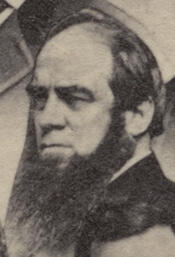
Here you will find contact information for Representative Francis William Kellogg, including email address, phone number, and mailing address.
| Name | Francis William Kellogg |
| Position | Representative |
| State | Alabama |
| District | 1 |
| Party | Republican |
| Status | Former Representative |
| Term Start | December 5, 1859 |
| Term End | March 3, 1869 |
| Terms Served | 4 |
| Born | May 30, 1810 |
| Gender | Male |
| Bioguide ID | K000064 |
About Representative Francis William Kellogg
Francis William Kellogg (May 30, 1810 – January 13, 1879) was a United States Representative from the states of Michigan, on the eve of and during the Civil War, and Alabama, during Reconstruction. He was born in Worthington, Massachusetts, where he attended the common schools. In 1833 he moved west to Columbus, Ohio, part of the broader migration of New Englanders into the Old Northwest. In 1855 he relocated again to Grand Rapids, Michigan, where he entered the lumber trade, becoming a partner in the firm Kellogg, White & Co. at Kelloggville in Kent County, Michigan, a community that was named in his honor.
Kellogg’s early public career developed in Michigan state politics. Active in local affairs in Kent County, he was elected as a member of the Michigan State House of Representatives, representing the Kent County 2nd district from 1857 to 1858. His service in the state legislature coincided with the rise of the Republican Party in the Upper Midwest and helped establish his reputation as a committed Republican and an advocate for the interests of his growing region.
In national politics, Kellogg was elected from Michigan as a Republican to the United States House of Representatives for the 36th, 37th, and 38th Congresses, serving from March 4, 1859, to March 3, 1865. He represented Michigan’s 3rd congressional district for his first two terms and, following redistricting, the 4th district for his third term. In all three general elections he defeated Thomas B. Church, a former mayor of Grand Rapids. His service in Congress occurred during a significant period in American history, as the nation moved from sectional crisis into the Civil War. As a member of the House of Representatives, Kellogg participated in the legislative process at a time when issues of union, slavery, and national reconstruction dominated the agenda, and he represented the interests of his Michigan constituents during this turbulent era.
During the American Civil War, Kellogg played an active role in military organization in addition to his legislative duties. By authority of the United States Department of War, he organized the Second, Third, and Sixth Michigan Cavalry Regiments, contributing to the Union war effort by raising and equipping volunteer forces from his state. He was appointed colonel of the Third Michigan Cavalry, reflecting the confidence placed in his leadership and organizational abilities at a moment when the Union was mobilizing on an unprecedented scale.
After leaving Congress in 1865, Kellogg continued in federal service during the early years of Reconstruction. On April 30, 1866, President Andrew Johnson appointed him collector of internal revenue for the southern district of Alabama. In that capacity, he resided in Mobile, Alabama, and served until July 1868, administering federal tax laws in a former Confederate state undergoing political and economic reorganization under federal authority.
Upon the readmission of Alabama to the Union, Kellogg was elected as a Republican to a partial term in Alabama’s 1st congressional district in the 40th Congress. He served as a Representative from Alabama in the United States Congress from July 22, 1868, to March 3, 1869. A member of the Republican Party, he contributed to the legislative process during this Reconstruction Congress and represented the interests of his Alabama constituents at a time when the former Confederate states were being reintegrated into the federal system. He was succeeded in this seat by fellow Republican Alfred Buck.
In his later years, Kellogg left the South and moved first to New York City and later to Alliance, Ohio. He died in Alliance on January 13, 1879. His remains were returned to Michigan, where he was interred in Fulton Street Cemetery in Grand Rapids, underscoring his long-standing ties to the state where he had first risen to prominence in business and politics.