Senator Francis John Myers
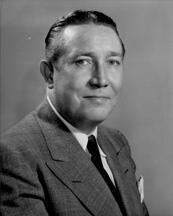
Here you will find contact information for Senator Francis John Myers, including email address, phone number, and mailing address.
| Name | Francis John Myers |
| Position | Senator |
| State | Pennsylvania |
| Party | Democratic |
| Status | Former Representative |
| Term Start | January 3, 1939 |
| Term End | January 3, 1951 |
| Terms Served | 4 |
| Born | December 18, 1901 |
| Gender | Male |
| Bioguide ID | M001127 |
About Senator Francis John Myers
Francis John Myers (December 18, 1901 – July 5, 1956) was an American teacher, lawyer, and Democratic Party politician who served in both houses of the United States Congress. He represented most of West Philadelphia and Southwest Philadelphia in the United States House of Representatives from 1939 to 1945 and represented Pennsylvania in the United States Senate for one term from 1945 to 1951. A member of the Democratic Party, he contributed to the legislative process during four terms in Congress and served as Senate Majority Whip from 1949 to 1951.
Myers was born in Philadelphia, Pennsylvania, to John Francis and Mary (née Donnelly) Myers, both the children of Irish immigrants. His father worked for the Philadelphia post office for forty years, retiring as chief auditor. Myers received his early education at George L. Brooks Elementary School in West Philadelphia and graduated from St. Joseph’s Preparatory School in 1919. He then attended St. Joseph’s University, also in Philadelphia, where he earned a Bachelor of Arts degree in 1923. While in college, he was active in extracurricular activities, participating on the baseball and football teams and serving on the debating team.
From 1923 to 1927, Myers was an instructor in Latin, English, and ancient history at St. Joseph’s Preparatory School. During this period he studied law in the evenings at Temple University Law School. He was admitted to the bar in 1927 and entered private practice. From 1929 to 1931, he worked as a secretary with the Philadelphia law firm of Monaghan and Phillips, whose senior partner, John Monaghan, also served as district attorney of Philadelphia. Myers later served as an attorney for the Home Owners’ Loan Corporation from 1934 to 1935, gaining experience in matters related to housing and finance during the New Deal era.
By the mid-1930s, Myers had become active in Democratic politics in Pennsylvania. He participated in the successful 1934 gubernatorial campaign of George H. Earle III, one of the first major Democratic victories in the state in the twentieth century. In 1937, he was appointed deputy attorney general of Pennsylvania, a position he held for about a year. These roles helped establish his reputation within the Democratic Party and provided a platform for his entry into elective office.
In 1938, Myers was elected to the United States House of Representatives from Pennsylvania’s 6th congressional district, encompassing much of West and Southwest Philadelphia. In the Democratic primary, he defeated incumbent Representative Michael Stack, who had largely opposed President Franklin D. Roosevelt’s New Deal policies. In the general election, Myers received just under 50 percent of the vote, defeating Republican J. Howard Berry and Stack, who ran on the Royal Oak ticket. He was re-elected in 1940 over Republican city solicitor Frank Truscott by a margin of 61 to 38 percent, and again in 1942, when he defeated Republican businessman William Sylk by approximately ten percentage points. His House service, from January 3, 1939, to January 3, 1945, coincided with the later years of the New Deal and the early period of American involvement in World War II, during which he represented the interests of his Philadelphia constituents in the national legislature.
In 1944, Myers successfully sought election to the United States Senate from Pennsylvania. He narrowly defeated Republican incumbent James J. Davis in the general election by a margin of 50 to 49 percent, becoming the first Catholic to serve as a United States Senator from Pennsylvania. His Senate term ran from January 3, 1945, to January 3, 1951, a period marked by the final stages of World War II, the beginning of the Cold War, and significant domestic policy debates. At the 1948 Democratic National Convention in Philadelphia, Myers served as chairman of the platform committee, where he played a key role in drafting a party platform that strongly endorsed civil rights, aligning the national party with more assertive civil rights policies. Within the Senate, he rose in the Democratic leadership, serving as Senate Majority Whip from 1949 to 1951 under Majority Leader Scott Lucas. In this capacity, he helped manage the legislative agenda and secure support for the Truman administration’s initiatives. He lost his bid for a second Senate term in 1950 to Republican Governor James H. Duff by a vote of 51 to 48 percent, a defeat widely attributed in part to his association with President Harry S. Truman’s increasingly unpopular administration.
After leaving the Senate in January 1951, Myers resumed the practice of law in Pennsylvania. He also remained active in public affairs and urban development. He served as chairman of the Philadelphia Redevelopment Authority, where he was involved in efforts to plan and guide postwar urban renewal in the city. In addition, he was a member of the General State Authority and participated in the Greater Philadelphia Movement, a civic organization focused on governmental reform and metropolitan planning. Through these roles, he continued to influence public policy and development in Pennsylvania beyond his congressional career.
Francis John Myers died of leukemia at Graduate Hospital in Philadelphia on July 5, 1956, at the age of 55. He was interred at Holy Sepulchre Cemetery in Cheltenham Township, Pennsylvania.