Senator Francis Griffith Newlands
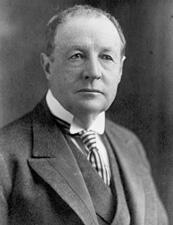
Here you will find contact information for Senator Francis Griffith Newlands, including email address, phone number, and mailing address.
| Name | Francis Griffith Newlands |
| Position | Senator |
| State | Nevada |
| Party | Democratic |
| Status | Former Representative |
| Term Start | August 7, 1893 |
| Term End | December 24, 1917 |
| Terms Served | 8 |
| Born | August 28, 1846 |
| Gender | Male |
| Bioguide ID | N000069 |
About Senator Francis Griffith Newlands
Francis Griffith Newlands (August 28, 1846 – December 24, 1917) was an American politician, land developer, and avowed white supremacist who served as both United States representative and senator from Nevada and was a member of the Democratic Party. He represented Nevada in the United States House of Representatives from 1893 to 1903 and then served in the United States Senate from 1903 until his death in 1917, a period that encompassed major developments in American expansion, conservation policy, and racial politics. Over eight terms in Congress, he played a central role in federal reclamation policy and the annexation of Hawaii, while also publicly advocating for racial restrictions on immigration and the rollback of political rights for African Americans.
Newlands was born in Natchez, Mississippi, on August 28, 1846 (some sources give 1848), the fourth of five children of Jessie and James Newlands, immigrants from Scotland. His father, trained as a physician in Edinburgh, died in 1851, after which Francis was raised in Illinois and in Washington, D.C. In 1867, he enrolled at Yale University but left after his first year. He then attended Columbian College in Washington, D.C. (now part of George Washington University), graduating in 1869. That same year he was admitted to the bar and began the practice of law. In 1901, Columbian College awarded him an honorary Master of Arts degree, reflecting his growing prominence in public life.
In 1870, Newlands moved to San Francisco, California, where he established himself in law and business. In 1874 he married Clara Adelaide Sharon, daughter of William Sharon, a prominent businessman who later served as a United States senator from Nevada. The couple had three daughters. Through his association with William Sharon, Newlands helped reopen the Bank of California after its collapse and supervised the management of the Palace Hotel in San Francisco, one of the city’s landmark enterprises. Upon the death of his wife, he inherited a substantial portion of the Sharon estate, greatly increasing his wealth. In 1888 he married Edith McAllister and moved to Nevada, a relocation that set the stage for his political career and his extensive activities in western land development.
Beginning in the late 1880s, Newlands became a leading figure in the development of streetcar suburbs around the nation’s capital. He and his partners began acquiring farmland in northwestern Washington, D.C., and southern Montgomery County, Maryland, with the goal of creating a planned residential community. On June 23, 1888, he chartered the Rock Creek Railway to operate a single-track streetcar line. Two years later, he and his associates formed the Chevy Chase Land Company to develop more than 1,700 acres they had assembled. Between 1890 and 1892, the company extended Connecticut Avenue for about five miles from Rock Creek across the District line into Maryland, constructing two new bridges and laying streetcar tracks down the center of the new roadway. The Rock Creek Railway opened in 1892 and, to power its electric streetcars, the company dammed Coquelin Run, a tributary of Rock Creek, creating Chevy Chase Lake as a reservoir for an electric generating plant. Newlands founded the neighborhoods of Chevy Chase, Washington, D.C., and Chevy Chase, Maryland, and took steps to prevent non-white people from moving there. His development companies attached restrictive covenants to lots in Chevy Chase, D.C.; Chevy Chase, Maryland; and later in Burlingame, California, which, by imposing minimum construction costs—such as $3,000 or $5,000 per house—effectively excluded many minority and less affluent buyers. He oversaw the creation of the Chevy Chase Springs Hotel (later the Chevy Chase School for Girls and now the National 4-H Youth Conference Center), and ensured that the community included schools, churches, country clubs, tree-lined streets, a water supply, and a sewage system. Groceries and other daily necessities were carried from Washington, D.C., on the railway at no charge to residents. From 1894 to 1936, the Chevy Chase Land Company operated an amusement park at Chevy Chase Lake to attract prospective buyers and provide evening and weekend passengers for the streetcars. On the West Coast, beginning in 1893, Newlands also subdivided property he had inherited in Burlingame, California, starting with the Burlingame Country Club and several cottages and adding the Burlingame train station in 1894.
Newlands entered national politics as a representative from Nevada, serving in the United States House of Representatives from March 4, 1893, to March 3, 1903. Initially elected as a member of the Silver Party, he aligned himself with western interests that favored the free coinage of silver and a more active federal role in developing the arid West. In 1898 he authored the Newlands Resolution, by which Congress annexed the Republic of Hawaii and created the Territory of Hawaii, a key step in American expansion into the Pacific. He strongly supported federal conservation measures and advocated for federal funding of irrigation projects to reclaim arid lands in the western states. His efforts culminated in the Reclamation Act of 1902, commonly known as the Newlands Reclamation Act, which established what became the Bureau of Reclamation and led to the construction of dams and irrigation works that transformed agriculture in much of the American West.
In 1903, Newlands entered the United States Senate as a Democrat and served there until his death in 1917. During his Senate career he continued to champion conservation and federal management of natural resources, supporting the transfer of forest reserves to the newly created United States Forest Service in 1905 and backing the establishment of the National Park Service in 1916. He served on the Senate subcommittee that investigated the 1912 sinking of the RMS Titanic, participating in the first ten of the inquest’s eighteen days of hearings and focusing particular attention on the inadequate number of lifeboats aboard the ship. The inquiry is regarded as one of the most significant Senate investigations of the twentieth century, leading to substantial reforms in maritime safety practices and regulation. In 1916, Newlands was the only Democratic senator to vote against President Woodrow Wilson’s nomination of Louis Brandeis to the United States Supreme Court. Throughout his congressional service, he represented Nevada during a period of rapid national growth, industrialization, and evolving federal authority, and he played a prominent role in shaping policies on irrigation, conservation, and territorial expansion.
Newlands was also an outspoken white supremacist and white nationalist who used his Senate position to advocate for racially exclusionary policies. He publicly supported restricting the rights of African Americans and argued for racial restrictions on immigration. In 1905 he proposed a program of paid resettlement of African Americans to the Caribbean. In a 1909 article titled “A Western View of the Race Question,” published in the Annals of the American Academy of Political and Social Science, he described Black Americans as “a race of children” and portrayed them as a danger to American institutions and civilization, calling for a national policy that would, in his view, minimize that “danger.” He also expressed fear that Asian immigration would lead people from “the yellow and brown races” to “take possession of our entire western coast and intermountain region” if not restricted, contrasting what he characterized as the “patient and submissive” Chinese with the “strong and virile” Japanese, whom he regarded as posing a greater challenge. In a June 17, 1912, article in the New York Times, he wrote, “I believe this should be a white man’s country and that we should frankly express our determination that it shall be.” At the 1912 Democratic National Convention, he proposed that the party platform include a “White Plank” calling for repeal of the Fifteenth Amendment to the United States Constitution, which guarantees voting rights regardless of race, and for the restriction of immigration to whites.
On December 24, 1917, Newlands suffered heart failure in his Senate office in Washington, D.C., and died later that night at his home at 2236 Massachusetts Avenue NW. He was interred at Oak Hill Cemetery in Washington, D.C. In 1943, a Liberty ship was commissioned in his honor as the SS Francis G. Newlands; it was scrapped in 1965. His legacy has remained visible in the built environment and in ongoing public debates. The Francis Griffith Newlands Memorial Fountain stands in Chevy Chase Circle, the federal park at the boundary of Washington, D.C., and Maryland. In 2014, a member of the Chevy Chase Advisory Neighborhood Commission introduced a resolution calling for the removal of Newlands’s name from the fountain because of his white supremacist views and his advocacy of disenfranchising African Americans; opponents argued that altering the monument would diminish recognition of his legislative accomplishments. On July 27, 2020, the Advisory Neighborhood Commission of Chevy Chase, D.C., voted unanimously to ask the National Park Service to remove the plaque bearing his name from the fountain and to create an exhibit documenting his racism. A similar effort has emerged to rename Newlands Park in Reno, Nevada. His former mansion in Reno is one of six properties in Nevada designated as a National Historic Landmark, and in the twentieth century it became known as a residence for individuals seeking divorces under Nevada’s liberal laws; among its notable guests was heiress Barbara Hutton, who stayed there in 1935 while awaiting the finalization of her divorce by local attorney George Thatcher, who had purchased the house in 1920.