Representative Francis Barretto Spinola
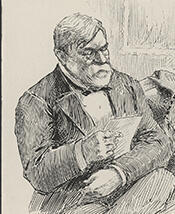
Here you will find contact information for Representative Francis Barretto Spinola, including email address, phone number, and mailing address.
| Name | Francis Barretto Spinola |
| Position | Representative |
| State | New York |
| District | 10 |
| Party | Democratic |
| Status | Former Representative |
| Term Start | December 5, 1887 |
| Term End | March 3, 1893 |
| Terms Served | 3 |
| Born | March 19, 1821 |
| Gender | Male |
| Bioguide ID | S000738 |
About Representative Francis Barretto Spinola
Francis Barretto Spinola (March 19, 1821 – April 14, 1891) was an American politician, military leader, and banker who is often considered to have been the first Italian American elected to the United States House of Representatives. A member of the Democratic Party, he represented New York in Congress from 1887 to 1891, contributing to the legislative process during a significant period in American history. He also served as a brigadier general of volunteers in the Union Army during the American Civil War and was long prominent in New York municipal and state politics.
Spinola was born on March 19, 1821, at Old Field, near Stony Brook, in the town of Brookhaven, Suffolk County, Long Island, New York. He was the son of João Leandro Spinola, later Anglicized as John Leander Spinola (b. 1782), a Portuguese merchant from Madeira Island whose family of noble Genoese origin had settled there in the late fifteenth or early sixteenth century as merchants, and Elizabeth Phelan (1790–1873) of Long Island. His father, described as a prosperous farmer and oysterman who migrated from Madeira to the United States, is recorded traveling between Funchal and New York aboard the brig Pomona in 1821 and later voyaging to Havana and Rio Grande; he was eventually buried in Green-Wood Cemetery in Brooklyn. Spinola’s mother was the daughter of Captain John Phelan (1747–1827), a veteran of the American Revolutionary War who served as a lieutenant in Wigglesworth’s 13th Massachusetts Regiment and a member of the Society of the Cincinnati, and his wife Susanna Davis of Long Island. Several of Spinola’s grand-uncles, including Edward, Patrick, and Phillip Phelan, also served as officers in the Revolutionary War, with Phillip Phelan dying in action at the Battle of Eutaw Springs in 1781. Through this lineage, the family was connected to later members of the Daughters of the American Revolution. Spinola grew up in a large family that included an older brother, John Leander Spinola (b. 1818), a druggist; a younger brother, Douglas A. Spinola (b. 1830); an older sister, Angelina, a seamstress (b. 1814); and younger sisters Louisa (b. 1825) and Ann Eliza (b. 1829). He later provided for his sister Ann Douglass until his death; by the early twentieth century she was living on a modest allowance from the Society of the Cincinnati, a circumstance that drew public notice to the family’s once-prominent status.
Spinola received his early education at Quaker Hill Academy in Dutchess County, New York. After completing his studies there, he read law, passed the bar examination, and established a law practice in Brooklyn. His legal training and family connections helped him enter public life at a relatively young age. On May 7, 1855, he married Elizabeth Nancy (Eliza N.) Glazebrook of Kings, Saratoga County, New York, in New York City. The couple made their home in Brooklyn and maintained a country seat at Crane Neck on Long Island, a property that was threatened by fire in 1887. Eliza Spinola survived her husband by five years, dying in 1896. Over time, Spinola also became active in business as a banker and insurance agent, roles that would later complement his political and military careers.
Spinola’s public career began in municipal government in Brooklyn. He was elected alderman of the Second Ward in 1846 and 1847, and, after being reelected in 1849, he served a total of four years on the Board of Aldermen. By the mid-1850s he had become one of the most respected and influential citizens of Brooklyn and New York City. In 1854 he joined a special force known as the “Special Police,” created to help maintain order in the streets of New York during periods of unrest. A committed Democrat, he was elected to the New York State Assembly from Kings County’s 2nd District in 1856. He advanced to the New York State Senate, representing the 3rd District from 1858 to 1861 and sitting in the 81st, 82nd, 83rd, and 84th New York State Legislatures. In 1860 he served as a delegate to the Democratic National Convention, participating in the fractious national party deliberations on the eve of the Civil War. At the outbreak of the war he was serving as commissioner of New York Harbor, a position that placed him at a strategic point of contact between the state’s commercial interests and the federal government.
With the onset of the Civil War, Spinola entered the Union volunteer forces from New York and was commissioned as an officer. On October 2, 1862, he was appointed brigadier general of volunteers. Between July and October 1862 he recruited and organized a brigade of four regiments that became known as “Spinola’s Empire Brigade,” reflecting both his organizational energy and his political influence in New York. He commanded two relief efforts to lift the Confederate siege of Washington, North Carolina, demonstrating his willingness to undertake difficult field operations. On July 11, 1863, shortly after the Battle of Gettysburg, Spinola assumed command of the famed New York “Excelsior Brigade” (the Second Brigade, Second Division, Third Army Corps) as the Army of the Potomac sought to fill command vacancies caused by heavy casualties. Under his leadership, the brigade led Union troops at the Battle of Wapping Heights in Linden, Virginia, on July 23, 1863, where it suffered 18 men killed, including two officers. Spinola himself was wounded in the fighting, along with dozens of his men. He continued in service until the end of the conflict and was honorably discharged in August 1865.
After the war, Spinola returned to New York and resumed civilian life as a banker and insurance agent, building on his prewar legal and political experience. He became an influential figure among the rapidly growing Italian immigrant community in the New York City area, his own heritage and prominence making him a symbolic leader for many newcomers. He reentered state politics and again served in the New York State Assembly, this time representing New York County’s 16th District in 1877, 1881, and 1883. His repeated elections testified to his enduring popularity and his role as a bridge between older New York families and newer immigrant constituencies. Throughout these years he maintained his status as a leading Democrat in the city and state, active in party affairs and public life.
Spinola’s national political career culminated in his election to the United States House of Representatives as a Democrat from New York. He served as a Representative from New York’s 10th congressional district from March 4, 1887, to March 3, 1891. His service in Congress occurred during a significant period in American history marked by industrial expansion, urban growth, and contentious debates over tariffs, immigration, and civil service reform. As a member of the House of Representatives, Francis Barretto Spinola participated in the democratic process and represented the interests of his constituents, contributing to the legislative work of the Fiftieth and Fifty-first Congresses. Existing accounts variously describe his congressional tenure as encompassing two or three terms in office, but all agree that he served continuously from 1887 until shortly before his death in 1891. His presence in the House was notable both for his Civil War record and for his status as one of the earliest Italian Americans to hold national office.
Spinola died in office in Washington, D.C., on April 14, 1891, from pneumonia. His funeral was held at the Church of the Immaculate Conception in New York City on April 16, 1891, and he was buried in Green-Wood Cemetery in Brooklyn, New York, where several members of his family were also interred. His estate, valued at over $1,000,000 in 1897, was left primarily to his wife, who died in 1896, and to a nephew, Ferdinand McKee. In 1897 his sister Annie Douglass contested his will, a dispute that drew renewed public attention to the Spinola family. Contemporary accounts described the Spinolas as a distinguished New York family of aristocratic standing, and the later financial difficulties of some relatives prompted appeals for assistance on their behalf. Spinola’s life and career, spanning municipal, state, and national office as well as distinguished military service, left a lasting imprint on New York politics and on the early history of Italian American participation in the federal government.