Representative Franck Roberts Havenner
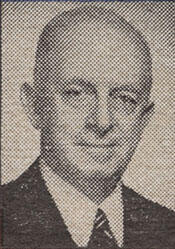
Here you will find contact information for Representative Franck Roberts Havenner, including email address, phone number, and mailing address.
| Name | Franck Roberts Havenner |
| Position | Representative |
| State | California |
| District | 4 |
| Party | Democratic |
| Status | Former Representative |
| Term Start | January 5, 1937 |
| Term End | January 3, 1953 |
| Terms Served | 6 |
| Born | September 20, 1882 |
| Gender | Male |
| Bioguide ID | H000356 |
About Representative Franck Roberts Havenner
Franck Roberts Havenner (September 20, 1882 – July 24, 1967) was a six-term United States Representative from California’s 4th congressional district in the mid-twentieth century. A member of the Democratic Party during his years in Congress, he served in the United States House of Representatives from 1937 to 1953, contributing to the legislative process during six terms in office and representing the interests of his San Francisco–area constituents during a significant period in American history.
Havenner was born in Sherwood, Maryland, on September 20, 1882. He pursued higher education at Columbian College in Washington, D.C. (now George Washington University), and later attended Stanford University in California. After his studies, he settled on the West Coast and embarked on a career in journalism in San Francisco, a role that brought him into close contact with the city’s political and civic life. His early political experience included service as private secretary to United States Senator Hiram Johnson of California from 1917 to 1921, an influential Progressive-era figure whose reformist outlook helped shape Havenner’s own political development.
Building on his experience in journalism and national politics, Havenner entered municipal government in San Francisco. He was elected to the San Francisco Board of Supervisors in 1926 and served there for a decade, remaining on the board until 1936. In 1935 he successfully ran for president of the Board of Supervisors. During his tenure in city government he became a prominent advocate for public ownership of utilities, fighting—though unsuccessfully—to fulfill the provisions of the Raker Act of 1913 and bring public power to the City and County of San Francisco. His efforts on this issue reflected both his Progressive roots and his commitment to expanding public control over essential services.
Originally a Republican, Havenner’s political alignment evolved as he became associated with Progressive and Democratic causes. In 1936 he was elected to the United States House of Representatives from California’s 4th congressional district with the nominations of both the Progressive and Democratic parties, defeating Republican incumbent Florence Prag Kahn. He was re-elected in 1938 with the same dual nominations, though their order on the ballot was reversed, and he subsequently re-registered as a Democrat. While serving in Congress, he also sought executive office in his home city; in 1939, in an officially nonpartisan race, he ran unsuccessfully for mayor of San Francisco against incumbent Angelo Rossi.
Havenner’s initial period in Congress began on January 3, 1937, and extended through January 3, 1941. After his defeat for re-election in 1940, he continued his public service at the state level as a member of the California Railroad Commission from 1941 to 1944, participating in the regulation of public utilities and transportation during the early years of World War II. He returned to national office when he won election to Congress again in 1944, resuming representation of California’s 4th district and serving from January 3, 1945, to January 3, 1953. During this second, longer tenure in the House of Representatives, he became a member of the House Armed Services Committee, engaging in oversight and legislative work related to national defense in the immediate postwar and early Cold War years. In 1947 he again sought the mayoralty of San Francisco but was unsuccessful. In 1952 he was defeated for re-election to Congress by Republican William S. Mailliard, bringing his congressional career to a close after six terms.
Following his departure from Congress, Havenner remained active in public affairs. He worked for the American Federation of Labor, aligning himself with organized labor and continuing his long-standing interest in issues affecting working people and public policy. His post-congressional activities reflected the same reformist and pro-labor orientation that had characterized much of his earlier political life at both the local and national levels.
Franck Roberts Havenner died in San Francisco, California, on July 24, 1967. He was interred at Cypress Lawn Memorial Park in Colma, California. His career spanned journalism, municipal government, state regulatory service, and multiple terms in the United States House of Representatives, during which he participated in the democratic process and legislative deliberations at a time of major economic, social, and international change for the United States.