Representative Frank W. Ballance Jr.
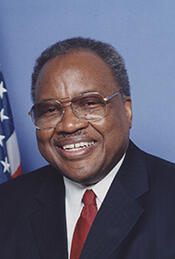
Here you will find contact information for Representative Frank W. Ballance Jr., including email address, phone number, and mailing address.
| Name | Frank W. Ballance Jr. |
| Position | Representative |
| State | North Carolina |
| District | 1 |
| Party | Democratic |
| Status | Former Representative |
| Term Start | January 7, 2003 |
| Term End | June 11, 2004 |
| Terms Served | 1 |
| Born | February 15, 1942 |
| Gender | Male |
| Bioguide ID | B001238 |
About Representative Frank W. Ballance Jr.
Frank Winston Ballance Jr. (February 15, 1942 – February 22, 2019) was an American politician and attorney who served as a Democratic member of the United States House of Representatives from 2003 to 2004, representing North Carolina’s 1st congressional district. A member of the Democratic Party, he contributed to the legislative process during one term in office before resigning from his seat due to health issues. His career encompassed service in the North Carolina General Assembly, leadership roles in higher education governance, and later federal criminal convictions arising from misuse of public funds.
Ballance was born in Windsor, Bertie County, North Carolina, on February 15, 1942. He graduated from W. S. Etheridge High School in 1959. He then attended North Carolina Central University in Durham, where he earned a bachelor’s degree in 1963 and a Juris Doctor degree in 1965. His education at North Carolina Central University, a historically Black university, helped shape his later involvement in civil rights and public service, including his later appointments to university boards of trustees.
Following his graduation from law school, Ballance briefly served as a faculty member at the South Carolina State University School of Law, furthering his engagement with legal education before entering private practice in 1966. In addition to his legal career, he served in the North Carolina National Guard Reserve from 1968 to 1971. During these early professional years, he established himself as an attorney and community leader, laying the groundwork for his subsequent entry into elective office and civic leadership, including work with the NAACP.
Ballance’s political career began in the North Carolina General Assembly. He was first elected to the North Carolina House of Representatives in 1983 and served there until 1986. In 1988, he was elected to the North Carolina Senate, where he would serve until 2002. That same year, 1988, he served as chair of the Guilford County chapter of the NAACP, reflecting his ongoing involvement in civil rights advocacy. During his tenure in the state senate, Ballance rose to a leadership position as deputy president pro tempore, a role he held from 1997 to 2002. He was also appointed to the Board of Trustees of both North Carolina Central University and Elizabeth City State University, underscoring his influence in higher education policy and governance within the state.
In 2002, Ballance ran for and was elected to the United States House of Representatives from North Carolina’s 1st congressional district. He took office in January 2003 as part of the 108th Congress. In Congress, he served as president of the Democratic freshman class of the 108th Congress, a position that reflected the confidence of his newly elected colleagues. Ballance served on the House Committee on Agriculture and the House Committee on Small Business, where he participated in shaping federal policy affecting rural communities, farming interests, and small enterprises. His service in Congress occurred during a significant period in American history, and he represented the interests of his constituents in eastern North Carolina in the national legislative process.
On June 8, 2004, Ballance resigned from his congressional seat, citing health issues after being diagnosed with myasthenia gravis, a neuromuscular disorder. His resignation ended his brief tenure in the U.S. House of Representatives. His successor, G. K. Butterfield, was elected in a special election held on July 20, 2004, and went on to hold the seat for many subsequent terms. Ballance’s departure from Congress marked a turning point in his public life, as legal issues that had arisen from his earlier state-level activities soon came to the forefront.
On September 2, 2004, Ballance was indicted on federal charges including money laundering, mail fraud, and conspiracy to commit mail fraud. The charges stemmed from allegations that he had directed approximately $2.3 million in state funds, which he had secured as a state senator for the John A. Hyman Memorial Youth Foundation, and used portions of those funds for the enrichment of himself, his family, and his church rather than solely for charitable purposes. On November 9, 2004, a plea agreement was reached under which Ballance pleaded guilty to one count of conspiracy to commit mail fraud and money laundering. In January 2005, he was disbarred from the practice of law in the state of North Carolina. On October 12, 2005, he was sentenced to four years in prison, to be followed by two years of supervised release, and fined $10,000. He began serving his sentence at the medium-security federal prison in Butner, North Carolina, on December 30, 2005, and, according to the Federal Bureau of Prisons, was released from prison in June 2009. His son, Garey (often spelled Garrey) Ballance, a state district judge in Guilford County, North Carolina, was also charged in connection with related matters, including income tax evasion; he was convicted, served a prison sentence, and was disqualified from serving as a judge again.
Ballance married Bernadine Smallwood in 1969, and the couple had three children. After his release from prison, he lived outside the public spotlight, his later years marked by the legacy of both his long record of public service and his federal conviction. Frank Winston Ballance Jr. died on February 22, 2019, at a hospital in Raleigh, North Carolina, from complications following surgery. His life and career place him among both the African-American members of the United States House of Representatives and the American federal politicians convicted of crimes, and his case is frequently cited in discussions of federal political scandals in the United States.