Representative Frank Eugene Hook
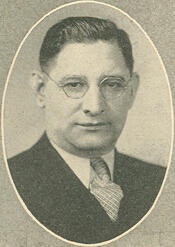
Here you will find contact information for Representative Frank Eugene Hook, including email address, phone number, and mailing address.
| Name | Frank Eugene Hook |
| Position | Representative |
| State | Michigan |
| District | 12 |
| Party | Democratic |
| Status | Former Representative |
| Term Start | January 3, 1935 |
| Term End | January 3, 1947 |
| Terms Served | 5 |
| Born | May 26, 1893 |
| Gender | Male |
| Bioguide ID | H000757 |
About Representative Frank Eugene Hook
Frank Eugene Hook (May 26, 1893 – June 21, 1982) was a Democratic politician from the U.S. state of Michigan who served as a Representative in the United States Congress from 1935 to 1947. Born in L’Anse, Michigan, he graduated from L’Anse High School in 1912. During World War I, he served in the United States Army Infantry from July 1918 until February 1919, an experience that preceded his entry into law and public service. His early years in Michigan’s Upper Peninsula, combined with military service, helped shape his identification with working people and veterans, constituencies he would later represent in Congress.
After completing high school, Hook pursued legal studies, first attending the College of Law of the University of Detroit and then graduating from the law department of Valparaiso University in 1918. Following his military service, he returned to Michigan’s Upper Peninsula, where from 1919 to 1924 he worked in the lumber woods and as an iron ore miner, while also serving as a law clerk in Wakefield, Michigan. During this period he began to enter local public life, serving as a member of the board of supervisors of Gogebic County from 1921 to 1923 and as city commissioner of Wakefield from 1921 to 1923. Admitted to the bar in 1924, he commenced the practice of law in Wakefield and served as municipal judge there in 1924 and 1925. In 1925, Hook moved to Ironwood, Michigan, where he continued his law practice and expanded his civic and business activities, including serving as president of WJMS Radio Station in Ironwood from 1930 to 1933.
Hook’s growing prominence in local and state Democratic politics led to his selection as a delegate to the Democratic National Conventions in 1936, 1940, 1944, and 1948. In 1934, he became the Democratic Party candidate from Michigan’s 12th congressional district for the U.S. House of Representatives. In the general election he defeated incumbent Republican W. Frank James and was elected to the 74th Congress. He was subsequently re-elected to the three succeeding Congresses, serving from January 3, 1935, to January 3, 1943. A member of the Democratic Party, Hook contributed to the legislative process during five terms in office, representing the interests of his Upper Peninsula constituents during a period marked by the Great Depression, the New Deal, and the onset of World War II. In 1936 he was admitted to practice before the United States Supreme Court, underscoring his standing as a lawyer-legislator.
Hook’s service in Congress occurred during a significant period in American history, and he served under Presidents Franklin Delano Roosevelt and Harry S. Truman. As a member of the House of Representatives, he participated in the democratic process and was closely identified with key elements of Roosevelt’s New Deal. He was instrumental in the establishment of Social Security and the federal minimum wage, measures that formed central pillars of the New Deal’s social and economic reforms. After the attack on Pearl Harbor, when Congress was convened to consider a declaration of war, Hook voted to declare war upon Japan, aligning with the overwhelming congressional support for U.S. entry into World War II. He also proposed the legislation that established Isle Royale National Park in Lake Superior and had the honor of dedicating the park in August 1946, reflecting his attention to conservation and the unique geography of his district.
Hook’s congressional career was marked by both controversy and personal combativeness, earning him the long-standing moniker “Fightin’ Frank,” a nickname dating back to his high school days. In 1940, he alleged on the floor of Congress that Representative Martin Dies had ties to William Dudley Pelley, leader of the fascist Silver Legion of America; the documents Hook relied upon were later revealed to be forgeries, an episode that drew national attention. His pugnacious reputation was further reinforced by an infamous altercation on the House floor on February 22, 1945, Washington’s Birthday, during a session of the 79th Congress. In a heated dispute over Hook’s support for the Congress of Industrial Organizations (C.I.O.) and Representative John Rankin of Mississippi’s denunciation of the organization as “communist,” Rankin physically jumped on Hook’s back, initiating a brief wrestling match. Hook later delivered a three-minute apology to the House, while Rankin denied wrongdoing. Hook offered to resign if Rankin would do the same “for the good of the country”; Rankin declined, and the incident gradually faded into obscurity.
Electorally, Hook’s tenure in Congress was characterized by a series of closely contested races, particularly against Republican John B. Bennett. After serving four consecutive terms from January 3, 1935, to January 3, 1943, Hook lost the 1942 general election to Bennett, whom he had previously defeated in 1938 and 1940. In 1944, he reclaimed the seat by again defeating Bennett and served in the 79th Congress from January 3, 1945, to January 3, 1947. He then lost the seat once more to Bennett in the 1946 election. In 1948, Hook sought higher office as the Democratic candidate for the United States Senate from Michigan but was defeated by Republican Homer Ferguson. During this era he also served on the President’s Fair Employment Practices Committee in 1943 and 1944, reflecting his involvement in early federal efforts to address employment discrimination.
Following his defeat in 1946, Hook remained active in public service and law. On October 1, 1949, he was appointed a member of the Motor Carrier Claims Commission, serving until his resignation on August 22, 1950. He made several subsequent attempts to return to Congress from Michigan’s 12th district, losing to John B. Bennett in the 1954 general election and then losing Democratic primary contests in 1956 and 1958 to Joseph S. Mack. In 1966, he sought a seat from Michigan’s 11th congressional district but was defeated in the Democratic primary by incumbent Raymond F. Clevenger. Despite these setbacks, Hook continued to be a recognizable figure in Michigan Democratic politics, and President Harry S. Truman notably campaigned on his behalf during his congressional career.
In his later years, Hook resumed the practice of law. He practiced in Detroit for a period and in 1953 returned to Ironwood, where he reestablished his law practice and remained closely connected to the Upper Peninsula community that had long been his political base. He was admitted to the Wisconsin bar in 1962, expanding his professional activities beyond Michigan. By the time of his death, he was a resident of Edina, Minnesota. Frank Eugene Hook died on June 21, 1982, and was interred in Fort Snelling National Cemetery in Minneapolis, Minnesota. His career, spanning local office, five terms in the U.S. House of Representatives, and continued legal and political engagement, reflected the trajectory of a New Deal-era Democrat deeply rooted in the working communities of Michigan’s Upper Peninsula.