Representative Frank Bateman Keefe
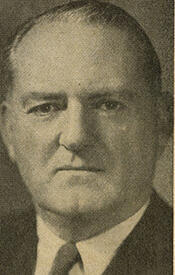
Here you will find contact information for Representative Frank Bateman Keefe, including email address, phone number, and mailing address.
| Name | Frank Bateman Keefe |
| Position | Representative |
| State | Wisconsin |
| District | 6 |
| Party | Republican |
| Status | Former Representative |
| Term Start | January 3, 1939 |
| Term End | January 3, 1951 |
| Terms Served | 6 |
| Born | September 23, 1887 |
| Gender | Male |
| Bioguide ID | K000041 |
About Representative Frank Bateman Keefe
Frank Bateman Keefe (September 23, 1887 – February 5, 1952) was an American lawyer and Republican politician from Oshkosh, Wisconsin, who served six terms in the United States House of Representatives, representing Wisconsin’s 6th congressional district from January 3, 1939, to January 3, 1951. Over the course of his twelve years in Congress, he was a member of the Republican Party and participated actively in the legislative process during a significant period in American history, including the Great Depression, World War II, and the early Cold War. Before his congressional service, he gained prominence as district attorney of Winnebago County, Wisconsin, serving six years in that office.
Keefe was born in Winneconne, Winnebago County, Wisconsin, on September 23, 1887, the third of eight children of Thomas Martin Keefe and Kathryn Rogene (née Forsythe) Keefe. His father was a child of Irish American immigrants and belonged to one of the earliest settler families in Winnebago County; an elder brother of Thomas Keefe was described as the first white child born in the town of Poygan, Wisconsin. Frank Keefe was educated in the public schools of the area and then attended Oshkosh State Normal School (now the University of Wisconsin–Oshkosh), from which he graduated in 1906. Following his graduation, he worked as a schoolteacher in Viroqua, Wisconsin, for two years, an experience that preceded his decision to pursue a legal career.
After teaching, Keefe enrolled at the University of Michigan Law School, where he studied law and earned his LL.B. degree in 1910. He was admitted to the bar at Madison, Wisconsin, shortly thereafter. Keefe initially practiced law briefly in Portage, Wisconsin, before returning to the Oshkosh area in 1911, where he opened a law firm in Omro, Wisconsin. On December 13, 1912, he married Mildred Virginia Steele of Ripon, Wisconsin; the couple had three children and remained married for forty years, until his death in 1952.
In his early political life, Keefe was active in the Democratic Party of Wisconsin. In 1912 he was elected village president of Omro, marking his first successful bid for public office. Later that year he was solicited to run for the Wisconsin State Assembly on the Democratic ticket in Winnebago County’s 3rd Assembly district, though he ultimately declined to enter the race. He sought the village presidency again in 1914 but was defeated by Frank W. Stanley. Shortly after that election, Keefe filed a criminal complaint under Wisconsin’s new corrupt practices act against Charles H. Stevens, alleging that Stevens had circulated false accusations during the campaign, including a claim that Keefe had accepted a $500 bribe from a brewery to permit the opening of a saloon in Omro. Stevens was convicted by a jury, though he appealed the conviction. Later in 1914, Keefe moved to Oshkosh. That fall he was elected chairman of the Winnebago County Democratic Party, a position he held for several years, and he was appointed the county’s first assistant district attorney under District Attorney Daniel E. McDonald. When McDonald declined to run again in 1916, Keefe became the Democratic candidate for district attorney but lost the general election to Republican David K. Allen.
During the late 1910s and early 1920s, Keefe deepened his involvement in civic and professional affairs. He served on the city draft board after the United States entered World War I, was active in the Benevolent and Protective Order of Elks, and became president of the local Kiwanis club. In his legal practice he partnered with Henry Barber under the firm name Barber & Keefe. He also engaged in local governmental reform efforts, notably championing a movement in Oshkosh to abandon the at-large council system adopted in 1912 and return to a traditional aldermanic district model, though this effort was ultimately unsuccessful. A committed Democrat at the time, he attended President Woodrow Wilson’s second inauguration in 1917 and continued to defend the Democratic Party agenda publicly as late as the spring of 1920. In a surprising shift two months later, however, he sought the Republican nomination for district attorney, challenging incumbent David K. Allen. Keefe acknowledged his prior Democratic affiliation, describing himself as essentially independent and arguing that the major party platforms had grown similar by 1920. Allen defeated him in the primary, and Keefe again failed in subsequent challenges to Allen, losing a third time two years later. By then, as a new member of the Republican Party, Keefe identified with its progressive wing and supported Wisconsin Senator Robert M. La Follette’s 1924 Progressive Party presidential campaign.
Keefe’s major breakthrough in public office came in 1926, when District Attorney David K. Allen announced he would not seek reelection. Keefe entered the race to succeed him and won the Republican primary over assistant district attorney R. Curtis Laus and former Menasha city attorney Silas L. Spengler; he faced no opposition in the general election. As district attorney of Winnebago County, he quickly gained a reputation for aggressive prosecution of corruption. In 1927 he brought charges of corruption and mismanagement against Sheriff Walter F. Plummer, alleging that Plummer had accepted bribes to protect speakeasies during Prohibition and had used confiscated liquor for parties and “orgies” at the county jail. Concluding that he lacked direct legal authority to remove the sheriff, Keefe presented his case to Governor Fred R. Zimmerman, who under Wisconsin law could remove sheriffs for cause. After three weeks of hearings in early 1928, Zimmerman stripped Plummer of his office. Keefe then pursued the chairman of the Winnebago County board, George A. Loescher, on charges of self-dealing in county contracts for the Sunnyview sanatorium and the Hicks Memorial Home over a ten-year period. Loescher ultimately entered a plea of nolo contendere, resigned his office, and paid a penalty. Keefe was reelected district attorney in 1928 and 1930, but in March 1932 he announced that he would not seek a fourth term.
After leaving the district attorney’s office, Keefe returned to private practice in a firm then known as Barber, Keefe, Patri & Horwitz. His reputation as a corruption prosecutor led to further public assignments. In December 1933 he was appointed special prosecutor for the district attorney of neighboring Outagamie County to investigate financial irregularities in county agencies. Two months later he issued a report detailing self-dealing and rigged bidding practices in the county highway department, naming several local and county officials as complicit and criticizing others for negligent oversight. During this period he also served as president of the county bar association and as a member of the board of governors of the State Bar of Wisconsin. Although he had supported La Follette’s independent Progressive Party presidential bid in 1924, Keefe remained with the Republican Party when La Follette’s sons and their allies formed the separate Wisconsin Progressive Party in 1934.
Keefe first sought a seat in the U.S. House of Representatives in 1936, when he was endorsed by the Republican convention of Wisconsin’s 6th congressional district. Despite the strong endorsement, he faced a primary challenge from former state senator Albert J. Pullen, whom he defeated with roughly two-thirds of the vote. In the general election he opposed incumbent Democrat Michael Reilly, who was seeking a fourth consecutive term, and Progressive candidate Adam F. Poltl, the mayor of Hartford, Wisconsin. The campaign centered on national issues, particularly the policies of President Franklin D. Roosevelt’s administration. Keefe criticized Roosevelt for what he described as wasteful spending, broken promises, and radicalism, contending that New Deal farm policies were damaging domestic agriculture and lowering tariff barriers to foreign imports. He repeatedly sought to engage Reilly in a public debate, which Reilly declined while mocking the request, and Reilly in turn accused Keefe of obscuring his Republican affiliation and avoiding mention of Republican presidential nominee Alf Landon. In the three-way race, Reilly narrowly prevailed with 39 percent of the vote. Keefe ran again in 1938, this time unopposed for the Republican nomination, though the primary drew unusually high turnout. Facing Reilly, Poltl, and a Union Party candidate in the general election, Keefe intensified his attacks on Roosevelt, calling him a “dictator” for his court-packing and government reorganization plans, while tempering his opposition to certain New Deal programs such as the Works Progress Administration and the Public Works Administration. He also engaged in open disputes with the press, notably the editor of the Sheboygan Press. The Townsend Plan, an alternative old-age pension proposal, emerged as a major issue; Keefe ultimately endorsed it. Benefiting from a national Republican wave in 1938, Keefe won the election, defeating Reilly, Poltl, and the Union Party candidate and securing an outright majority of the vote. He took office on January 3, 1939, beginning the first of his six consecutive terms in Congress.
During the 76th Congress, Keefe aligned himself with the work of the House Un-American Activities Committee and became a vocal anti-communist, adopting increasingly hostile rhetoric toward the Roosevelt administration. He consistently supported measures to maintain strict U.S. neutrality as Europe moved toward World War II and opposed aid to belligerent nations. In this period he also voted for legislation authorizing the creation of American concentration camps for the detention of aliens whose countries of origin would not readmit them, remarking, “If we detain American citizens who are unable to cope with conditions, why not detain aliens?” In early 1940 he briefly considered challenging Senator Robert M. La Follette Jr. for the United States Senate but ultimately chose to seek reelection to the House. He was returned to Congress in the 1940 election with 57 percent of the vote. In the 77th Congress he received an appointment to the influential House Appropriations Committee, on which he would serve for the remainder of his congressional career. He continued to oppose aid to nations engaged in World War II, arguing that the Lend-Lease program would amount to a declaration of war. Following the Japanese attack on Pearl Harbor on December 7, 1941, however, Keefe’s position shifted dramatically; he embraced the war effort while spending much of 1942 explaining and defending his earlier non-interventionist stance. Despite this earlier opposition to intervention, he won a third term in 1942 by his largest margin yet, taking 62 percent of the vote.
Keefe remained in the House through the 78th, 79th, and 80th Congresses, continuing to represent Wisconsin’s 6th district until January 3, 1951. His long tenure on the Appropriations Committee placed him at the center of debates over wartime and postwar federal spending, and in the 79th Congress he was appointed to the Joint Committee on the Investigation of the Pearl Harbor Attack, which examined the circumstances surrounding the 1941 attack and the nation’s preparedness. Throughout his service, he represented the interests of his Wisconsin constituents while engaging in the broader national controversies of the era, including the expansion of federal power, the conduct of the war, and the emerging struggle against communism. In 1950 he announced that he would retire from Congress at the end of his sixth term. Contemporary Wisconsin press accounts speculated that his retirement might be preparatory to a campaign for the U.S. Senate or the governorship in 1952, though no formal candidacy was launched.
After leaving Congress in January 1951, Keefe returned to Wisconsin and resumed his legal and civic activities, though his post-congressional career was brief. On February 5, 1952, while speaking at a women’s luncheon club in Neenah, Wisconsin, he collapsed and died of a heart attack at the age of sixty-four. He was survived by his wife, Mildred Virginia Steele Keefe, and their three children. His career, spanning local office in Omro, a notable tenure as district attorney of Winnebago County, and twelve years in the U.S. House of Representatives, reflected both the shifting political currents of Wisconsin in the first half of the twentieth century and the broader national transformations of the New Deal and World War II eras.