Representative Frank Morey
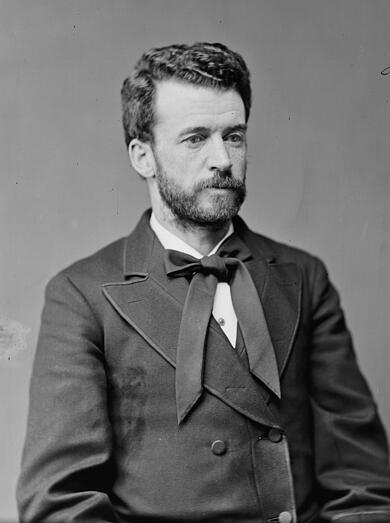
Here you will find contact information for Representative Frank Morey, including email address, phone number, and mailing address.
| Name | Frank Morey |
| Position | Representative |
| State | Louisiana |
| District | 5 |
| Party | Republican |
| Status | Former Representative |
| Term Start | March 4, 1869 |
| Term End | March 3, 1877 |
| Terms Served | 4 |
| Born | July 11, 1840 |
| Gender | Male |
| Bioguide ID | M000942 |
About Representative Frank Morey
Frank Morey (July 11, 1840 – September 22, 1890) was an American soldier, planter, lawyer, and Republican politician who represented Louisiana in the United States House of Representatives during the Reconstruction era. He served in Congress from 1869 to 1876, participating in four consecutive terms and contributing to the legislative process during a significant period in American history. His final election was successfully contested, and he lost his seat in June 1876 to Democrat William B. Spencer.
Morey was born in Boston, Massachusetts, on July 11, 1840, and attended the public schools there. At the age of seventeen he moved west to Illinois, where he continued his education and began the study of law. His early legal studies were interrupted by the outbreak of the American Civil War, which redirected his career into military service.
With the onset of the Civil War, Morey entered the Union Army in 1861, enlisting in the Thirty-third Regiment, Illinois Volunteer Infantry. He served throughout the duration of the conflict, remaining in the Union Army until the close of the war in 1865. Over the course of his service he rose to the rank of colonel, gaining leadership experience and a public profile that would later support his political career.
After the war, in 1866 Morey moved to Louisiana, joining the wave of northern migrants who settled in the South during Reconstruction. He established himself as a cotton planter and entered the insurance business, becoming part of the emerging economic order in the postwar South. His involvement in local affairs and business quickly led him into state politics as Louisiana underwent the process of reconstructing its government and legal system in line with the new federal constitutional amendments.
Morey was elected as a Republican member of the Louisiana State House of Representatives in 1868 and 1869. During this period he was appointed a commissioner to revise the statutes and codes of the state under Reconstruction, a role that involved adapting Louisiana law to reflect the Thirteenth, Fourteenth, and Fifteenth Amendments, including provisions granting citizenship and voting rights to formerly enslaved people. He also gained national exposure when he served as a commissioner to the Vienna Exposition in 1873, representing American and Louisiana interests abroad.
In 1868 Morey was elected as a Republican to the Forty-first Congress from Louisiana, and he won reelection to the Forty-second and Forty-third Congresses, serving from 1869 to 1876. As a member of the U.S. House of Representatives, he participated in the democratic process and represented the interests of his Louisiana constituents during a turbulent phase of Reconstruction, when federal authority, civil rights enforcement, and the reintegration of former Confederate states were central issues before Congress. He presented his credentials as a Member-elect to the Forty-fourth Congress as well, reflecting his initial success in the 1876 election.
Morey’s 1876 reelection, however, was contested by his Democratic opponent, William B. Spencer. After investigation and debate, Congress overturned Morey’s election in June 1876, and Spencer was seated in his place. This contest occurred amid a broader political shift in Louisiana and the South, as Democrats regained control of the Louisiana state legislature in elections marked by violence and intimidation. Paramilitary groups such as the White League worked to suppress Black voting and undermine Republican officeholders. The following year, in 1877, federal troops were withdrawn from Louisiana as part of the end of Reconstruction, consolidating Democratic control in the state.
Following the loss of his congressional seat, Morey left Louisiana and moved to Washington, D.C. There he resumed his legal pursuits and practiced law, drawing on both his earlier legal studies and his experience as a legislator. He remained in the capital for the rest of his life. Frank Morey died in Washington, D.C., on September 22, 1890, and was interred in the Congressional Cemetery, reflecting his long association with national public service.