Representative Frank Plumley
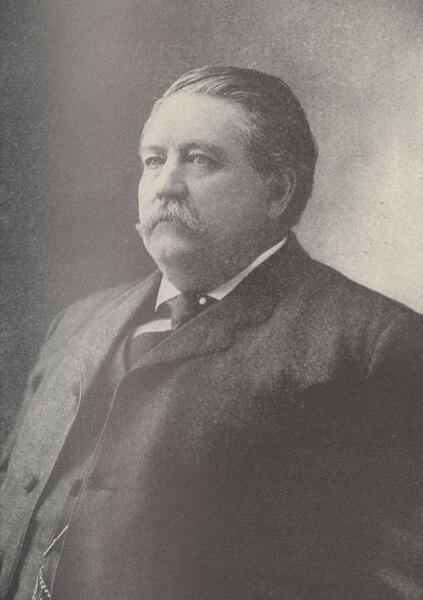
Here you will find contact information for Representative Frank Plumley, including email address, phone number, and mailing address.
| Name | Frank Plumley |
| Position | Representative |
| State | Vermont |
| District | 2 |
| Party | Republican |
| Status | Former Representative |
| Term Start | March 15, 1909 |
| Term End | March 3, 1915 |
| Terms Served | 3 |
| Born | December 17, 1844 |
| Gender | Male |
| Bioguide ID | P000396 |
About Representative Frank Plumley
Frank Plumley (December 17, 1844 – April 30, 1924) was an American politician, lawyer, and diplomat from Vermont who served as United States district attorney and as a Republican Representative from Vermont in the United States Congress from 1909 to 1915. Over the course of a long public career, he held numerous state and federal offices and played a notable role in international arbitration at the turn of the twentieth century.
Plumley was born in Eden, Vermont, the son of William Plumley and Eliza Little. He attended the public schools and later studied at People’s Academy in Morrisville, Vermont. As a young man he taught school while studying law in Morrisville, combining work and legal training in the traditional manner of the period. He subsequently enrolled at the University of Michigan Law School, from which he graduated before returning to his home state to begin his legal career.
In May 1869 Plumley was admitted to the bar in Lamoille County, Vermont, and soon afterward commenced the practice of law in Northfield, Vermont, which remained his professional base for the rest of his life. He quickly became active in public affairs and legal administration. From 1876 to 1880 he served as state’s attorney of Washington County, Vermont, gaining experience as a prosecutor and establishing himself in Republican Party circles. In 1882 he was elected to the Vermont House of Representatives. His influence within the party grew, and he served as chairman of the Republican State Convention in 1886 and as a delegate to the Republican National Convention in 1888.
Plumley also developed a long association with Norwich University. In 1884 he was appointed lecturer in constitutional law at Norwich, reflecting his growing reputation as a legal authority. He was named a trustee of the university in 1888, and in 1892 Norwich conferred upon him the honorary degree of Master of Arts. He later rejoined the board of trustees in 1905. That same year Norwich awarded him the honorary degree of Doctor of Laws (LL.D.), and the University of Vermont also conferred an honorary LL.D. upon him in 1909, recognizing his contributions to law, education, and public service.
At the federal level, Plumley served as United States district attorney for the District of Vermont from 1889 to 1894. He continued his involvement in state government as well, serving in the Vermont State Senate in 1894, where he was elected president pro tempore. In the early twentieth century he was appointed to the Vermont Court of Claims, serving as a member from 1902 to 1904 and as chief justice from 1904 to 1908. His legal expertise led to significant international responsibilities: in 1903 President Theodore Roosevelt appointed him umpire of the mixed commissions of Great Britain and Venezuela, and of the Netherlands and Venezuela, which sat in Caracas to resolve financial and diplomatic disputes. In 1905 France and Venezuela selected him as umpire in the French–Venezuela mixed commission, which convened in Northfield, Vermont. This appointment was notable as the only instance in which an American not then holding high official office was chosen by foreign governments to arbitrate their differences.
In 1909 Plumley was elected to the United States House of Representatives as a Republican from Vermont. He was reelected twice, serving three consecutive terms from March 4, 1909, to March 3, 1915. During this significant period in American history, he contributed to the legislative process and participated in the democratic governance of the nation, representing the interests of his Vermont constituents in the House of Representatives. While in Congress he was selected as one of four delegates from the United States Congress to the Inter-Parliamentary Union of the World, which met in Geneva in 1912, reflecting his interest in international affairs and parliamentary cooperation. In 1914 he declined to be a candidate for renomination, bringing his congressional service to a close at the end of the Sixty-third Congress.
Plumley’s personal life was closely tied to his community and to the legal profession. On August 9, 1871, he married Lavinia Lucretia Smith Fletcher. The couple had two children, Charles Albert Plumley and Theodora May Plumley. Their son Charles Albert Plumley later became president of Norwich University and, following in his father’s footsteps, served as a member of the United States House of Representatives from Vermont, extending the family’s influence in education and national politics.
After leaving Congress in 1915, Frank Plumley resumed the practice of law in Northfield, Vermont. He entered into partnership with his son, Charles Albert Plumley, and with Murdock A. Campbell, continuing to be active in legal and civic affairs in his later years. He remained a respected figure in Vermont’s legal and political communities until his death on April 30, 1924. Frank Plumley was interred in Mount Hope Cemetery in Northfield, Vermont, closing a career that spanned local, state, national, and international service.