Representative Frank Thompson Jr.
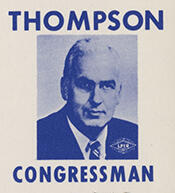
Here you will find contact information for Representative Frank Thompson Jr., including email address, phone number, and mailing address.
| Name | Frank Thompson Jr. |
| Position | Representative |
| State | New Jersey |
| District | 4 |
| Party | Democratic |
| Status | Former Representative |
| Term Start | January 5, 1955 |
| Term End | January 3, 1981 |
| Terms Served | 13 |
| Born | July 26, 1918 |
| Gender | Male |
| Bioguide ID | T000200 |
About Representative Frank Thompson Jr.
Frank Thompson Jr. (July 26, 1918 – July 22, 1989) was an American politician who represented New Jersey’s 4th congressional district in the United States House of Representatives as a Democrat from 1955 to 1980. Over the course of 13 terms in office, he served from 1955 to 1981 as a Representative from New Jersey in the United States Congress and became a prominent figure in the House Democratic leadership. His long tenure in Congress coincided with a significant period in American history, encompassing the civil rights era, the Vietnam War, and major shifts in domestic and foreign policy.
Thompson was born in Trenton, New Jersey, on July 26, 1918. He attended public schools in Trenton and went on to study at Wake Forest University in North Carolina. His early life in New Jersey, a state with a diverse industrial and suburban population, helped shape his later focus on labor, education, and cultural issues in Congress. After college, he returned to his home state, where he would soon begin a career in public service that was interrupted but also defined by military duty during World War II.
During World War II, Thompson served in the United States Navy from 1941 to 1948. He saw active duty in both the Atlantic and Pacific theaters and rose to the rank of lieutenant. His extended service, continuing for several years after the war’s end, reflected both the demands of the postwar Navy and his own commitment to public duty. The experience provided him with a grounding in national security and veterans’ concerns that would later inform his legislative work.
Following his military service, Thompson entered state politics. He was elected to the New Jersey General Assembly, serving from 1950 to 1954. In the Assembly he gained experience in legislative procedure and constituent service, building a reputation as an effective advocate for his district. This period in state government laid the foundation for his successful campaign for Congress and introduced him to many of the issues—particularly labor relations, education, and public administration—that he would continue to address at the federal level.
Thompson was elected to the U.S. House of Representatives in 1954 and took office on January 3, 1955, representing New Jersey’s 4th congressional district. A member of the Democratic Party, he contributed actively to the legislative process during his 13 terms in office, participating in the democratic process and representing the interests of his constituents through a period of rapid social and economic change. He became particularly known for his work on labor and education policy and for his support of the arts and humanities. Thompson played a key role in the creation of the National Endowment for the Arts and the National Endowment for the Humanities, reflecting his belief in the federal government’s role in supporting cultural and educational institutions.
Within the House, Thompson rose steadily in influence. He served on the Committee on Education and Labor, where he was involved in legislation affecting workers’ rights, wages, and workplace conditions, as well as in measures expanding educational opportunities. In 1976 he became chairman of the House Administration Committee, a powerful panel responsible for the internal operations of the House of Representatives, including oversight of House finances, staffing, and facilities. He held this chairmanship from 1976 to 1980, a position that placed him at the center of institutional decision-making and underscored his status within the Democratic caucus.
Thompson’s congressional career ended abruptly as a result of the Abscam investigation, an FBI sting operation targeting political corruption. In 1980 he was one of seven federal politicians convicted in the Abscam case on charges related to bribery and conspiracy. As a result of his conviction, he resigned from Congress, bringing to a close a quarter-century of service in the House, and subsequently served two years in prison. His departure marked a dramatic fall for a senior legislator who had been deeply involved in shaping House procedures and national policy.
After his release, Thompson lived largely out of the public eye. He remained in New Jersey, where his long record of public service, legislative accomplishments, and the controversy surrounding his final years in office continued to shape assessments of his career. Frank Thompson Jr. died on July 22, 1989, in Alexandria, Virginia, just days before his 71st birthday. His life and career reflected both the opportunities and the vulnerabilities of long-term congressional service during a transformative era in American politics.