Representative Franklin Davenport
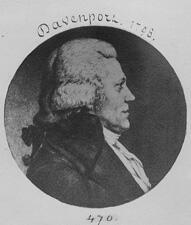
Here you will find contact information for Representative Franklin Davenport, including email address, phone number, and mailing address.
| Name | Franklin Davenport |
| Position | Representative |
| State | New Jersey |
| District | 5 |
| Party | Federalist |
| Status | Former Representative |
| Term Start | December 5, 1798 |
| Term End | March 3, 1801 |
| Terms Served | 2 |
| Gender | Male |
| Bioguide ID | D000069 |
About Representative Franklin Davenport
Franklin Davenport (September 1755 – July 27, 1832) was a Federalist Party United States Senator and United States Representative from New Jersey who served in Congress from 1798 to 1801. Born in Philadelphia in the Province of Pennsylvania, he was a nephew of Benjamin Franklin. He received an academic education and, as a young man, moved across the Delaware River to New Jersey, where he studied law in Burlington. He was admitted to the New Jersey bar in 1776 and commenced the practice of law in Gloucester City, New Jersey, at the outset of the American Revolutionary War.
Davenport’s early public career developed in tandem with the Revolution. In 1776 he was appointed clerk of the Gloucester County Court, and in 1777 he served as prosecutor of pleas. He enlisted as a private in the New Jersey militia during the Revolutionary War and advanced through a series of military roles, becoming brigade major and then brigade quartermaster. In 1778 he was appointed assistant quartermaster for Gloucester County. His responsibilities and rank continued to grow, and in 1779 he was appointed a colonel in the New Jersey militia. He later rose to the rank of major general in the state militia, a commission he held until his death, reflecting his long-standing involvement in New Jersey’s military establishment.
In 1781 Davenport moved to Woodbury, New Jersey, where he continued his legal practice and expanded his civic responsibilities. He was appointed the first surrogate of Gloucester County in 1785, overseeing probate matters in the county. From 1786 to 1789 he served as a member of the New Jersey General Assembly, participating in the legislative affairs of the state during the formative years of the new republic. His military experience remained significant; during the Whiskey Insurrection of 1794 he served as a colonel in the New Jersey Line, helping to support federal authority during that domestic uprising. In 1796 he was appointed brigadier general of the Gloucester County militia, further solidifying his dual role as both civil and military leader in his region.
Davenport’s federal legislative career began in the late 1790s, a period of intense partisan division and international tension. A committed member of the Federalist Party, he was appointed to the United States Senate to fill the vacancy caused by the resignation of Senator John Rutherfurd of New Jersey. He served in the Senate from December 5, 1798, to March 3, 1799, participating in the legislative process at a time when the young nation was grappling with issues such as relations with France, internal security, and the consolidation of federal power. His brief Senate tenure placed him among the Federalist leadership during the administration of President John Adams.
Following his service in the Senate, Davenport was elected as a Federalist to the Sixth United States Congress from New Jersey’s southern district and served in the House of Representatives from March 4, 1799, to March 3, 1801. His service in the House overlapped with his earlier Senate appointment, so that overall he served in Congress from 1798 to 1801. During these two terms in federal office, he represented the interests of his New Jersey constituents and contributed to the legislative debates of a significant period in American history, including the closing years of the Adams administration and the pivotal election of 1800. Running on the statewide Federalist ticket, he sought reelection in 1800 but was defeated as the Federalist Party began to lose ground to the Democratic-Republicans.
After leaving Congress, Davenport resumed the practice of law in Woodbury, maintaining his prominence in local legal and civic affairs. He continued to hold positions of trust and responsibility in New Jersey’s legal system and, in 1826, was appointed master in chancery, a judicial and administrative office dealing with equity matters. He remained active in public and professional life in Gloucester County until his final years.
Franklin Davenport died in Woodbury, Gloucester County, New Jersey, on July 27, 1832. At the time of his death he still held the rank of major general in the New Jersey militia, underscoring his long military association with the state. He was interred in the Presbyterian Cemetery in north Woodbury, New Jersey. His career, spanning service in the Revolutionary War, state and local offices, and both houses of the United States Congress, reflected the trajectory of many early American leaders who helped shape the institutions of the new nation at both the state and federal levels.