Representative Franklin Landers
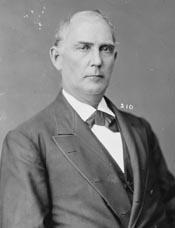
Here you will find contact information for Representative Franklin Landers, including email address, phone number, and mailing address.
| Name | Franklin Landers |
| Position | Representative |
| State | Indiana |
| District | 7 |
| Party | Democratic |
| Status | Former Representative |
| Term Start | December 6, 1875 |
| Term End | March 3, 1877 |
| Terms Served | 1 |
| Born | March 22, 1825 |
| Gender | Male |
| Bioguide ID | L000046 |
About Representative Franklin Landers
Franklin Landers (March 22, 1825 – September 10, 1901) was a Democratic U.S. Representative from Indiana who served one term in the Forty-fourth Congress from 1875 to 1877. Born near the village of Landersdale in Morgan County, Indiana, he grew up in a rural community that would shape his later identification with agrarian interests. He attended local schools in Morgan County, receiving a basic education typical of the period. At the age of twenty-one he engaged in teaching school, an early occupation that reflected both his modest formal schooling and his ambition to advance through practical experience rather than extended academic training.
After his brief period as a schoolteacher, Landers entered business life in central Indiana. He was associated with his brother in mercantile pursuits at Waverly, Indiana, gaining experience in trade and local commerce. Demonstrating an entrepreneurial spirit, he laid out the town of Brooklyn, Indiana, where he engaged in mercantile pursuits and stock raising. These activities tied him closely to the agricultural economy of the region and helped establish his reputation as a businessman and farmer. His familiarity with farming and livestock later informed his political identity as a spokesman for agrarian interests within the Democratic Party.
Landers’s public career began at the state level. He served as a member of the Indiana State Senate from 1860 to 1864, a period that spanned the early and middle years of the Civil War. In the Senate he participated in state governance during a time of national crisis, aligning with the Democratic Party in a state that was deeply affected by wartime politics and economic disruption. Following his legislative service, he moved to Indianapolis in 1865, where he engaged in the dry-goods business, expanding his commercial interests in the growing state capital. In 1873 he became the head of a pork-packing house, a position that further connected him to the agricultural and livestock sectors and reinforced his standing as a substantial businessman.
Landers’s prominence in business and state politics led to his election to the United States House of Representatives. A member of the Democratic Party, he was elected as a Democrat to the Forty-fourth Congress and served as a Representative from Indiana from March 4, 1875, to March 3, 1877. His service in Congress occurred during a significant period in American history, in the aftermath of the Panic of 1873 and in the later years of Reconstruction. As a member of the House of Representatives, Franklin Landers participated in the legislative process and represented the interests of his constituents, particularly those in the agrarian and debtor communities. He was elected as a supporter of currency inflation and became identified as a representative of the agrarian wing of the Democratic Party, reflecting the concerns of farmers and rural businessmen who favored an expanded money supply.
Contemporaries took note of Landers’s distinctive personal appearance and manner. A reporter described him as “a big-framed, big-boned man, stoop-shouldered and red-faced. He shambles in his walk and talks in a low, cooing tone of confidentiality. He chews his cigar distractedly, rarely consuming it with fire. His eyes are soft and insinuating. His face is placid and innocent. … His grammar education was neglected. He is not ‘high-toned.’ He dresses as stylish as H. G. [Horace Greeley] did, and could give a better account of ‘what I know about farming,’ for he does know a potato patch from a field of buckwheat.” Landers embraced his rural and agricultural identity, once remarking, “The man who don’t like the smell of a hog is a leetle too nice to live.” He detested and denounced the national banking system, and after the Panic of 1873 allegedly withdrew his name from all the deposits at the First National Bank in Indianapolis, putting them all in his wife’s name instead, a gesture that underscored his distrust of the financial establishment.
Landers’s congressional term coincided with his rising influence within Indiana Democratic politics, and he was soon considered a serious contender for higher office. With support from the Greenbackers, who shared his inflationist views, he had a good chance at winning the Democratic gubernatorial nomination in 1876. At the state convention, however, his forces deadlocked with those of Congressman William S. Holman, and a compromise candidate, James D. “Blue-Jeans” Williams, was selected instead. Deeply discouraged by this outcome, Landers announced that he intended to quit politics, declaring, “I am not a candidate for anything henceforth. I am only a private man whose only mission in politics will be to vote the democratic ticket…. The dirty skunks! I spent my money to carry the district at the state election, and I pulled them through, and when I went home I found them organized against me. No, sir; your Kerrs, McDonalds, and Hendrickses can run the machine. I am done.” Despite this declaration, he was induced to change his mind and reenter the political arena.
Landers’s renewed engagement in politics, however, brought him into conflict with some of his former allies. Much to the Greenback Party’s resentment, he spurned their nomination for governor, a decision that alienated many of the inflationist supporters who had earlier backed him. When he later entered a congressional race against John Hanna, a prominent lawyer “of vocal volume,” the Greenbackers, angered by his refusal to accept their gubernatorial nomination, put a candidate of their own into the race, thereby splitting the vote and ensuring Landers’s defeat. This episode effectively ended his prospects for further national office and marked the close of his most active period in public life.
In his later years, Landers withdrew from the forefront of politics and devoted himself to his private affairs. He engaged in the management of his farming lands, continuing the agricultural and business pursuits that had long underpinned his public identity. Remaining in Indianapolis, he lived out his final decades as a prominent, if increasingly retired, figure in Indiana’s political and economic life. Franklin Landers died in Indianapolis, Indiana, on September 10, 1901. He was interred in Crown Hill Cemetery, one of the state’s most notable burial grounds, closing the life of a businessman, state legislator, and one-term member of Congress whose career reflected the tensions between agrarian interests and financial power in the post–Civil War era.