Representative Fred J. Eckert
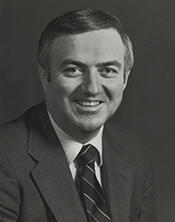
Here you will find contact information for Representative Fred J. Eckert, including email address, phone number, and mailing address.
| Name | Fred J. Eckert |
| Position | Representative |
| State | New York |
| District | 30 |
| Party | Republican |
| Status | Former Representative |
| Term Start | January 3, 1985 |
| Term End | January 3, 1987 |
| Terms Served | 1 |
| Born | May 6, 1941 |
| Gender | Male |
| Bioguide ID | E000033 |
About Representative Fred J. Eckert
Fred James Eckert (born May 6, 1941) is an American politician, diplomat, journalist, and author who served as a Republican member of the United States House of Representatives from New York’s 30th congressional district from January 3, 1985, to January 3, 1987. A friend and political ally of President Ronald Reagan, he also served as United States ambassador to Fiji, Tonga, Kiribati, and Tuvalu, and later as U.S. ambassador to the Food and Agriculture Organization (FAO) in Rome, Italy. Over the course of his public career, Eckert became known for his strong support of Reagan administration policies, his independent stance on immigration reform, and his work as a writer and photographer.
Eckert was born in Rochester, New York, and grew up in the nearby town of Greece, New York. From an early age he displayed a marked interest in history and government. While attending Saint Charles Borromeo Elementary School, his knowledge of the subject was so advanced that the nuns who operated the school had him teach eighth-grade social studies to his fellow eighth-graders. As a teenager he developed a correspondence and later a friendship with Pulitzer Prize–winning Civil War historian Bruce Catton after calling Catton’s attention to minor historical errors in his best-selling book This Hallowed Ground, then the number one best-selling book in the country. This early engagement with history and writing foreshadowed Eckert’s later work as a journalist and author.
Eckert attended the University of North Texas, where he earned a Bachelor of Arts degree, majoring in government and minoring in both history and journalism. While in college, he worked as a journalist for the Richardson Daily News and served as a contributing editor to The New Guard, the magazine of Young Americans for Freedom. As a student writer he sold two magazine articles: one to Writer’s Digest describing lessons he had learned from Bruce Catton, and another to Family Weekly about Texas oil billionaire H. L. Hunt, whom he later interviewed for Playboy. Following his graduation and marriage to his college sweetheart, Karen Laughlin, Eckert pursued further professional development in communications, taking advanced courses in advertising, public relations, and television scriptwriting at New York University and at The New School for Social Research while living in the New York City area.
After college, Eckert began his professional career in communications and public relations. He first served as assistant director of mass communications for the Catholic Foreign Mission Society of America. He was then recruited to join the public relations staff of General Foods at its headquarters in White Plains, New York. Returning to the Rochester area, he joined the region’s largest advertising and public relations agency as an account executive, working on major corporate accounts including Eastman Kodak and Mobil. At age twenty-seven, he entered elective office when he was elected town supervisor of Greece, New York, marking the start of his formal political career.
In 1972, Eckert was elected to the New York State Senate, defeating incumbent Democrat Thomas F. McGowan. As a Republican state senator, he became active in statewide and national party politics. During the 1976 Republican presidential primaries, he was the only Republican officeholder in New York State to endorse Ronald Reagan in Reagan’s challenge to President Gerald Ford, a decision that helped forge a lasting personal and political friendship between Eckert and Reagan. His support for Reagan and his reputation as a committed conservative later contributed to his selection for diplomatic service. Eckert resigned his seat in the New York State Senate when President Reagan appointed him United States ambassador to Fiji, a post in which he also had responsibility for diplomatic relations with Tonga, Kiribati, and Tuvalu.
Eckert’s first ambassadorship marked the beginning of his diplomatic career. As U.S. ambassador to Fiji, Tonga, Kiribati, and Tuvalu, he represented American interests in the South Pacific during the early 1980s, a period of growing strategic and economic attention to the region. His close alignment with Reagan administration policies and his earlier loyalty to Reagan’s presidential ambitions underscored his role as a trusted political appointee. After his service in the Pacific, Eckert returned to the United States and sought election to Congress from New York’s 30th congressional district.
Eckert was elected to the U.S. House of Representatives as a Republican and served one term from 1985 to 1987. His service in Congress occurred during a significant period in American history, in the latter half of the Reagan administration, when debates over foreign policy, national security, and domestic reform were prominent. As a member of the House of Representatives, he participated in the legislative process and represented the interests of his constituents in upstate New York. Congressional Quarterly ranked Eckert as the member of Congress most supportive of President Reagan, reflecting his consistent backing of administration initiatives. Reader’s Digest published a profile portraying him as an example of a “gutsy” leader who was not intimidated by special interests and who embodied the kind of forthright representation the magazine argued Washington needed.
Despite his strong overall support for the Reagan administration, Eckert broke with the president on one major issue: the Immigration Reform and Control Act of 1986. He opposed the legislation, arguing that it effectively rewarded individuals who had violated U.S. immigration law and would encourage further illegal immigration in the future. His vote against the bill stood out given his otherwise close alignment with Reagan; the president later stated that signing the measure into law had been a mistake. During his time in public life, Eckert also engaged in international policy debates beyond the formal confines of Congress. In May 1966, the Oxford University Union selected him to debate the British government’s Shadow Minister for Foreign Affairs on how best to counter international terrorism. In that debate, he argued that state-sponsored terrorism should be regarded as acts of war rather than mere violations of law and should be met with effective military force, a position that drew criticism from newspapers in his home district but anticipated later discussions about the nature of terrorism and state responsibility.
Following his defeat for re-election to Congress in 1986, President Reagan appointed Eckert as United States ambassador to the Food and Agriculture Organization in Rome, Italy. In this capacity, he represented the United States at the United Nations–affiliated agency responsible for international efforts to combat hunger and improve agricultural productivity. After a period of service in Rome, Eckert resigned his ambassadorship and returned to the United States and private life. Shortly thereafter, he accepted an offer from the government of Fiji to serve as a strategic advisor in the aftermath of the 1987 Fijian coups d’état. Fiji’s prime minister publicly praised Eckert’s work as “invaluable.” In addition to his advisory role, Eckert engaged in other consulting work and partnered with a friend to develop real estate subdivisions.
In retirement and semi-retirement, Eckert continued to write and to pursue his long-standing interest in photography. Throughout his public career he had written his own speeches, newspaper columns, and newsletters, and he occasionally authored feature articles and opinion pieces for publications such as The Wall Street Journal and Outdoor Life. For Reader’s Digest, he wrote a profile of a then little-known computer entrepreneur, Michael Dell, and authored the magazine’s iconic “Unforgettable” tribute to his friend and mentor Bruce Catton. He also became the author and photographer of two coffee table books on Fiji—Fiji: Pacific Paradise and Fiji: Some Enchanted Islands—and one on Tonga, titled Tonga: The Friendly Islands. As a semi-professional photographer, his images have appeared in books, magazines, advertisements, encyclopedias, postcards, and travel brochures around the world and have won awards in competitions.
Fred J. Eckert and his wife, Karen, reside in Raleigh, North Carolina. They have three grown children, including entrepreneur Cindy Eckert, and four grandchildren. Through his combined careers in journalism, public relations, local and state government, diplomacy, and national legislative service, Eckert has remained engaged in public affairs while also cultivating a parallel vocation as an author and photographer.