Representative Fred Upton
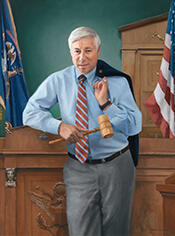
Here you will find contact information for Representative Fred Upton, including email address, phone number, and mailing address.
| Name | Fred Upton |
| Position | Representative |
| State | Michigan |
| District | 6 |
| Party | Republican |
| Status | Former Representative |
| Term Start | January 6, 1987 |
| Term End | January 3, 2023 |
| Terms Served | 18 |
| Born | April 23, 1953 |
| Gender | Male |
| Bioguide ID | U000031 |
About Representative Fred Upton
Frederick Stephen Upton (born April 23, 1953) is an American politician who served as a U.S. representative from Michigan from 1987 to 2023. A member of the Republican Party, he represented Kalamazoo and much of southwestern Michigan for 18 terms before retiring in 2023. Over the course of his long tenure, he became one of the most senior members of the House of Representatives and, after the retirement of Sander Levin at the end of the 115th Congress, served as the dean of Michigan’s congressional delegation. His service in Congress spanned a significant period in modern American history, during which he participated in the legislative process on issues ranging from health care and energy policy to impeachment and budgetary matters.
Upton was born in St. Joseph, Michigan, the son of Elizabeth B. (née Vial) and Stephen Edward Upton (1924–2022). He grew up in southwestern Michigan, a region he would later represent in Congress for more than three decades. He attended Shattuck-Saint Mary’s, a boarding school in Minnesota, graduating in 1971. He then enrolled at the University of Michigan, where he earned a Bachelor of Arts degree in journalism in 1975. While at the university, he was a member of the Alpha Delta Phi fraternity, Peninsular Chapter, and became a sports editor at The Michigan Daily, the student newspaper. At that time he considered a career in sports journalism and imagined he might someday cover the Chicago Cubs, reflecting an early interest in communications and public affairs that would later inform his political career.
Following his graduation, Upton began his professional life in national politics rather than journalism. From 1976 to 1980, he served on the congressional staff of U.S. Representative David Stockman of Michigan, gaining experience in legislative work and federal policymaking. When Stockman was appointed Director of the Office of Management and Budget (OMB) under President Ronald Reagan, Upton followed him into the executive branch. From 1981 to 1985, Upton worked in the Office of Management and Budget, where he was involved in the administration’s budgetary and management initiatives during a period of significant federal fiscal policy debates. This early service in both the legislative and executive branches provided him with a foundation in federal budgeting, regulatory policy, and the internal workings of Congress and the White House.
In 1986, Upton sought elective office in his own right, running for Congress in Michigan’s 4th congressional district. The seat was then held by Republican Mark Siljander, who had succeeded Stockman. Upton challenged Siljander in the Republican primary and won with 55 percent of the vote to Siljander’s 45 percent, signaling a shift in the district’s Republican leadership. In the general election, he prevailed with 62 percent of the vote, securing his first term in the U.S. House of Representatives and beginning a congressional career that would extend across 18 consecutive terms. He won reelection to a second term with 71 percent of the vote, consolidating his position in the district. In a subsequent cycle, he defeated Ed Fredricks in the Republican primary by a margin of 63 percent to 37 percent and went on to win a third term in the general election with 58 percent of the vote, demonstrating consistent electoral strength.
After the 1990 census, redistricting altered the contours of Upton’s constituency. His district was renumbered as the 6th district and absorbed a large portion of the Kalamazoo-based 3rd district, which had been represented by Democrat Howard Wolpe. Although Kalamazoo became the largest city in the reconfigured district, geographically the new 6th district more closely resembled Upton’s prior district than Wolpe’s, and Wolpe chose to retire rather than seek reelection there. Upton won reelection to a fourth term with 62 percent of the vote, now representing a district that included Kalamazoo and a broader swath of southwestern Michigan. He continued to secure reelection by substantial margins, defeating Democratic nominee Scott Elliott, an art gallery owner, by 65 percent to 32 percent; Democratic nominee Kim Clark by 61 percent to 38 percent; and Democratic nominee Don Cooney, a Kalamazoo City Commissioner, by 59 percent to 39 percent. In another cycle, he faced former State Representative Jack Hoogendyk in the Republican primary and defeated him 57 percent to 43 percent, then again defeated Cooney in the general election by 62 percent to 34 percent.
Upton’s long tenure was marked by periodic challenges from within his own party as well as from Democrats. After another round of redistricting, he faced a primary challenge from State Senator Dale Shugars, whom he defeated by a margin of 66 percent to 32 percent, before winning the general election with 69 percent of the vote. In 2011, Hoogendyk met with the Club for Growth, a conservative advocacy organization, about running against Upton again, amid criticism from some conservative commentators and groups—including Rush Limbaugh, Glenn Beck, FreedomWorks, Right to Life of Michigan, and the Southwest Michigan Tea Party Patriots—who argued that Upton was not sufficiently conservative. On January 17, 2012, Hoogendyk formally announced that he would challenge Upton in the Republican primary, with the winner to face Democratic nominee Mike O’Brien, a former Marine and businessman. While initial polling showed Upton with a sizable lead over O’Brien, an October poll indicated that the race had tightened to a near dead heat heading into the final stretch of the campaign, underscoring the increasingly competitive environment he sometimes faced even as an incumbent of long standing.
Within the House of Representatives, Upton rose to positions of significant influence, most notably as chairman of the Committee on Energy and Commerce, one of the chamber’s most powerful committees with jurisdiction over health care, energy, telecommunications, and consumer protection. In that role, he played a major part in shaping health care legislation in the years following the enactment of the Affordable Care Act (“Obamacare”), including efforts to revise and modify aspects of the law and related health policy. His committee leadership placed him at the center of debates over energy policy, environmental regulation, and the regulation of emerging technologies, and he became a key figure in negotiations that crossed party lines. Over his 18 terms, he contributed to the legislative process during a period of major national and international developments, representing the interests of his constituents in Kalamazoo and southwestern Michigan while engaging in broader national policy discussions.
Upton’s voting record also placed him in a distinctive position in American political history. He is the only person in American history to have voted to impeach two presidents. In 1998, he voted in favor of the impeachment of President Bill Clinton, aligning with the House Republican majority in that proceeding. More than two decades later, in 2021, he was one of ten Republicans who voted in favor of the second impeachment of President Donald Trump, following the January 6 attack on the U.S. Capitol. These votes reflected his willingness at key moments to break with portions of his party and underscored his reputation as a legislator sometimes willing to take politically difficult positions. After serving continuously from 1987 through the 117th Congress and representing his district through numerous political and demographic changes, Upton retired from Congress in 2023, concluding a 36-year career in the House of Representatives.