Representative Frederick George Bromberg
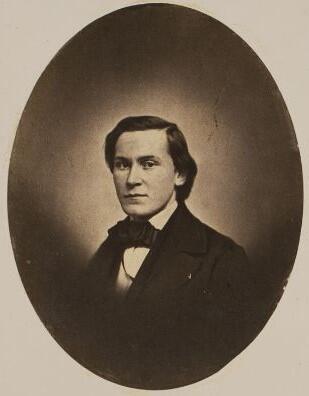
Here you will find contact information for Representative Frederick George Bromberg, including email address, phone number, and mailing address.
| Name | Frederick George Bromberg |
| Position | Representative |
| State | Alabama |
| District | 1 |
| Party | Liberal Republican |
| Status | Former Representative |
| Term Start | December 1, 1873 |
| Term End | March 3, 1875 |
| Terms Served | 1 |
| Born | June 19, 1837 |
| Gender | Male |
| Bioguide ID | B000864 |
About Representative Frederick George Bromberg
Frederick George Bromberg (June 19, 1837 – September 4, 1930) was an American educator, lawyer, and politician who served one term as a U.S. Representative from Alabama from 1873 to 1875. Born in New York City, he moved with his parents to Mobile, Alabama, in February 1838, where he was raised and attended the public schools. His early relocation to the Gulf Coast placed him in a region that would later become central to his legal and political career during and after the Civil War.
Bromberg pursued higher education at Harvard University, graduating in 1858. Demonstrating particular aptitude in the sciences and mathematics, he remained at Harvard for advanced study, undertaking coursework in chemistry from 1861 to 1863. He then served as a tutor of mathematics at Harvard from 1863 to 1865, reflecting both his academic ability and his early professional identity as an educator. This period in Cambridge coincided with the Civil War years, though his work remained in the academic sphere rather than in military service.
After returning to Alabama in the postwar Reconstruction era, Bromberg entered public life in Mobile. In July 1867 he was appointed treasurer of the city of Mobile by Major General John Pope, who then commanded the military department that included Alabama, and he served in that capacity until January 19, 1869. He was elected to the Alabama State Senate, serving from 1868 to 1872, during which time he participated in the complex political realignments of Reconstruction. In July 1869 he was appointed postmaster of Mobile, a position he held until his removal in June 1871. His prominence in reform-oriented Republican circles was further underscored when he served as chairman of the Alabama delegation to the Liberal Republican National Convention at Cincinnati in 1872, the only national convention held by that short-lived party.
Bromberg’s congressional career arose directly from the turbulent partisan environment of the early 1870s. He was elected as a Liberal Republican and Democratic Party fusion candidate to the Forty-third Congress, serving from March 4, 1873, to March 3, 1875. Running in a fractured political landscape, he won the seat largely due to a split in the main Republican vote, defeating Philip Joseph after the regular Republican Party divided into various factions. In that election he received 43.59 percent of the vote. As a member of the Liberal Republican Party representing Alabama, Bromberg contributed to the legislative process during his single term in office, participating in the democratic process and representing the interests of his constituents during a significant period in American history.
In 1874 Bromberg sought reelection to Congress but was defeated by Jeremiah Haralson, an African American Republican leader. In this race he actually increased his share of the vote to about 46 percent, but in the absence of a three-way split among his opponents, he lost the contest. He subsequently contested the results of the election before Congress, challenging Haralson’s victory, but the House ultimately accepted the results as valid, bringing his brief period of congressional service to a close.
Following his departure from Congress, Bromberg turned to the study of law. He was admitted to the bar in 1877 and commenced legal practice in Mobile, Alabama, where he built a long and distinguished career as an attorney. His professional standing in the legal community grew steadily, culminating in his service as president of the Alabama State Bar Association in 1906. In addition to his legal work, he remained active in public affairs; notably, he served as the Alabama commissioner to the World’s Columbian Exposition held in Chicago in 1893, representing the state at one of the most important national and international exhibitions of the era.
Frederick George Bromberg spent his later years in Mobile, continuing to be identified with the city where he had lived since infancy and where he had held numerous public offices. He died in Mobile on September 4, 1930, and was interred in Magnolia Cemetery. His long life spanned from the antebellum period through Reconstruction and into the modern industrial age, and his career reflected the shifting political and professional landscape of the nineteenth and early twentieth centuries in Alabama and the United States.