Representative Frederick Haskell Dominick
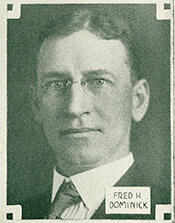
Here you will find contact information for Representative Frederick Haskell Dominick, including email address, phone number, and mailing address.
| Name | Frederick Haskell Dominick |
| Position | Representative |
| State | South Carolina |
| District | 3 |
| Party | Democratic |
| Status | Former Representative |
| Term Start | April 2, 1917 |
| Term End | March 3, 1933 |
| Terms Served | 8 |
| Born | February 20, 1877 |
| Gender | Male |
| Bioguide ID | D000408 |
About Representative Frederick Haskell Dominick
Frederick Haskell Dominick (February 20, 1877 – March 11, 1960) was an American lawyer and Democratic politician who represented South Carolina’s 3rd congressional district in the United States House of Representatives from 1917 to 1933. Over eight consecutive terms in Congress, he participated actively in the legislative process during a transformative era that encompassed World War I, the 1920s, and the onset of the Great Depression, representing the interests of his constituents in upstate South Carolina.
Dominick was born in Peak, Newberry County, South Carolina, on February 20, 1877. He attended the public schools of Columbia, South Carolina, before pursuing higher education at Newberry College and South Carolina College in Columbia. Seeking professional training in the law, he continued his studies at the law school of the University of Virginia in Charlottesville. This combination of local and regional education prepared him for a career in public service and the legal profession at the turn of the twentieth century.
Admitted to the South Carolina bar in 1898, Dominick commenced the practice of law in Newberry, South Carolina. He quickly entered public life, serving as a member of the South Carolina House of Representatives from 1901 to 1902. In addition to his legislative service at the state level, he became an influential figure in party politics, acting as chairman of the Democratic Party county committee from 1906 to 1914. He further expanded his responsibilities in state government when he served as an assistant attorney general of South Carolina from 1913 to 1916, gaining experience in public law and statewide legal affairs.
Dominick’s growing prominence in South Carolina politics led to his election to the U.S. House of Representatives as a Democrat from South Carolina’s 3rd congressional district. He was first elected to the Sixty-fifth Congress and then to the seven succeeding Congresses, serving from March 4, 1917, to March 3, 1933. His eight-term tenure in the House coincided with major national developments, and he contributed to the legislative process during this significant period in American history. On April 5, 1917, he cast a notable vote against declaring war on Germany, making him one of only 50 representatives to oppose U.S. entry into World War I and the only member of Congress from South Carolina to do so. During his time in Congress, he also served as one of the managers appointed by the House of Representatives in 1926 to conduct the impeachment proceedings against George W. English, a judge of the United States District Court for the Eastern District of Illinois, reflecting his involvement in one of the more serious constitutional functions of the House.
In addition to his legislative duties, Dominick played a role in national Democratic Party affairs. He was a delegate to the Democratic National Conventions in 1920 and 1924, participating in the selection of presidential nominees and the shaping of party platforms during the postwar and early interwar years. Despite his long service, he was an unsuccessful candidate for renomination in 1932, bringing his congressional career to a close at the end of the Seventy-second Congress in March 1933.
After leaving Congress, Dominick returned to the practice of law in Newberry, South Carolina. During the Second World War, he again entered federal service, working in Washington, D.C., as an assistant to the United States Attorney General in the Department of Justice. In that capacity, he contributed to the legal and administrative work of the federal government during a period of global conflict. Following the war, he continued his legal practice in Newberry until his death there on March 11, 1960. He was interred in Rosemont Cemetery in Newberry, closing a long career in law and public service that spanned from the late nineteenth century through the mid-twentieth century.