Senator Frederick Huntington Gillett
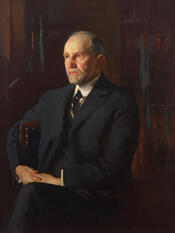
Here you will find contact information for Senator Frederick Huntington Gillett, including email address, phone number, and mailing address.
| Name | Frederick Huntington Gillett |
| Position | Senator |
| State | Massachusetts |
| Party | Republican |
| Status | Former Representative |
| Term Start | August 7, 1893 |
| Term End | March 3, 1931 |
| Terms Served | 17 |
| Born | October 16, 1851 |
| Gender | Male |
| Bioguide ID | G000201 |
About Senator Frederick Huntington Gillett
Frederick Huntington Gillett (October 16, 1851 – July 31, 1935) was an American lawyer and Republican politician who served as the 42nd Speaker of the United States House of Representatives from 1919 to 1925 and as a United States Senator from Massachusetts from 1925 to 1931. Over the course of a long congressional career spanning from 1893 to 1931, he became a prominent legislative figure and, at the time of his election to the Senate in 1924, was the oldest individual ever elected to a first term in that body.
Gillett was born in Westfield, Massachusetts, to Edward Bates Gillett (1817–1899) and Lucy Fowler Gillett (1830–1916). He was educated in the public schools of his native town before entering Amherst College, from which he graduated in 1874; while at Amherst he was a member of the Alpha Delta Phi fraternity. He then studied law at Harvard Law School, receiving his degree in 1877. That same year he was admitted to the bar and commenced the practice of law in Springfield, Massachusetts, establishing himself professionally before entering public life.
Gillett’s early career in public service began in the legal branch of state government. From 1879 to 1882 he served as Assistant Attorney General of Massachusetts, gaining experience in the administration of state law and in appellate advocacy. He subsequently entered elective office as a member of the Massachusetts House of Representatives, serving two one-year terms from 1890 to 1891. His work in the state legislature marked the beginning of a sustained political career within the Republican Party and provided a platform for his election to national office.
In 1892 Gillett was elected as a Republican to the Fifty-third Congress, and he took his seat in the United States House of Representatives on March 4, 1893. He would remain in the House continuously from 1893 to 1925, winning reelection to seventeen consecutive terms and representing Massachusetts during a significant period in American history that encompassed the Progressive Era and World War I. As a member of the House, he participated actively in the legislative process and represented the interests of his constituents. On January 24, 1914, he introduced legislation to initiate the adoption of an anti-polygamy amendment to the United States Constitution, reflecting contemporary moral and social reform concerns within Congress.
Gillett rose to national prominence following the 1918 elections, in which Republicans gained a net total of 24 seats and expanded their majority in the House. Chosen by the Republican caucus as its candidate for Speaker of the House in the Sixty-sixth Congress, he was elected Speaker on May 19, 1919, defeating the Democratic incumbent Champ Clark by a vote of 228 to 172. Known for a reserved and understated personal style—one reporter remarked that he avoided drinking coffee in the morning “for fear it would keep him awake all day”—he was expected to exercise less centralized control than some of his predecessors. Gillett was reelected Speaker in 1921 and again in 1923. His final election as Speaker in 1923 was notable for requiring multiple ballots due to opposition from the Progressive wing of the Republican Party; only after Republican leaders agreed to certain procedural reforms did he secure the speakership on the ninth ballot. This episode marked the only time in the twentieth century that the House failed to elect a Speaker on the first roll call, and it was the fourteenth such occurrence in the chamber’s history.
In 1924 Gillett decided to seek a seat in the United States Senate. He easily won the Republican primary against two opponents and, in the general election of November 1924, narrowly defeated incumbent Democratic Senator David I. Walsh amid a broader Republican landslide led by President Calvin Coolidge, a former governor of Massachusetts. At age 73, Gillett thus became the oldest individual ever elected to a first term in the U.S. Senate, a record he held until Peter Welch’s election from Vermont in 2022 at age 75. His prominence at the time was underscored when Time magazine featured him on its cover on November 17, 1924. Gillett served one term in the Senate from March 4, 1925, to March 3, 1931, continuing his long tenure in Congress. During his Senate service he remained aligned with Republican policies of the era; in June 1930, when queried by prohibition advocates, he declined to state his position on national prohibition or its repeal, reflecting the political sensitivities surrounding that issue. Facing a difficult primary challenge, he chose not to seek reelection in 1930 and retired from the Senate at the end of his term in 1931.
After leaving public office, Gillett withdrew from active political life. He spent his later years in Massachusetts, where his long record of service in both houses of Congress and in state government was recognized by contemporaries and preserved in archival collections, including the Gillett Family Papers at Amherst College and materials in the Westfield Athenaeum Archives. Frederick Huntington Gillett died on July 31, 1935. His career, encompassing service in the Massachusetts House of Representatives, more than three decades in the U.S. House of Representatives, the speakership, and a term in the U.S. Senate, placed him among the most enduring Republican legislators of his generation.