Representative Frederick Augustus Conrad Muhlenberg
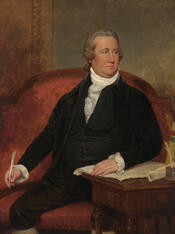
Here you will find contact information for Representative Frederick Augustus Conrad Muhlenberg, including email address, phone number, and mailing address.
| Name | Frederick Augustus Conrad Muhlenberg |
| Position | Representative |
| State | Pennsylvania |
| District | 2 |
| Party | Republican |
| Status | Former Representative |
| Term Start | March 4, 1789 |
| Term End | March 3, 1797 |
| Terms Served | 4 |
| Born | January 1, 1750 |
| Gender | Male |
| Bioguide ID | M001063 |
About Representative Frederick Augustus Conrad Muhlenberg
Frederick Augustus Conrad Muhlenberg (January 1, 1750 – June 4, 1801) was an American Lutheran minister and politician who became the first Speaker of the United States House of Representatives and an early congressional leader from Pennsylvania. Born in Trappe, Pennsylvania, he was a son of the prominent Lutheran clergyman Henry Melchior Muhlenberg, a leading figure in organizing the Lutheran Church in colonial America. Raised in a German-speaking household within Pennsylvania’s substantial German community, Frederick Muhlenberg grew up in an environment that combined religious devotion with public service, influences that would shape both his clerical and political careers.
Muhlenberg received his early education in Pennsylvania and, following the pattern of many colonial clergy families of German origin, continued his studies in Europe. He was educated at the University of Halle in Germany, where he prepared for the Lutheran ministry. After completing his theological training, he returned to America and was ordained a Lutheran pastor. During the 1770s he served congregations in New York City and in the mid-Atlantic region. The disruptions of the American Revolutionary War, including British occupation of New York, affected his pastoral work and contributed to his eventual relocation back to Pennsylvania, where he continued to minister to German-speaking congregations.
Before entering national politics, Muhlenberg established himself as both a respected clergyman and an emerging public figure in Pennsylvania. He served as a Lutheran pastor by profession while gradually taking on civic responsibilities. As the new nation took shape after independence, he became involved in state politics and constitutional reform. He was a delegate to the Pennsylvania state constitutional convention, participating in the framing of the state’s governmental structure in the post-Revolutionary period. This experience introduced him to legislative procedure and political negotiation at a formative moment in both state and national history.
Muhlenberg’s national prominence began with the establishment of the federal government under the Constitution. He was elected as a Representative from Pennsylvania to the United States Congress and served in the House of Representatives from March 4, 1789, to March 3, 1797, encompassing the First through the Fourth Congresses. During these four terms in office, he represented the interests of his Pennsylvania constituents at a time when the new federal institutions were being tested and defined. Although the existing record describes him as a member of the Republican Party, contemporary historical accounts identify him as aligned with the Federalist Party in the early party system, reflecting the fluid and evolving nature of political affiliations in the 1790s.
Within the House of Representatives, Muhlenberg played a central institutional role. At the opening of the First Congress in 1789, he was elected the first Speaker of the United States House of Representatives, serving in that capacity from 1789 to 1791. He again held the speakership from 1793 to 1795 during the Third Congress. In these terms as Speaker, he presided over debates on foundational legislation, including measures related to the organization of the federal judiciary, the assumption of state debts, and the establishment of executive departments. His position required him to manage a chamber still developing its rules, precedents, and norms of procedure. Muhlenberg also served as the first dean of the United States House of Representatives, a designation reflecting his seniority and standing among his colleagues in the early years of the institution.
Muhlenberg’s congressional service occurred during a significant period in American history, as the new republic confronted questions of federal authority, fiscal policy, and foreign relations. As a member of the House of Representatives, he participated in the democratic process and contributed to the legislative framework that would guide the young nation. He is often remembered for his role in shaping the speakership itself, helping to define the office as a central leadership position in the House. His background as a minister and as a representative of Pennsylvania’s German-speaking population also made him an important intermediary between ethnic communities and the emerging federal government.
After leaving Congress in 1797, Muhlenberg remained a respected public figure in Pennsylvania, though he did not again hold national office. He continued to be associated with civic and community affairs while maintaining the stature he had earned as the first Speaker of the House. His residence in Trappe, Pennsylvania, known as the Speaker’s House, became closely linked with his legacy. The home, which he occupied during his years of prominence, is now a museum and is undergoing restoration to return it to its appearance during Muhlenberg’s occupancy, preserving both his personal history and the material culture of the early federal period.
Frederick Augustus Conrad Muhlenberg died on June 4, 1801. His career as a Lutheran pastor, state constitutional delegate, Representative from Pennsylvania from 1789 to 1797, and first Speaker and first dean of the United States House of Representatives places him among the key figures in the institutional development of Congress and the political life of the early United States.