Representative Frederick Stone
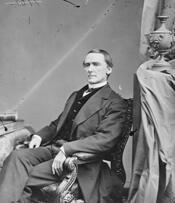
Here you will find contact information for Representative Frederick Stone, including email address, phone number, and mailing address.
| Name | Frederick Stone |
| Position | Representative |
| State | Maryland |
| District | 5 |
| Party | Democratic |
| Status | Former Representative |
| Term Start | March 4, 1867 |
| Term End | March 3, 1871 |
| Terms Served | 2 |
| Born | February 7, 1820 |
| Gender | Male |
| Bioguide ID | S000957 |
About Representative Frederick Stone
Frederick Stone (February 7, 1820 – October 17, 1899) was an American lawyer, legislator, and jurist who served two terms as a Democratic Representative from Maryland’s fifth district in the United States Congress from 1867 to 1871. His congressional service took place during the tumultuous Reconstruction era, when he participated in the legislative process and represented the interests of his Maryland constituents in the Fortieth and Forty-first Congresses.
Stone was born on February 7, 1820, in Leonardtown, St. Mary’s County, Maryland. He was a member of a prominent Maryland family: he was the grandson of Michael J. Stone, who was the younger brother of Thomas Stone, a Maryland signer of the Declaration of Independence. Raised in this environment of public service and legal tradition, he pursued a classical education and attended St. John’s College in Annapolis, Maryland, from which he graduated in 1839.
After completing his formal education, Stone studied law and was admitted to the bar in 1841. He began his legal practice in Port Tobacco, in Charles County, Maryland, where he quickly established himself as a capable attorney. His legal expertise was recognized by the Maryland legislature, which in 1852 appointed him as one of the commissioners to revise the rules of pleading and practice in the state courts. This work placed him at the center of efforts to modernize and systematize Maryland’s judicial procedures and further enhanced his professional reputation.
Stone’s legal career brought him into national prominence during the aftermath of President Abraham Lincoln’s assassination. In May and June 1865, he served as one of the defense counsel in the military commission trial of the alleged conspirators. Along with Thomas Ewing Jr., Stone represented Dr. Samuel Mudd and David Herold. Their defense of Mudd, in particular, is generally credited with helping Mudd avoid the death penalty, a result that drew widespread attention to Stone’s skill as a trial lawyer during one of the most consequential criminal proceedings of the era.
Stone’s political career began in state government. He served as a member of the Maryland House of Delegates in 1864 and 1865, representing Charles County during the closing years of the Civil War. In 1867 he was a member of the Maryland Constitutional Convention, again for Charles County, participating in the framing of a new state constitution in the early Reconstruction period. That same year, as a member of the Democratic Party, he was elected to the United States House of Representatives from Maryland’s fifth district and took his seat in the Fortieth Congress on March 4, 1867. He was reelected to the Forty-first Congress, serving continuously until March 3, 1871. During his two terms in Congress, Stone contributed to the legislative process at a time when the nation was grappling with the political, legal, and social consequences of the Civil War and Reconstruction. He unsuccessfully sought reelection in 1870, concluding his service in the House at the end of his second term.
In his personal life, Frederick Stone married Maria Louisa Stonestreet on June 10, 1852. The couple had four daughters. After Maria’s death in November 1867, Stone married her sister, Jennie Stonestreet Ferguson, on June 15, 1870. His family life was centered in Charles County, where he maintained his law practice and later his country residence.
Following his congressional service, Stone continued to play a significant role in Maryland’s public life. Although long identified with the Democratic Party, he later aligned himself with the Republican Party sometime after 1880. Running as a Republican, he defeated the appointed incumbent Daniel Randall Magruder to win a position as an associate judge of the Maryland Court of Appeals, the state’s highest court. He served on that court from 1881 to 1890, bringing to the bench decades of experience as a practitioner and legislator and participating in the development of Maryland jurisprudence in the late nineteenth century.
Frederick Stone spent his later years at his country home, known as “Idaho,” near La Plata in Charles County, Maryland. He died there on October 17, 1899. Stone was interred in Mount Rest Cemetery in La Plata, Maryland, closing a life that spanned from the antebellum era through the Civil War, Reconstruction, and the dawn of the twentieth century, and that encompassed service as a lawyer, state legislator, United States Congressman, and judge of the Maryland Court of Appeals.